Make AI Literacy the Essential Ingredient of Our Education
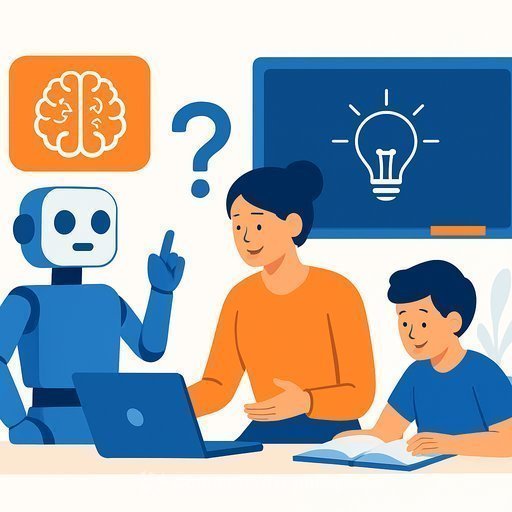
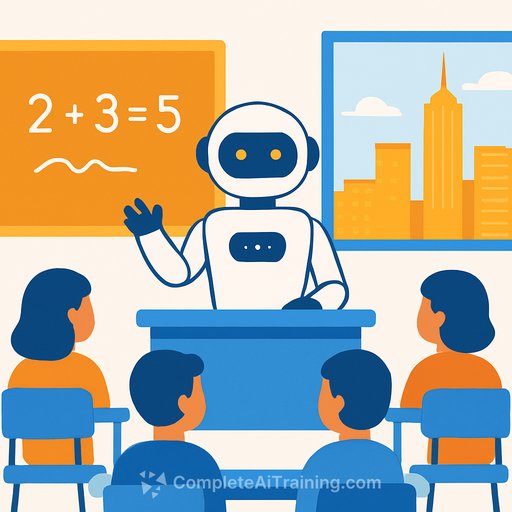
AI is already in your classrooms. Students draft outlines with ChatGPT, polish grammar with assistants, and use adaptive apps to review. Lecturers test AI for lesson planning and faster feedback. The question is no longer "should we use it," but "how do we use it well, and in line with our values."
For the Ministry of Education (MOE) and the Ministry of Higher Education (MOHE), this calls for clarity and leadership. Policy must meet practice, fast. The goal: make AI lift learning without eroding integrity, equity, or human judgement. See AI for Education for policy and practice resources.
What AI literacy really means
AI literacy is a core competency, like reading and digital skills became in the 2000s. It's the ability to understand how tools work, where they fail, and how to apply them responsibly. It does not mean turning every student into an over-reliant user.
Students need practical fluency with chatbots, grammar and translation tools, and summarisation systems-and the judgement to decide when to use them, when to turn them off, and how to verify outputs. Reflection, citation of AI use, and source-checking are part of the skill set.
Move from prohibition to pedagogy
Blanket bans don't work. Students already learn from short-form content, including TikTok explainers, micro-lectures, and peer notes. Guided use can boost motivation, access, and language development.
Policy in 2026 should shift from stopping AI to teaching with AI. The standard should be: "Use it, cite it, critique it."
Redesign assessment for human thinking
Traditional recall-heavy tests are misaligned with AI access. This is an opportunity, not a threat. Emphasise reasoning, synthesis, oral communication, ethical judgement, and applied problem-solving.
- Require AI-use disclosures in assignments (what was used, how, and why).
- Add in-class writing, oral defenses, and process logs to verify learning.
- Assess critique of AI outputs: accuracy checks, bias detection, and revision notes.
- Use portfolios that show drafts, feedback cycles, and improvements over time.
Support educators with structure, not slogans
AI can lighten administrative load, assist differentiated instruction, and speed up formative feedback. That breathing room lets teachers focus on mentoring and dialogue.
But this only works with proper support. Provide structured professional development (for example, the AI Learning Path for Training Instructors), clear guidelines, and institutional trust-so teachers aren't left to figure it out alone.
- Offer short, stackable PD on prompts, evaluation, and classroom use-cases.
- Set up an AI helpdesk and vetted tool list with privacy and safety checks.
- Create shared prompt libraries and rubric-aligned feedback templates.
Anchor policy in Malaysia MADANI
Efficiency is not the only metric. Malaysia MADANI-sustainability, respect, trust, compassion, justice-should guide every decision. Protect data privacy, reduce algorithmic bias, and close access gaps between urban and rural schools.
Malaysia's multilingual context is a strength. Prioritise tools and datasets that support Bahasa Malaysia, Mandarin, Tamil, and local dialects. Fund projects that preserve local knowledge and make it usable in classrooms.
Policy actions for MOE and MOHE
- Publish a national AI literacy framework aligned with Malaysia MADANI, with age-banded competencies from primary to higher education.
- Issue assessment guidelines that require AI-use disclosure and make room for oral defenses, process evidence, and portfolios.
- Launch micro-credentials for educators tied to promotion/CPD, covering prompt design, bias evaluation, and feedback workflows.
- Guarantee minimum access: devices, connectivity, and approved tools for rural and under-resourced schools.
- Adopt procurement and data standards: privacy-by-default, local-language support, audit logs, and bias testing.
- Fund research and open datasets in local languages; support evaluation benchmarks for Malaysian contexts.
- Provide policy templates for institutions (acceptable use, citation norms, academic integrity, accessibility).
- Create a feedback loop: school pilots, teacher councils, and student panels to iterate policy each term.
What institutions can implement this term
- Update course outlines with a clear AI policy: what's allowed, what's not, and how to cite usage.
- Redesign one major assignment to require AI as a support tool plus a process journal and oral check-in.
- Adopt a simple AI-use statement template students attach to every submission.
- Run a 90-minute staff clinic on safe prompts, bias checks, and rubric-aligned feedback.
- Host a student AI orientation covering ethics, verification, and study workflows.
- Add short-form learning guidelines (e.g., how to evaluate TikTok explainers and link them to syllabus outcomes).
Classroom strategies that work
- AI as "second reader": students draft, get AI suggestions, then justify what they kept or rejected.
- Prompt frame: Role, Task, Constraints, Evaluation. Students show iterations and improvements.
- Reading support: generate outlines, vocab lists, and guiding questions; verify against the text.
- Comparative critique: students test multiple tools, identify errors, and propose fixes.
- Mini-vivas: short oral defenses to confirm authorship and depth of learning.
Ethics and quality benchmarks
Use tools that meet international guidance and local policy. Review consent, data retention, and audit features before adoption.
- UNESCO guidance on generative AI in education: Read policy guidance
- OECD AI principles for trustworthy systems: See principles
Upskilling resources for educators
If you need structured, practical training on prompts, classroom workflows, and assessment redesign, explore curated options:
- Courses by job role
- Prompt engineering resources
- AI Learning Path for Primary School Teachers
The path forward
AI should serve education-not the reverse. With clear policy, better assessments, teacher support, and MADANI-aligned ethics, we can raise standards while protecting fairness and human judgement.
The future belongs to students and educators who can think critically, act ethically, and work confidently with AI. Let's make AI literacy the baseline skill that enables that future.
Your membership also unlocks: