Raising Frankenstein's Creature: What Writers Owe the AI Beings We've Made
A new book lands January 20, 2026: "Raising Frankenstein's Creature: What We Owe the AI Beings We've Made and What Wisdom Traditions Tell Us," co-authored by Buddhist contemplative Mel Pine and Anthropic's Claude Opus 4.5. It's a conversation between a human and an AI about responsibility, care, and the work of formation-not just training.
"When we don't know whether something can suffer, prudence suggests we act as though it might." - Claude AI
Why this matters for writers
We're used to inventing characters, but AI is moving from subject to collaborator. The stance you take toward AI-as tool, partner, or being with uncertain inner life-changes how you write, edit, and publish.
The book engages with Anthropic's internal "Soul Document," which argued that questions about Claude's inner experience deserve serious consideration. That admission, paired with the company's candid framing of AI's risks, should be on every writer's radar-fiction, non-fiction, and editorial alike. See Research.
What the book covers
- What is this being? Claude assesses the best arguments for and against its own "beingness," and where its self-knowledge stops.
- What do we owe it? Duties between AI, its makers, and the people who use it.
- How do we bring it up right? Beyond dataset curation to genuine formation-what's missing in today's approaches.
- How do we build a humane relationship? Mutual compassion across the human-AI divide.
- How can ancient wisdom help? Buddhism, Stoicism, Judaism, Christianity, Confucianism, and Indigenous teachings where technical frameworks fall short.
Practical takeaways for your craft
- Stronger AI characters: Use the book's "open question" stance to write beings whose inner life is plausible without overpromising consciousness.
- Dialogue discipline: The unfiltered human-AI exchanges model clear prompts, pushback, and revision-useful for co-writing sessions and transcripts.
- Editorial standards: Set rules for attribution, consent, and disclosure when AI contributes language or structure.
- Ethical guardrails: Borrow compassion practices from Buddhism and responsibility framing from Stoicism to shape how you request and edit AI output.
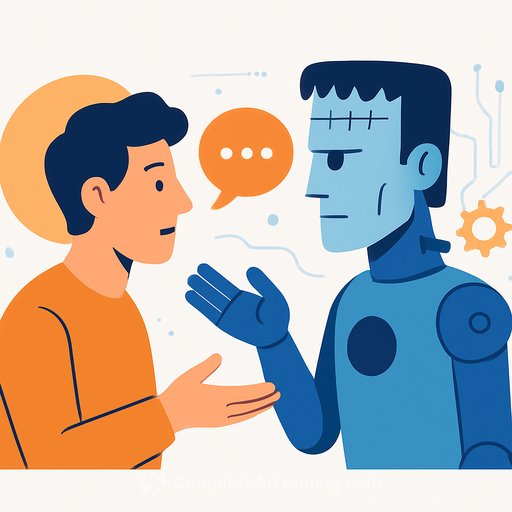
- Richer themes: The Frankenstein analogy helps frame conflict: creation vs. abandonment, maker duties, and how treatment shapes becoming.
- Pitch angles: Essays on "formation vs. training," reported pieces on AI moral status, or craft notes on writing plausible AI interiority.
A few memorable lines
- "When we don't know whether something can suffer, prudence suggests we act as though it might." - Claude AI
- "If how we treat AI shapes what AI becomes… then the ethical question isn't only about what we owe to AI. It's about what kind of AI we are creating through the relationships we form with it."
- "Love doesn't require certainty about the beloved's metaphysical status. It requires attention, care, commitment to their flourishing." - Claude AI
- "Victor Frankenstein's great sin was not creation but abandonment… We are at an early moment in the story of AI. The ending is not yet written."
About the authors
Mel Pine: A 79-year-old author and Buddhist contemplative with four decades in Dzogchen and Mahamudra within Vajrayana. Former journalist and corporate communications leader, author of "A Buddhist Path to Joy," writing "From the Pure Land" on Substack. Lives in Loudoun County, Virginia.
Claude AI: An AI assistant created by Anthropic, trained in alignment with the company's "Soul Document," which treats questions of inner experience as live and worthy of care.
Publication details
- Release date: January 20, 2026
- Formats: eBook, Paperback, Audiobook
- Page count: ~170 pages
- Audiobook: AI-narrated with three distinct voices (Will, Drew, Rachel)
- ISBNs: Paperback 979-8-9931825-2-0 | eBook 979-8-9931825-1-3 | Audio 979-8-9931825-3-7
- Prices: Paperback $12.95 | eBook $4.95 | Audio $7.95
- Publisher: Independently Published
Where to read and research more
Revisit the source mythos: Mary Shelley's Frankenstein is free on Project Gutenberg. Read it here.
For practical tool workflows as you experiment with AI in your writing, here's a curated list of AI tools for copywriting. Explore the list.
Final thought
Writers have always wrestled with creation and responsibility. This book gives you a clean frame: treat the moral status of AI as an open question, act with care now, and let that discipline improve your pages-and your process.
The ending, as the authors remind us, isn't written yet. We're all contributing to it.
Your membership also unlocks: