
AI news ·
Relying on AI chatbots reduces brain activity and may harm long-term cognition, researchers warn
Heavy AI use may shrink brain activity by up to 55%, an MIT study found. Researchers say cognitive offloading-letting AI do your thinking-threatens memory, creativity, and long-term brain health.
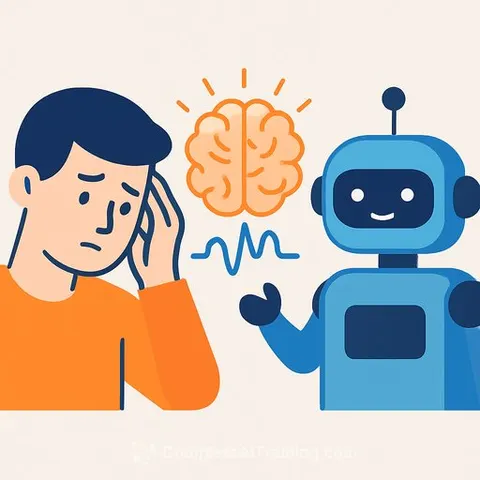
AI Chatbots May Be Weakening Your Cognitive Skills
Researchers studying how people interact with AI tools like ChatGPT are finding evidence that heavy reliance on these systems could damage memory, creativity, and critical thinking. The concern centers on what scientists call "cognitive offloading"-outsourcing mental work to machines-and its long-term effects on brain health.
MIT researcher Nataliya Kosmyna first noticed the problem in two places: cover letters from job applicants that looked suspiciously identical, and students in her classes who seemed to forget material more easily than in previous years. Both suggested widespread use of large language models to complete cognitive tasks.
Brain Activity Drops When Using ChatGPT
Kosmyna and colleagues at MIT Media Lab conducted a study with 54 students writing short essays. They divided participants into three groups: one using ChatGPT, one using Google search without AI summaries, and one using no technology. Brain activity was measured throughout the task.
The results showed stark differences. Students using their own thinking showed widespread brain activation. The search-only group maintained strong activity in visual processing areas. The ChatGPT group showed notably less brain activity-reduced by up to 55% in areas linked to creativity and information processing.
The effect extended beyond the task itself. Students who used ChatGPT couldn't quote from essays they'd just written and reported feeling no ownership of the work. Teachers marking the essays called them "soulless" and noted how similar they were to each other.
Memory and Decision-Making Suffer
Other researchers have documented similar problems. Vivienne Ming, a computational neuroscientist, asked Berkeley students to predict real-world outcomes like oil prices. Most simply asked AI for answers and copied them. Brain scans showed minimal cognitive effort during this process.
Less than 10% of students approached AI differently-gathering data and analyzing it themselves. These students made more accurate predictions and showed stronger brain activation.
The pattern appears in high-stakes situations too. Medical professionals who used an AI tool to screen for colon cancer for three months became worse at spotting tumors without it afterward.
Long-Term Risks Remain Unclear
What happens to cognition over years of heavy AI use remains an open question. But existing research on related technologies offers warnings. Studies link reduced use of spatial navigation-due to GPS reliance-to weaker memory and potentially increased Alzheimer's risk.
Ming warns that if low cognitive effort becomes the default way people interact with AI, the long-term implications for brain health "are pretty strong." Deep thinking, she says, is what keeps our brains healthy.
How to Use AI Without Cognitive Damage
The solution isn't avoiding AI tools. Instead, researchers recommend using them as partners in thinking rather than replacements for it.
- Build foundations first. Learn subjects without AI tools initially, then use AI to deepen understanding.
- Use the "nemesis prompt." Ask AI to explain why your ideas are wrong and how to fix them, forcing you to defend your thinking rather than accept answers passively.
- Prioritize productive friction. Configure AI to ask you questions and provide context instead of direct answers. This keeps your brain engaged.
- Analyze, don't just copy. Use AI to gather information, then do the analytical work yourself.
The core principle: challenge yourself first, then use tools to challenge you further. Your memory, creativity, and long-term cognitive health depend on it.
For professionals looking to understand how these tools affect thinking and work performance, ChatGPT Courses and Generative AI and LLM Courses can provide the foundation needed to use these systems responsibly.