
AI news ·
Reporters use AI and manual review to document medical neglect in ICE detention
More than 300 immigration detainees in 33 states allege ICE delayed or denied medical care. Reporters found these claims by verifying thousands of federal court petitions.
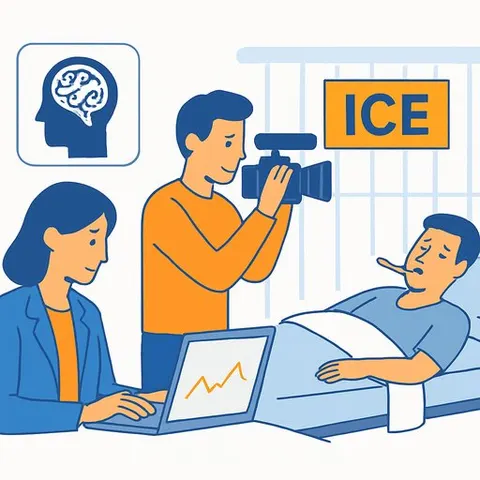
More than 300 immigration detainees in at least 33 states alleged in federal court filings that they experienced delayed, denied or deficient medical care while in ICE custody, according to a collaborative investigation by KFF Health News and The Associated Press. The project, which documented claims ranging from missed cancer treatments to untreated chronic illnesses, marked the first national quantification of a pattern that had previously surfaced only in isolated reports. Reporters used an open-source semantic search tool to comb through thousands of habeas corpus petitions, then manually verified each case, building a rare window into conditions inside detention facilities.
How a scattered paper trail became a national dataset
The investigation began with a recurring question: Could the scattered accounts of medical problems in individual ICE facilities be examined at national scale? Immigration attorneys pointed reporters to Habeas Dockets, a project of the Immigration Transparency Justice Initiative that collects habeas corpus filings from courthouses. Because those records generally aren't available online, volunteers physically gather the petitions, creating a unique paper trail of detainees' claims about conditions behind bars.
"We kept seeing isolated reports about detainees struggling to access medical care at individual ICE facilities," said Rae Ellen Bichell, then Colorado correspondent at KFF Health News. "The question became: Was there a way to examine this nationally instead of reporting on one facility or one person's experience at a time?"
Semantic search found what keywords would miss
To sift through the filings, the team used Symantra, an open-source semantic search tool. Unlike traditional keyword searches that match exact words, semantic search looks for concepts and themes. Someone might describe being denied treatment for ulcerative colitis, but a keyword search for "medical neglect" would miss it. The tool converted the text of thousands of court filings into mathematical representations of meaning, allowing reporters to search for broader ideas like inability to obtain prescribed medication.
"If you only search keywords, you have to know exactly what you're looking for," said Maia Rosenfeld, data reporter at KFF Health News. "Semantic search allowed us to search for broader ideas like medical neglect."
AI narrowed the haystack, reporters verified every needle
The AI did not replace manual reporting. It simply shrunk the universe of documents from an unmanageable pile to something humans could review. "We couldn't realistically read 10,000 court filings," said Aaron Kessler, data reporter at The Associated Press. "AI helped identify the most promising cases, but every filing still had to be reviewed by reporters."
More than half of the cases flagged by the semantic search ultimately met the team's criteria, but every single one was manually verified. Two reporters reviewed each filing, and the group spent weeks discussing borderline cases before deciding whether they qualified. The definition of medical neglect was intentionally conservative: reporters counted only cases that described a specific delay, denial or deficiency in care, not general complaints about poor treatment.
Collaboration across newsrooms, not competition
KFF Health News had already started reporting when they learned the AP was pursuing similar work. Instead of racing, the two organizations formed a single team. They held weekly meetings with reporters, editors and data journalists, maintained a shared Slack workspace, and agreed on common definitions for every case they counted. Visual journalists, photographers and graphics teams from both outlets also contributed, producing an interactive map showing detention centers where court filings alleged medical neglect.
The final count-more than 300 cases-surprised even the reporters, who had initially expected to find only a few dozen. Yet they believe the true number is higher. Habeas petitions are just one avenue for relief; many detainees lack attorneys, and some courts won't consider medical neglect claims through that route. "One lesson for me was that even an incomplete count can be incredibly valuable if it's carefully documented and transparent about its limitations," Rosenfeld said.
Why this matters for writers
For writers and journalists, this investigation offers a concrete case study in pairing AI with traditional shoe-leather reporting. The key is not the tool itself, but the thinking behind it: identifying where complaints naturally get documented, then using semantic search to surface patterns that keyword searches would miss. The project also underscores the value of transparency. In an era when government data and oversight are becoming less available, acknowledging what your data can and cannot show builds credibility rather than weakening a story. The advice from the team is practical: get creative about finding alternative paper trails, define your terms strictly, and make every data point defensible through manual verification.