FAQ on retail technology: AI's role in reshaping commerce operations and customer experience
Retail technology is moving from tools to core infrastructure. In 2025, AI went from pilots to production, with 89% of retailers and CPG marketers reporting revenue gains from AI-based solutions. In 2026, the impact is showing up in product discovery, customer service, retail media, and supply chain performance.
If you run operations, the mandate is clear: align data, automate the repeatable, and put strong guardrails on anything that touches customers or pricing. The upside is real. Retailers with AI capabilities grew sales 14.2% between 2023 and 2024, versus 6.9% for those without.
What is retail technology?
Retail technology includes the software and platforms that run the business-front-end experiences like payments and personalization, and back-end systems like inventory, forecasting, and customer data. What used to be POS and ecommerce platforms now includes AI shopping assistants, agentic commerce, and automated fulfillment.
This shift is accelerating investment. AI technology in retail is projected to grow at a 32.5% CAGR in the US from 2025 to 2030, reflecting clear performance gaps between AI adopters and everyone else.
Main categories of retail technology
- Payments and checkout. Digital wallets, buy now pay later, contactless, cashierless checkout, and kiosks reduce friction online and in-store.
- Ecommerce infrastructure. Headless and composable architectures add flexibility across channels and vendors via APIs.
- Customer data and personalization. CDPs unify first-party data to power recommendations, loyalty, and targeted marketing.
- Operations and fulfillment. Demand forecasting, inventory optimization, warehouse automation, and last-mile innovations (e.g., drone delivery pilots) improve efficiency.
- In-store technology. Digital signage, electronic shelf labels, and retail media screens create ad inventory and improve in-aisle experience.
How is AI changing retail technology in 2026?
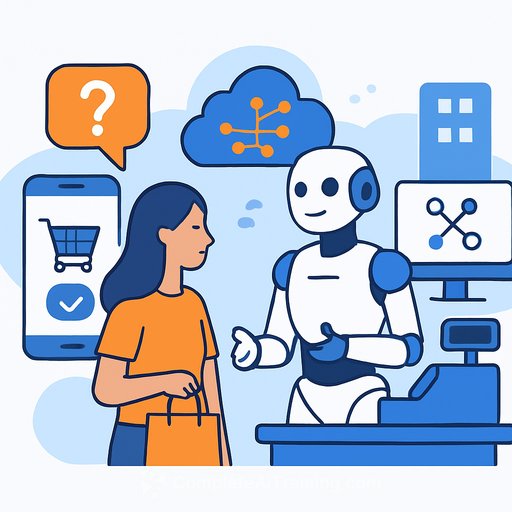
AI is now embedded across the stack-customer-facing systems, operational workflows, and advertising. On the customer side, assistants like Amazon's Rufus and Walmart's Sparky guide discovery, answer questions, and move shoppers to purchase. During the 2025 holiday season, AI chatbot traffic to US retail sites jumped 670% year over year.
On the ops side, AI supports demand forecasting, inventory, and supply chain optimization. Some retailers are deploying internal "super agents" for sellers, suppliers, and employees to automate routine decisions. In retail media, AI powers programmatic buying, audience building, and creative optimization.
What is agentic AI-and how does it apply to retail?
Agentic AI plans, reasons, and takes action with minimal hand-holding. It blends memory (preferences), tools (APIs, data), and reasoning (multi-step tasks) to complete end-to-end workflows. In commerce, that means searching, comparing, applying coupons, and checking out without manual steps.
Examples are already here: "Auto Buy" triggers when prices hit targets, end-to-end checkout inside conversational interfaces, and shopping agents that use search history to personalize picks. The market is young but growing fast-AI platforms are projected to account for 1.5% of US retail ecommerce sales in 2026 ($20.9 billion), nearly quadruple 2025. Among Gen Z and millennials, 58% say they trust an AI agent to compare prices and recommend options.
How is AI changing retail media and personalization?
Retail media networks use first-party data to target ads across owned sites, social, and CTV. Spend will reach $69.33 billion in 2026 in the US, up 17.9% from 2025. Amazon Ads and Walmart Connect capture the vast majority of incremental spend, with Walmart Connect the only RMN expected to gain share through 2027.
Personalization is getting sharper. Recommendation engines drive 71% of ecommerce product suggestions. Pinterest's AI "taste graph" parses billions of signals to tailor discovery for 600 million monthly users, with campaign formats that often deliver 20%+ lower CPA.
What challenges should retailers consider with AI adoption?
- Data privacy and security. Conversational interfaces invite personal data. That widens the attack surface and raises compliance risk. Nearly 70% of organizations cite the fast-moving generative AI ecosystem as a top security concern.
- Platform dependency and fragmentation. External shopping agents can disintermediate product discovery. Major platforms have started limiting agent activity, and some now restrict agents from completing checkout.
- Scalability gaps. While 44% of retailers use AI weekly or more, only 11% feel ready to scale across the business. The bottleneck is usually governance, data quality, and integration-not algorithms.
How should operations leaders prioritize investments in 2026?
- Start with data infrastructure. Centralize customer, product, and inventory data before layering on advanced AI. Implement a CDP and standardize product metadata, reviews, and full-sentence descriptions so AI systems can parse them.
- Evaluate build vs. buy vs. partner. Most teams get faster ROI by partnering with established AI platforms instead of building from scratch. Focus internal builds on proprietary advantages-assortment, pricing logic, or fulfillment IP.
- Prepare for agentic commerce. Expect external agents to change discovery and price comparison. Adopt generative engine optimization: clean schema, structured offers, indexable reviews, and rich Q&A. Track attribution models that account for assistant-driven sessions.
- Balance automation with oversight. Put guardrails on pricing, promotions, and service bots. Establish human-in-the-loop review for edge cases, audit models for bias and drift, and set clear escalation paths for exceptions.
Operations playbook: where to act in the next 90 days
- Data and catalog. Fix product data hygiene. Enforce schema, standard attributes, and canonical naming across channels. Backfill missing images, specs, and natural-language descriptions.
- Forecasting and inventory. Pilot AI forecasting in one volatile category. Compare error rates and stockouts vs. baseline. Tie reorder thresholds to confidence intervals, not static rules.
- Service and sales. Add an AI assistant to high-intent pages. Limit scope to FAQs, sizing, and availability. Measure deflection rate, AOV lift, and time-to-resolution.
- Retail media. Move 10-20% of spend to AI-optimized campaigns. Test creative variations and audience models weekly. Hold out controlled geos to validate incrementality.
- Governance. Create an AI review board across security, legal, merchandising, and ops. Define redlines for pricing, content, and PII. Log model prompts and decisions for audit.
Resources for operations teams
Want structured guidance on supply chain optimization, inventory management, workflow automation, and AI governance? Explore the AI Learning Path for Operations Managers.
We prepared this article with the assistance of generative AI tools and stand behind its accuracy, quality, and originality. EMARKETER forecast data was current at publication and may have changed. EMARKETER clients have access to up-to-date forecast data.
Your membership also unlocks: