Forging the Future: Creative Agencies' Battle Plan Against AI Disruption in 2025
AI is no longer a novelty in creative work. It drafts headlines in seconds, builds mood boards on command, and spins up campaign variations before your coffee cools. The question isn't "Will it replace us?" The question is "How do we build teams and systems that turn this into a creative advantage?"
Agencies that win aren't chasing faster outputs. They're rebuilding culture, workflows, and pricing to ship better ideas with tighter feedback loops. That means treating AI as a collaborator, not a shortcut.
The mindset shift: from faster to better
As one strategist put it, the real challenge isn't the tech-it's the shift in how teams work. Speed is a nice perk, but the point is stronger concepts and more thoughtful execution. AI should extend your taste, your strategy, and your craft. If it doesn't, you're just automating mediocrity.
This requires clarity on where humans create the spark and where machines handle the heavy lifting. It also means building a culture where testing new workflows is normal, not risky.
Training that sticks
Upskilling isn't about tool-of-the-week demos. It's about building a durable skill stack that lets creatives steer AI toward results clients feel. Smart shops are running short cycles of training, testing, and adoption so skills turn into outcomes.
- Prompt craft that goes beyond keywords: tone, structure, constraints, and iterative briefs.
- Model sense: strengths, limits, failure modes, and when to switch tools.
- Ethics and IP: dataset provenance, consent, bias checks, and originality audits.
- Data literacy: reading signals, turning insight into creative direction.
- Agent orchestration: breaking work into steps machines can execute and humans can review.
Agencies are setting up "AI sandboxes" for low-stakes testing and pairing AI-savvy juniors with veteran creatives. The goal is simple: shift from fear to practice. For structured study on ethics, data provenance, and evaluation frameworks, explore AI Research Courses.
Workflow redesign with agentic AI
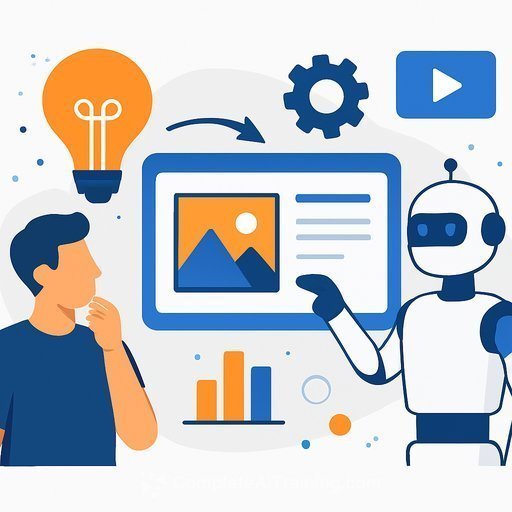
Agentic systems can run multi-step tasks without constant hand-holding. In a creative shop, that looks like this: the agent scans market chatter, drafts three positioning routes, fetches visual references, and proposes hooks for each channel. The team then edits, blends, and polishes.
The output improves because humans spend time on framing, taste, and story-while the agent handles the grunt work. Wrap it with checkpoints: prompt logs, bias checks, brand guardrails, and final human sign-off.
Rethinking talent without losing the soul
The fear is real: "If AI can concept and comp, where do I fit?" Here's the truth-originality, judgment, and emotional intelligence still decide what ships. AI widens the option space; people decide what matters.
Expect new hybrid roles: creative technologist, AI art director, brand systems designer, agent orchestrator. Career ladders need to reward taste, strategy, and the ability to direct machines with clarity.
Pricing for outcomes, not hours
Hourly billing breaks when a "day's work" becomes a 20-minute draft plus 40 minutes of curation. Agencies are moving to value-based fees and productized services tied to outcomes-brand lifts, conversions, sales cycles, or time-to-iteration.
- Sell outcomes: positioning sprints, concept packs, testable ad matrices, content systems.
- License IP: reusable prompts, model presets, and brand-specific agent workflows.
- Offer AI audits: content governance, risk checks, and tool recommendations.
This shift reframes the agency as a strategic partner, not a pair of hands.
Ethics you can ship
Clients want speed, but they also want safety and trust. Build ethical guardrails that are practical in daily work.
- Bias and representation checks baked into reviews.
- Dataset disclosure, consent tracking, and clear rules for style influence.
- Originality scans and IP checks before delivery.
- Watermarking and model notes when requested.
Put these steps in your SOWs and post them on your site. Signal that you care about the humanity of the work as much as the output.
Tools that actually move the needle
Specialized tools now go far beyond generation. Real-time audience analysis, predictive trends, and automated variation testing feed better creative decisions. The teams that win keep a tight core stack with clear handoffs and logs.
If you want to ground your strategy in broader patterns, the latest AI surveys and model updates are useful context. For example, the McKinsey Global Survey on AI discusses where businesses are seeing real value, with a growing focus on agent-driven workflows. You can skim a summary here: McKinsey: State of AI.
On the model front, Google's research updates highlight advances shaping real-time analysis and content generation. See their year-in-review here: Google AI blog.
Culture: make it safe to experiment
Culture is the multiplier. Make experimentation part of the job, not a side hobby.
- Weekly "10-minute experiments" with a quick show-and-tell.
- Shared prompt libraries and tagged case studies.
- Live red-teams to stress test outputs for bias, tone, and brand fit.
- Clear norms: what can be automated, what must be human, and who decides.
Short cycles. Small bets. Visible wins. That's how you shift behavior.
Co-creation, authorship, and the new craft
GANs, diffusion models, and audio generators raise questions about authorship. That debate won't end soon, but the practical move is to document influence. Note model versions, key prompts, and human edits. Treat the process like a creative score.
The best work we're seeing blends automation with taste: AI proposes, the team refines. To level up on craft-visual systems, typography, and framing AI-driven taste-see AI Design Courses. Think of AI as an instrument-strong in pattern and speed, weak without direction.
Partnerships and data moats
Agencies are cutting deals with AI vendors and data providers to build shared platforms. The advantage comes from proprietary data, brand-specific fine-tunes, and workflows others can't copy.
- Private data lakes for research and creative references.
- Custom agents that reflect brand voice and legal rules.
- Secure client sandboxes for collaboration and approvals.
Privacy matters here. Bake in consent, access controls, and retention policies from day one.
Energy, cost, and the reality check
There's growing scrutiny of model costs and energy use. Teams are responding with smaller, efficient models for day-to-day work and reserving larger models for high-stakes tasks. The result: lower spend, faster cycles, and a lighter footprint.
Track GPU hours like billable time. It focuses teams on craft instead of brute force.
Regional nuance and multilingual work
Adoption patterns differ by region. Europe is leaning into stricter compliance; Asia is pushing fast on tool development and multilingual models. For global campaigns, multilingual prompts and local datasets make a clear difference.
Case in point: one agency rebuilt a relaunch process around AI-human loops-AI scanning sentiment and drafting routes, humans refining story and design. Production time dropped by about 40%, and the concepts tested stronger.
What creatives can do this week
- Build your personal AI stack: 1 text model, 1 image model, 1 agent runner, 1 data note-taking system.
- Create a prompt playbook: voice, tone, structure, brand constraints, and "negative" rules.
- Run a weekly "taste workout": 5 variations, 1 synthesis, 1 rationale.
- Add AI process notes to your portfolio so clients see your thinking, not just the end result.
- Measure your craft: concept-to-first-test time, variation count, and hit rate.
- Join or form a small practice group to swap prompts and critique.
If you need structured paths by role or skill, explore curated options here: AI courses by job.
Hype vs. outcomes
Some big predictions didn't materialize this year. That's fine. Creativity lives in the gap between promise and reality. Agencies that keep a tight loop-prototype, test, learn, repeat-are the ones turning AI into client value.
Keep your feet on the ground with numbers. Track ROI for each workflow: time saved, cost reduced, quality improved. Publish the wins internally. Retire what doesn't perform.
The next era is human x machine
The message closing out 2025 is clear: AI isn't the end of creativity-it's the upgrade, if you choose to make it one. The shops that lead are investing in people, codifying ethics, and building systems where agents handle the slog and humans set the story.
By 2030, this won't be optional. Start with one workflow. Ship one result. Share one lesson. Then repeat until it becomes your unfair advantage.
Your membership also unlocks: