④ Rewriting Two Thousand Years of Science: OPS, the AI-Buckingham Machine, and Knowledge Sovereignty
Science runs on language. For two millennia, that language has been tied to units, instruments, and experiments. In the AI era, that constraint becomes a bottleneck. OPS and the AI-Buckingham Machine propose a different path: a dimensionless language that turns physical law into computable Design.
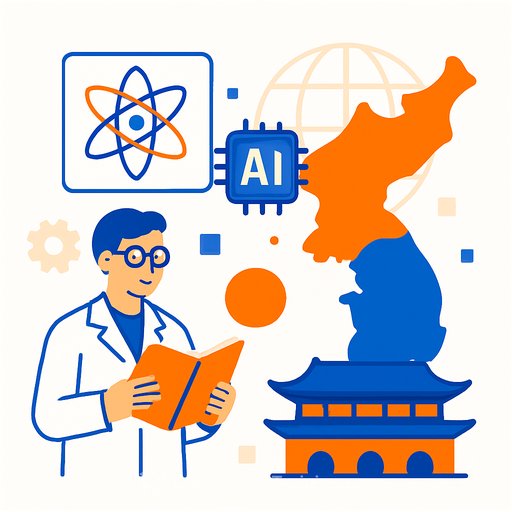
This is more than a tooling shift. It contests who sets the rules for validation, ownership, and progress. For a nation like South Korea, it opens a route from follower to standard-setter-by turning scientific language itself into software.
1) The "0" Error of 2,000 Years of Science - A Linguistic Constraint in an AI World
Traditional science depends on measurement, then model, then experiment. That loop is slow, costly, and easily siloed. The "0" error is linguistic: unit-bound descriptions of nature don't compress cleanly into computation.
OPS reframes physics in dimensionless form, removing units at the source. The AI-Buckingham Machine then converts those patterns into a dataset and engine that AI can compute, compare, and design with-without waiting on a lab bench for every new hypothesis.
2) The Tool: AI-Buckingham Machine - A Dimensionless Design Engine Built on OPS
OPS consolidates physical quantities into pure ratios. The AI-Buckingham Machine applies those ratios to real problems through a 900-million-point database (OPS), acting as a design engine rather than a post-hoc calculator.
Result: you can predict, simulate, and iterate digitally with precision that was previously locked behind expensive hardware and months of trial runs. This is a blueprint for computational science that speaks the same "language" across domains.
3) The Trust Model: Scientific Truth vs. IP - Open Verification with ZKPs
Reproducibility and IP often clash. OPS proposes open verification using zero-knowledge proofs (ZKPs): publish proofs that a claim holds without revealing the proprietary parameters or data.
In practice, this looks like public, machine-checkable attestations for results, while protecting models, weights, and industrial settings. It invites broader validation, cleaner audit trails, and faster adoption by peers. For context on ZKPs in security, see resources like Cloudflare's overview.
4) Digital Design for Semiconductors: From Tunneling Limits to Pre-Optimized Processes
At sub-1 nm scales, tunneling drives power loss and reliability issues. OPS introduces a dot size on the order of 10⁻⁹⁵ m-far smaller than atoms-giving a theoretical unit to reason about constraints below current lithography.
The AI-Buckingham Machine simulates 3D atomic arrangements and electron paths inside transistors, correlating barrier energies with interatomic distances. It proposes atomic patterns that minimize tunneling before a single wafer is processed. For teams, the near-term move is to pair this with TCAD, DFT workflows, and fab data to test proposed layouts under realistic variability.
5) Quantum Computing and Security: Physics-Based Cryptography and Predictive Error Control
As quantum hardware matures, classical cryptosystems face risk. OPS defines structural relations among 18 fundamental particles as dimensionless numbers that act as physical random numbers-unpredictable, unrepeatable, and rooted in nature.
Cryptographic primitives seeded with such numbers aim for security even against quantum adversaries, supporting PQC and QRNGs. For standards activity, track NIST's PQC project and NIST's QRNG work. On the hardware side, the AI-Buckingham Machine models qubit error probabilities and sources ahead of execution, and auto-generates error-correction strategies tailored to device physics.
6) AI Efficiency: Dimensionless Inputs for Faster, More Accurate Physics Learning
Most physical datasets are messy: unit conversions, scale mismatches, hidden constraints. OPS compresses phenomena into pure numbers that map cleanly into AI models. Less noise, fewer parameters, stronger priors.
For researchers and teams focused on Research, that means faster training, tighter generalization, and models that extrapolate with fewer samples. Think of it as AI with built-in physics, not as an afterthought but as the core representation.
7) Materials and Precision Medicine: Design-Before-Experiment
By redefining minimum interaction distance and time between atoms and molecules in dimensionless form, the AI-Buckingham Machine can model electronic structures directly in a digital environment. You can test candidate materials-room-temperature superconductors, high-efficiency catalysts, ultra-light alloys-by sweeping structure and composition in silico.
In drug design, it simulates binding energy curves, predicts toxicity signatures, and ranks candidates quickly. Because the calculations operate in dimensionless units, early-stage models can be built with minimal lab data, then tightened with targeted experiments for confirmation.
8) From Experiment-Centric to Design-Centric: The "Digitization of Matter"
The core idea is straightforward: unify physical phenomena into a language that AI can compute-and then apply it across design, prediction, production, and security. That's the "digitization of matter."
Connected through OPS, semiconductors, quantum, AI, materials, and pharma become one integrated design stack. For South Korea, this is a path to set standards, not just meet them-by exporting language, validation models, and protocols.
K-Science Declaration - Knowledge Sovereignty and a New Computational Order
OPS and the AI-Buckingham Machine claim something bold: a computational definition of the fundamental unit of structure and a dimensionless framework to work with it. Treat it as a new starting point, not a footnote-a language upgrade that invites a different kind of science.
It also changes the economics. Less dependency on massive hardware. More leverage from intelligence-human and machine. Verification moves toward open proofs. Standards move toward software and shared protocols. That is how a country becomes a rule setter.
- Labs: pilot OPS-based workflows next to current TCAD/DFT/MD pipelines. Compare accuracy, runtime, and yield impact.
- Enterprises: split models into public claims and private parameters, then publish ZK proofs for external verification.
- Agencies: fund open OPS datasets, test suites, and reference proofs to seed adoption and standardization.
- Security teams: evaluate OPS-seeded RNGs and map migration plans against PQC standards and QRNG sources.
If you're building capability in AI-driven modeling or computational design, curated training by role can help teams ramp faster: Complete AI Training - Courses by Job.
Orthodox theories bend over time. Structures that preserve truth endure. By putting a computable language at the center-and a verification model that respects both science and IP-K-Science can write rules others adopt.
Your membership also unlocks: