$47M Richland lab will use AI and autonomy to speed microbial discovery
On the PNNL campus in Richland, the U.S. Secretary of Energy, Chris Wright, keyed in a launch command for a first-of-its-kind system: the Anaerobic Microbial Phenotyping Platform, or AMP2. It's the opening move for the nation's Genesis Mission, a federal push to apply AI to scientific research. The goal is simple and aggressive-compress discovery cycles from months or years to days.
The bigger build is already funded. Through the DOE Office of Science, Ginkgo Bioworks won a $47 million contract to construct a facility with 10x the lab space of the current prototype inside PNNL's EMSL.
What's being built
The new Microbial Molecular Phenotyping Capability (M2PC) will add 32,000 square feet onto EMSL, a national scientific user facility where researchers compete for access. It will house about 100 high-tech analytical instruments and run high-throughput experiments around the clock. Ground breaks next year, with first use planned for 2030. The prototype inside EMSL begins research projects next month.
How the system works
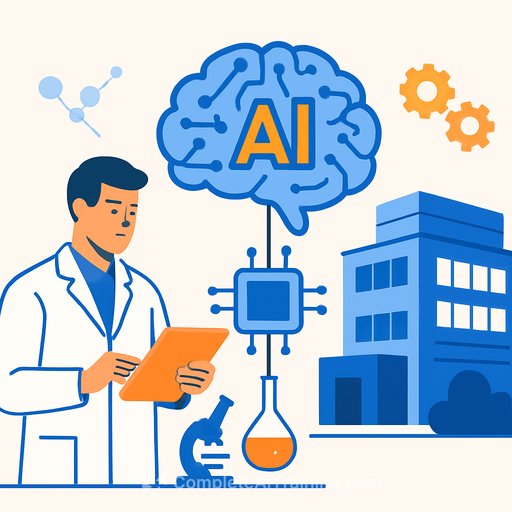
Think "self-driving" for lab workflows. Scientists set a hypothesis; robotic arms execute sample handling and move plates across instruments; AI evaluates results in near real time and selects the next best step-automatically.
That closed loop means one experiment flows into the next without constant human intervention. Researchers still guide the design and guardrails, but the autonomy handles the throughput. As Douglas Mans at PNNL put it, this approach lets labs accomplish in days what used to take weeks or months.
Why microbes
Microbes-bacteria, fungi, and more-represent the largest pool of biological function on Earth. Yet scientists know almost nothing about 95% of them.
AMP2 and M2PC will map phenotypes at scale: growth rates, nutrient preferences, temperature and pH ranges, and production windows for compounds of interest. Scott Baker at PNNL compared today's view of microbes to a grainy black-and-white photo; this program aims for a full-color, panoramic picture.
What this can deliver
- Drug discovery: new paths for diseases such as Alzheimer's and cancer.
- Energy and materials: bio-based routes to fuels and novel materials.
- Industrial biology: move from trial-and-error to data-driven optimization.
- Critical minerals: study bacteria-produced acids to leach lithium and cobalt from mine tailings.
The bioeconomy is valued above $4 trillion today and is projected to exceed $30 trillion within three decades. Scaling microbial phenotyping with AI is a direct lever on that growth curve.
People, jobs, and policy
Washington's life sciences sector already supports more than 100,000 jobs. With PNNL leading on an AI-enabled biotech platform, the state is positioned to push advances in cleaner fuels, sustainable materials, and new medicines.
Wright emphasized that these tools augment scientists rather than replace them. As productivity rises, demand for skilled researchers goes up with it. The message: more science, done faster, needs more scientists.
If you're a researcher, here's how to engage
- Apply to the EMSL user facility to compete for instrument time and collaborations.
- Design experiments for closed-loop operation: clear objectives, measurable endpoints, and machine-readable metadata.
- Set up data standards early (naming, QC, versioning) so models can iterate without friction.
- Skill up on active learning, Bayesian optimization, and experiment scheduling to get the most from autonomous runs.
- Plan validation runs that confirm AI-selected conditions before scaling.
Want structured upskilling on AI workflows relevant to lab work? Explore job-focused tracks at Complete AI Training.
Key details at a glance
- AMP2 prototype commissioned at PNNL's EMSL; research starts next month.
- $47M contract to Ginkgo Bioworks for a 32,000-square-foot M2PC addition with ~100 instruments.
- 10x the lab space of the prototype; ground breaks next year; first use in 2030.
- Focus: high-throughput microbial phenotyping with autonomous, AI-driven experiment cycles.
- Part of the national Genesis Mission to apply AI to scientific research.
Your membership also unlocks: