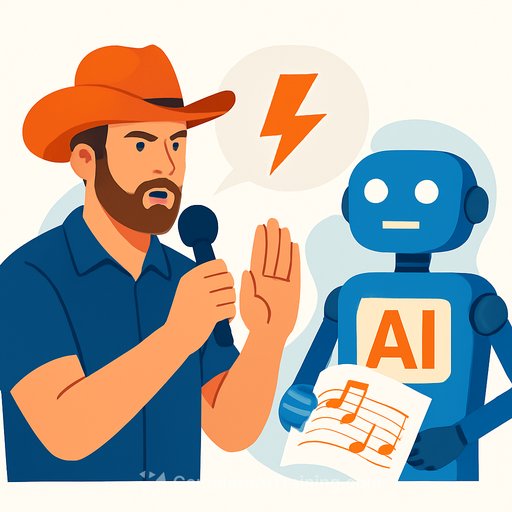
Riley Green on AI and Songwriting: Why Emotion Still Wins
Writers have always built work from different places-collaborations, solitude, and personal memory. Then AI showed up and compressed the time from idea to draft. Some creators welcomed the speed; others questioned the cost. Country artist Riley Green is firmly in the second group.
What Riley Green Actually Said
On the CMA Awards red carpet, Green admitted he hasn't gone deep on AI, but he didn't mince words: "Let your calculator write that song." Later on the Like a Farmer podcast, he added, "I feel like there's probably a really useful world for AI. Writing songs is probably not it."
He compared AI-assisted songwriting to cheating. "That's the laziest thing I've ever heard of. It's the most 'me in college' version of writing songs ever. You know, looking up the SparkNotes for a test." For him, the bigger issue is emotion: "I just don't think that there's a world where AI is gonna write something that's gonna make you feel a real emotion."
Green also flagged the commercial pressure behind AI adoption. To him, it looks like another machine for mass production, not better art. Whether you agree or not, his stance is clear: real songs come from lived experience, not prompts.
What This Means for Writers
Swap "song" for "article," "script," or "copy," and the argument holds. Your edge is lived detail, earned insight, and a voice readers recognize. AI is fast, but emotion isn't a speed problem. It's a specificity problem.
Use technology where it's a tool, not a replacement. Research, structure, and iteration are useful-but final voice and meaning are still on you.
Use AI Without Losing Your Voice
- Start human: write a messy first draft from your own stories, notes, and proof. Then use AI for line edits, clarity passes, and headline options.
- Ask for questions, not paragraphs: prompt AI to challenge your angle, find gaps, and suggest counterarguments you should address.
- Keep a voice guide: a short doc with tone rules, banned clichés, and examples of lines that "sound like you." Refer to it before any AI edit.
- Set a ratio: aim for 70/30 human-to-AI effort on creative pieces. If AI did most of the writing, you probably lost the texture readers come for.
- Ban filler: remove generic phrases and templated hooks. Add specifics-scenes, choices, stakes, numbers, and names.
- Source, then speak: use AI to gather references and data points, but translate them through your experience before they hit the page.
Quick Gut-Checks Before You Publish
- Would this piece still make sense if you swapped your name with anyone else's? If yes, add lived detail.
- Can you point to a moment, person, or decision that shaped the take? If not, you have opinions, not experience.
- Read it aloud. Flat rhythm often means generic thinking.
Why Green's Take Resonates Beyond Music
Readers can feel the difference between manufactured and earned emotion. They reward specificity, vulnerability, and craft. AI can help you get to a cleaner draft faster, but it won't live your scenes for you. That's the part that makes work memorable-and shareable.
Resources
- U.S. Copyright Office: AI policy and guidance - useful context for authorship and rights as you blend tools with original work.
- Practical AI tools for copywriting - use tools on research and refinement while keeping your voice in the driver's seat.
- AI Research Tools Training - guidance on using AI for research and refinement without losing your authorial voice.
Bottom Line
Speed is helpful. Voice is priceless. Use AI to reduce friction, not to outsource the part that makes people care.
Your membership also unlocks: