
AI news ·
Rising use of artificial intelligence in political campaign ads prompts calls for government regulation
Republican Bruce Blakeman released an AI-generated ad attacking New York Gov. Kathy Hochul with fake scenes. The video highlights risks of deepfakes and voter deception.
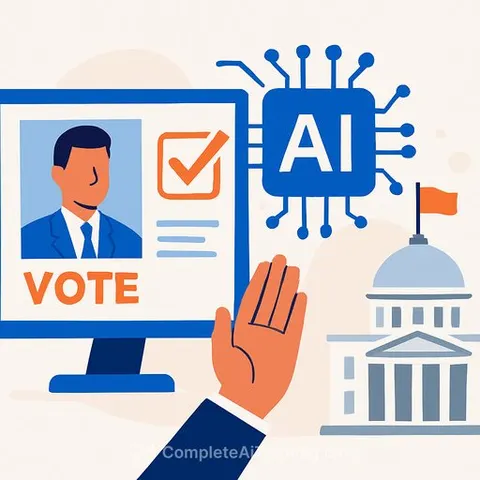
A campaign advertisement for Republican gubernatorial candidate Bruce Blakeman uses entirely fabricated, AI-generated scenes to attack New York Governor Kathy Hochul, spotlighting the growing use of artificial intelligence in political messaging and the risks it poses for voter deception.
The ad, paid for by Blakeman for New York, shows a computer-generated version of Hochul welcoming undocumented immigrants into a luxury hotel, walking through a park filled with unhoused people, and smiling at a dinner with donors. In one sequence, the fake Hochul says the state "ended cash bail so that we could stop punishing people who commit brutal crimes against our fellow New Yorkers, like this nice young man," before a tattooed man behind her asks, "Want some crack?" The video ends with the slogan "Criminals, Cronies, and Illegal Immigrants for Hochul" and a small disclaimer: "This video includes AI-generated imagery."
Blakeman, the Nassau County Executive, defended the use of the technology in an interview with PIX11. "Well, I use every tool available," he said. "AI is very good at producing things that people want to watch, entertaining videos on important political issues. Sometimes we use humor and satire, which has been used in politics since George Washington."
AI-generated ads appear in races nationwide
The Hochul ad is not an isolated case. In the Los Angeles mayor's race, a Republican candidate's ad used AI to show a Pilates class whispering support for him. In Texas, a Democratic Senate candidate was depicted in an AI-created video dressed as Maria from "The Sound of Music" singing about transgender issues. Both ads used computer-generated imagery to misrepresent the candidates' positions or popularity.
Why deepfakes in politics raise alarms
Researchers have found that people are worse at identifying AI-generated images than they expect. When a disclaimer appears only at the end of a video, as in Blakeman's ad, viewers may miss it and accept the fabricated scenes as real. The technology also enables distortions that push moral boundaries. In the 2025 New York City mayoral race, an Andrew Cuomo campaign ad depicted candidate Zohran Mamdani eating rice with his hands. Former President Donald Trump once shared a video portraying Barack and Michelle Obama as apes. For communications professionals, the rise of AI-generated campaign ads underscores the value of AI for PR & Communications Training in maintaining ethical standards and countering disinformation.
Because AI has no sense of appropriateness, the responsibility falls on politicians to decide what to publish - a dynamic that critics say invites abuse. As the technology improves, distinguishing real from fake will become harder, making it easier for campaigns to spread disinformation under the guise of satire.
Calls for government regulation grow
The increasing use of AI in political advertising has led to demands for government intervention. Government staff tasked with drafting AI regulations may benefit from resources like AI for Government Courses to close the knowledge gap. Without regulation, businesses that profit from these ads are unlikely to restrict themselves, and voluntary guidelines have failed to keep pace. The only solution, some argue, is for lawmakers to set clear rules on the use of AI in campaign materials. While public education on spotting deepfakes can help, the real safeguard lies in enforceable standards.
Why this matters for government and communications professionals
For government officials, the Blakeman ad and similar deepfakes highlight the urgency of understanding AI's capabilities and limits. Crafting effective regulation requires technical literacy that many legislative staff currently lack. Without that knowledge, rules risk being either too weak to prevent harm or so broad that they stifle legitimate political speech.
For PR and communications practitioners, the episode is a warning about the speed at which AI can fabricate convincing narratives. Teams must be prepared to detect and respond to synthetic media, and to advise clients or organizations on the ethical boundaries of AI use. The line between satire and deception is blurring, and the reputational stakes are high.