Text-to-World hits Roblox as Japan's creatives push back
Two currents are colliding: frictionless creation inside game engines, and rising concern from artists whose work funds entire industries. If you make things for a living, this moment asks you to get specific about your stance, your workflow, and your business model.
What Roblox just shipped
Roblox rolled out a beta that turns text prompts into 3D objects inside live games. It builds on last year's Roblox Cube, but now generated assets tie into physics, collision, and scripting, so what you create is immediately interactive.
Right now there are two schemas: single-mesh static objects and drivable, four-wheeled vehicles. Each asset inherits schema-level parameters like bounding boxes, materials, and mobility limits before it's compiled into the runtime.
In the Wish Master sandbox, users produced 160,000+ items over six months. Developers saw a 64% lift in engagement and session length. Roblox engineers frame this as groundwork for a wider "vocabulary schema system" that could generate any object or behavior supported by the platform's APIs.
Behind the scenes, the company is testing "real-time dreaming," which blends language models with procedural scene building. Demos show prompts that rebuild terrain and lighting on the fly.
The broader signal: Google's Genie and investor jitters
Days earlier, Google showed Genie-playable, physics-aware worlds generated from video or text. Investor buzz pulled Roblox shares down in the short term, a reminder that model-driven world building could upend familiar pipelines for engines, studios, and freelancers.
Meanwhile in Japan: a clear line in the sand
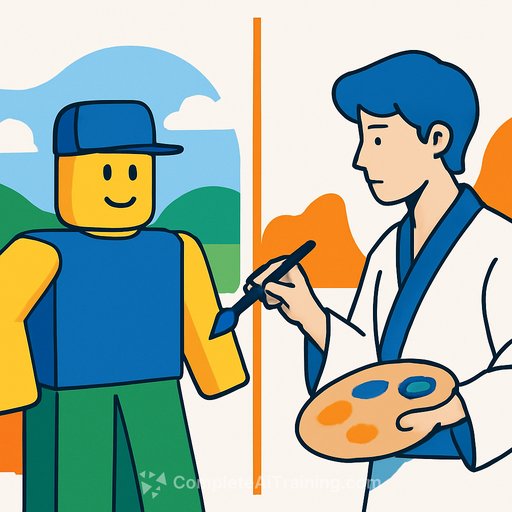
The Freelance League of Japan surveyed nearly 25,000 creative pros, mostly visual artists. 88.6% see AI as a serious threat to earning a living; 93.3% fear displacement in current or future contracts.
About 12% say they've already lost income due to AI image tools replacing commissioned work, and ~10% have taken secondary jobs outside creative fields. Accountability was loud and specific: 92%+ want disclosure of exact copyrighted training data; 61.6% favor permission-first data use; 26.6% support outright bans. Even royalty or licensing ideas landed cold-roughly a third rejected all options presented.
What this means for working creatives
- Decide your data stance. Permission-first, opt-out, or open-use with terms-pick one and document it on your site, bios, and contracts.
- Update agreements. Add clauses for training data consent, attribution, derivative use, and indemnity. Include a fee schedule for AI-assisted deliverables and revisions.
- Productize workflows. Offer two lanes: "human-original" packages and "AI-assisted rapid" packages with clear boundaries and delivery times.
- Build prompt libraries and schema presets. Treat them as reusable assets that cut iteration time and protect margins.
- Specialize deeper. Niches with strong style codes, lore, or community IP are harder to swap out.
- Track replacement risk. Flag briefs that could be satisfied by models and steer clients to a hybrid approach you control.
- Negotiate disclosure. If a client uses generative tools, require notes on which systems, prompts, and datasets influenced the work.
Practical ways to test text-to-world (without losing your edge)
- Prototype, don't publish. Use prompt-gen to mock scenes, blockouts, and physics toys, then hand-finish the final.
- Create schema checklists. Define materials, bounds, interaction rules, and naming conventions so generations drop cleanly into your pipeline.
- Measure the delta. Time your before/after on ideation, iteration, and polish. Keep anything that saves time without thinning your style.
- Ship small, often. Release micro-experiences to learn what audiences actually engage with inside engines.
Signals to watch next
- Schema ecosystems. If "vocabulary schemas" open up, expect marketplaces for behaviors, physics rigs, and interaction patterns.
- Licensing norms. Permission-first data use could spread beyond Japan if major buyers start requiring it.
- Engine-native AI. Terrain, lighting, and asset logic driven by prompts will favor creators who think in systems, not single assets.
Do this this week
- Draft a one-page AI policy for clients: data use, credit, tools allowed, and pricing tiers.
- Pick one engine sandbox and recreate a past project with text prompts; log time saved and quality gaps.
- Create a "human-original" badge and process outline to signal provenance in portfolios and storefronts.
- Join a rights group or collective that is pushing for disclosure and consent-based training.
- Plan a paid mini-offer that uses AI for sketches or wireframes, then sells your finishing touch.
The bottom line
Automation is moving into the core of creation. Some will treat it as a shortcut; others will set terms, turn speed into margin, and protect their signature.
Pick your lane, put your policy in writing, and refine a workflow clients can trust-and pay for.
If you want structured upskilling paths built for working creatives, browse Complete AI Training by job, or explore AI Research Courses for deeper study into responsible model use and research-focused training.
Your membership also unlocks: