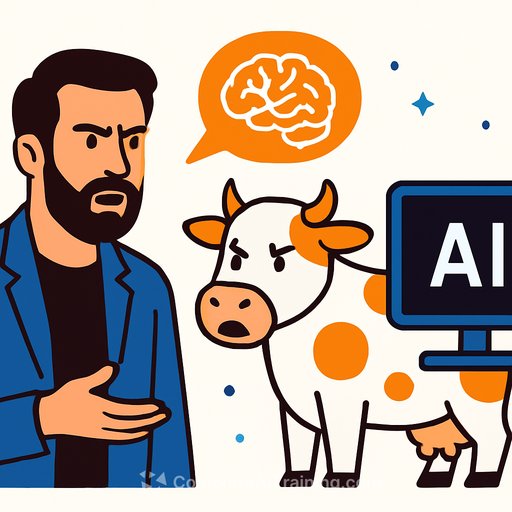
Dan Houser Says AI Will "Eat Itself." Here's What That Means for Writers
Dan Houser, co-founder of Rockstar and longtime Grand Theft Auto writer, just compared AI to mad cow disease. His point: if models keep training on content made by other models, the system degrades. The output gets blurrier, lazier, and more self-referential.
He also questioned who's steering the tech. In his words, some of the people trying to define the future of "humanity" and "creativity" using AI "maybe aren't fully rounded humans." That should make every working writer sit up.
The core argument in plain English
Houser believes AI will "eventually eat itself." The internet is filling with AI-made text and images. If models scrape that, they learn from copies of copies - like feeding cows to cows. The result is quality collapse.
Researchers have warned about this feedback loop, sometimes called model collapse. If you want the technical angle, see this overview of training-on-generated-data challenges: arXiv: The Curse of Recursion.
The legal climate: messy and getting louder
The fights over training data and character usage are heating up. Disney and Universal have sued Midjourney, and Disney sent a cease and desist to Character.AI over unauthorized use of its characters.
On the culture side, the CEO of Genvid claimed "Gen Z loves AI slop," while Epic faced backlash for what fans believe is AI-generated art in Fortnite. This tension won't fade. It affects how your writing is scraped, remixed, and redistributed.
For the rules as they stand, the U.S. Copyright Office has a running resource on AI and copyright: copyright.gov/ai.
What this means for working writers
- Differentiate with proof. Use firsthand reporting, interviews, datasets you built, and unique frameworks. Models can mimic style; they can't fake your access, process, or receipts.
- Track your sources. Keep citations, links, and notes. If your work gets scraped or disputed, documentation matters.
- Publish with a clear policy. State how you use AI (if at all). Readers care about trust. Editors care about liability.
- Use AI as a tool, not the author. Outlines, rewrites, counters, checklists - yes. Final claims and facts - double-check with human judgment.
- Create from a clean corpus. Build a personal knowledge base: interviews, transcripts, books you've read, and original analysis. That's your moat against generic output.
- Fact-check aggressively. Models are confident and wrong - often. If it sounds slightly off, verify. If it sounds perfect, verify twice.
- Keep your voice sharp. Short sentences. Specific nouns. Fresh angles. If your draft reads like everyone else's, it will get buried.
- Protect your IP. Register major works when appropriate. Watermark PDFs, disable copy-paste on sensitive docs, and watch for unauthorized reuse.
- Own your distribution. Email lists, communities, and direct readership reduce your exposure to algorithmic churn and AI summaries replacing the original.
Smart, safe ways to use AI in your workflow
- Idea stress tests: Ask for counterarguments to your thesis. Good for blind spots.
- Outline speed: Generate multiple structures, then merge the best parts. You choose, not the model.
- Language tightening: Use it to cut fluff, vary sentence length, and fix tone drift.
- Research leads, not answers: Use outputs to surface terms, angles, and sources to check - then go read the originals.
- Transcripts and summaries: Turn interviews into bullet points, then add your analysis and context.
- Reference-aware drafting: Feed excerpts from your notes to ground responses, instead of letting the model riff on scraped web text.
Why Houser's warning matters for your next draft
If the web fills with "AI of AI," readers will value clarity, accuracy, and voice even more. Editors will pay for original reporting, deep expertise, and repeatable systems for quality. Mediocre content will get cheaper - and ignored.
That's the opening. If you produce work with substance, you win as the baseline quality drops.
Want structured upskilling?
For practical courses and tools that help writers use AI without losing their voice, explore:
Bottom line
Dan Houser's take is blunt: AI trained on AI trends toward decay. As a writer, your edge is human: taste, judgment, and original inputs. Build with that, use AI with intent, and your work stands out while the noise blends together.
Your membership also unlocks: