Dan Houser on AI's hype cycle: "not the most humane or creative people" are steering it
Rockstar co-founder Dan Houser is on a press run for a new novel set in the same world as his studio's next game. In a recent interview on Virgin Radio UK with Chris Evans, he called out the current AI push: "Some of these people trying to define the future of humanity [with AI] are not the most humane or creative people."
He didn't mince words about the vibe driving the narrative: "They're sort of saying, 'We're better at being human than you are.' It's obviously not true." He added that a "certain group of people" is pulling humanity in a direction that feels off, led by "maybe [not] fully-rounded humans."
"AI will eat itself" - and why that matters
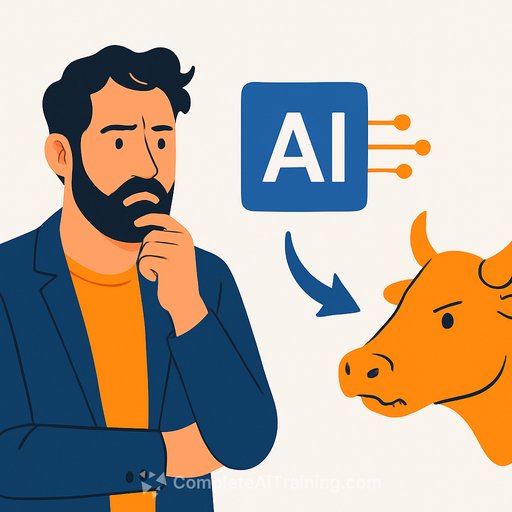
Houser's core critique is simple: if models keep training on model-made content, quality decays. "I think that AI is gonna eventually eat itself," he said, comparing it to "when we fed cows with cows and got mad cow disease."
He's not anti-tool. He's anti-myth. AI "will do some tasks brilliantly, but it's not going to do every task brilliantly." That's the line creatives should adopt: use it where it's sharp, refuse it where it dulls the work.
He echoed the point on Channel 4's Sunday Brunch: AI is a catch-all label for "future computing," marketed like it can solve everything. It can't-yet-and throwing money at the promise doesn't change that.
The industry split: soul vs shortcuts
Game leaders are already drawing boundaries. "I don't feel that games created with only AI will have soul," said Konrad Tomaszkiewicz (The Witcher 3, The Blood of Dawnwalker). Another team put it more bluntly: "Maybe AI is a creative solution if you aren't a creative person."
Translation for any creative: if the work relies on AI end-to-end, the audience can feel it. If AI supports a human-led idea, the audience feels that too. One path is a shortcut. The other is leverage.
Practical guardrails for creatives
- Use AI for grunt work: research, summaries, alt lines, rough passes. Keep the concept, voice, and final cut human.
- Create a style spine: principles, references, constraints. Make AI conform to your system, not the other way around.
- Protect inputs: read books, collect field notes, interview people. Feed your work with sources machines can't scrape.
- Avoid model soup: don't train internal tools purely on synthetic outputs. Keep a clean stream of human-made data.
- Ship a human version first: if the piece can't stand without AI, the idea isn't ready.
- Studio policy: define where AI is allowed, where it's banned, and what needs disclosure. Review for sameness creep.
Where AI actually helps
- Idea expansion: generate 20 angles, pick 2, rewrite them your way.
- Pitch sharpening: ask for objections, then answer them in your own voice.
- Variations at scale: thumbnails, alt text, microcopy, placeholder VO. Speed up the parts no one will praise you for.
- QA and continuity checks: catch inconsistencies you're too close to see.
Bottom line
Houser's point isn't anti-technology. It's pro-human. Use AI like a fast assistant. Keep taste, judgment, and vision in-house. The work with soul will outlast the work made to hit a quota.
Want to skill up without losing your voice?
- Curated AI courses by job - learn what's useful for creatives without the hype.
- Popular AI tools - find practical tools for writing, art, and video you can plug into your process.
Your membership also unlocks: