RSNA 2025: AI Agents Move From Tasks to Clinical Partnership
December 12, 2025 - At RSNA 2025, United Imaging Intelligence (UII) put a clear prompt in front of radiology: "Agent Radiologist: Are We There Yet?" The focus was practical-AI agents that can understand, reason, and act across the care pathway to make precision care more accessible and to close gaps across sites and populations. For discussions of clinical applications and role-based training that relate to these developments, see AI for Healthcare.
The conversation wasn't about hype. It was about redefining day-to-day workflows, tightening reporting consistency, and connecting clinical reasoning to action in real settings.
Imaging-to-Report: uAI Insight Steps Into the Reading Room
uAI Insight made its North American debut as an Imaging-to-Report agent that brings clinical reasoning into the reporting process. Built on multimodal medical models across language, vision, and speech, it correlates findings, flags key patterns, and generates structured reports with clear statements and supporting evidence.
Within the suite, the uAI Agent for Chest CT Reporting detected 73 thoracic diseases from a single scan with an average AUC of 95%. The uAI Agent for Brain MRI Reporting identified 47 neurological conditions from one scan. Together, they point to a shift from single-task tools to systems that support end-to-end diagnostic thinking.
Ultrasound, Reconsidered: Embodied AI With Tactile Feedback
UII also introduced the uAI Agent for Ultrasound-an embodied AI system with a robotic arm that performs autonomous scanning and assists with diagnosis. It interprets visual, tactile, and pressure cues in real time, adjusting probe position and force with precision to support comfort and consistency.
A Unified Ecosystem: From Patient Intake to Hospital Operations
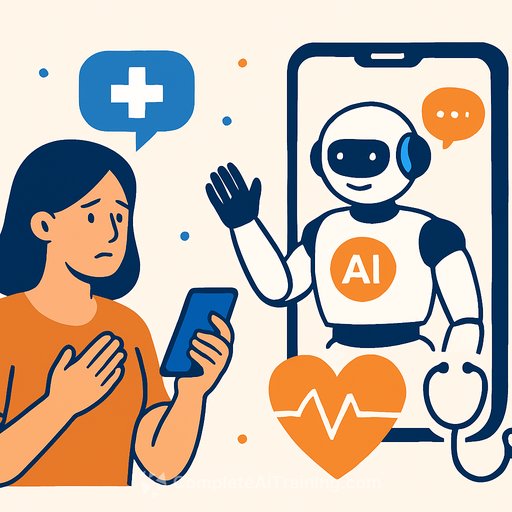
Across the booth, AI agents worked as a team. uAI Avatar acted as an intelligent medical assistant for pre-diagnostic intake through natural conversation, while the uAI Agent for Hospital Management tracked imaging and reporting quality, evaluated equipment performance, and turned operational data into actions clinicians and administrators can use. These operational capabilities reflect the growing emphasis on AI for Operations in health systems.
UII's broader concept-the "Digitelligent Hospital"-brings these pieces together. Built on multimodal medical large models refined through clinical collaborations and supported by United Imaging's technology portfolio, the approach pairs agent reasoning with embodied systems to handle real-world tasks and natural interactions.
The result is a hospital that learns, adapts, and improves across every stage of care.
What This Means for Healthcare Teams
For radiology and enterprise leaders, the message is straightforward: AI agents are moving from add-ons to infrastructure. The gains to watch are throughput, report quality, standardization, and reduced documentation drag-without losing clinician oversight. Leaders should consider governance, ROI, and deployment strategy early (AI for Executives & Strategy).
- Start with narrow, high-value workflows (e.g., chest CT follow-up) and define clear KPIs for time-to-report, quality, and safety.
- Validate on local data before scaling; monitor performance drift and bias over time.
- Integrate outputs into PACS/RIS/EMR via existing standards to avoid workflow friction.
- Keep a human-in-the-loop for exceptions and critical findings; document escalation paths.
- Train radiologists, technologists, and sonographers to collaborate with agents and override when needed.
- Address governance early-privacy, cybersecurity, audit trails, and change management.
What to Watch Next
Interoperability across scanners and vendors. Generalization across sites and patient populations. Measurable ROI in time, quality, and patient experience. And careful attention to fairness so benefits reach low-resource settings, not just flagship centers.
Regulatory and Availability
Products and features referenced may not be available in all countries, and future availability cannot be guaranteed. Not all AI applications presented are CE-marked or FDA-cleared.
For regulatory context on AI/ML-based software as a medical device, see the FDA's guidance and updates: FDA: AI/ML Software as a Medical Device.
Learn More and Skill Up
If your organization is building an AI upskilling plan by role, explore curated options here: Complete AI Training - Courses by Job.
Your membership also unlocks: