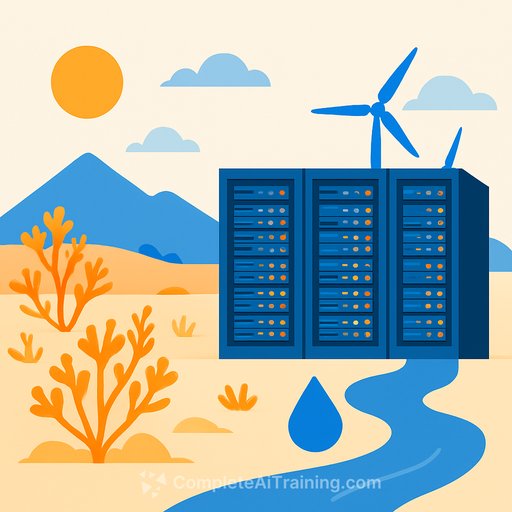
The desert where AI builds: How Storey County turned into America's datacenter factory
Drive past the sagebrush and transmission towers east of Reno and you hit a wall of concrete, cranes, and security gates. The Tahoe-Reno Industrial Center (TRIC) spans more than 100,000 acres - bigger than Denver - and it's now one of the densest datacenter buildouts on the planet.
Switch operates the largest datacenter in the US here. Google, Microsoft, Apple, and other hyperscalers have picked up thousands of acres for campuses. Tesla's battery "gigafactory" anchors the park, proving how a fast permit can pull in a mega-project and kick-start a cluster.
Why TRIC works for megaprojects
The model is blunt but effective: no residential uses, pre-approved industrial and commercial activity, and a permit pathway designed for speed. That combination let Tesla pour a 6m-sq-ft foundation months after landing the site - and even got "Electric Avenue" on the map.
Land control was the unlock. A small group acquired the ranch for roughly $20m in the late 1990s and set the rules that made later deals simple. Today, every square foot of the original inventory has been sold; what's moving now are resales and assemblages.
The AI buildout is rewriting demand
AI training and inference are driving a new wave of capacity. Microsoft (with OpenAI) plans to double its datacenter footprint over two years. Amazon (with Anthropic), Google, Meta, Oracle, and a $500bn "Stargate" consortium are rolling out large programs.
McKinsey projections peg global AI datacenter spend in the trillions by 2030. Whether that number lands high or low, the message to developers and GCs is clear: plan for scale, speed, and serial phases - not one-off boxes.
Utility math: water, energy, and the cooling trade
AI loads pull harder on water and electricity than typical cloud. A single AI query can use roughly 10x the electricity of a non-AI search. Evaporative cooling can consume on the order of a million gallons a day at scale, while non-evaporative designs cut water but raise electric demand.
Federal research tracks the surge. A recent US Department of Energy review shows US datacenter water use tripled over the last decade and could multiply again before decade's end. See the DOE overview for context: energy.gov.
TRIC built a reclaimed-water system with a 21-mile pipeline to supply clients. It reduces direct river withdrawals but still changes watershed flows, which is why local stakeholders pushed for safeguards and replenishment rules.
Local constraints are real, and they're non-negotiable
Storey County averages roughly 11 inches of rain a year. Downriver, the Pyramid Lake Paiute Tribe depends on the Truckee River - the same system feeding TRIC. "Our tribe's number one goal is protecting our resources," said Chairman Steven Wadsworth. "We know what happens when we don't fight for the water."
Historic diversions already dried Lake Winnemucca last century and dropped Pyramid Lake by 80 feet. Expect scrutiny on every gallon: direct withdrawals, reclaimed flows, and on-site usage. Bring stakeholders in early and put enforceable water accounting on the table.
Power is the other bottleneck
These campuses function like small cities in electric load. The International Energy Agency estimates datacenter electricity consumption could double from 2022 to 2026, approaching the annual use of Japan. Snapshot here: IEA Electricity 2024.
NV Energy serves the park with a natural gas plant and has added more gas units to keep pace. Meanwhile, Switch and the hyperscalers contract solar, wind, and other sources, layering PPAs and green financing to offset grid mix. Still, local brownouts make clear the grid edge is tight, especially on hot afternoons.
Inside the fence: what these campuses actually require
- Land: Hundreds to thousands of acres with room for multiple phases, triple-fencing, and deep setbacks. Avoid residential adjacency.
- Permitting speed: Pre-approved uses and a one-stop entitlement path beat incentives. Two to three years to permit can kill a program.
- Transmission and substations: On-site substations, redundant feeds, and reserved capacity. Expect upstream upgrades and interconnection queues.
- Water strategy: Reclaimed water lines, on-site storage, metering, and clear make-up water rights. Engineer for both evaporative and dry/hybrid options.
- Cooling choice: Evap vs. air/liquid hybrids is a water-energy trade. Decide with workload forecasts, not generic rules.
- Security design: Controlled private roads, screening berms, and patrol access. Plan early for antenna, cameras, and RF-sensitive zones.
- Construction logistics: Heavy-crane access, laydown for long-lead gear, winter wind management, and dust control in arid soils.
- Wildlife and habitat: At TRIC, wild horses roam. Expect fencing, crossing plans, and BLM/tribal coordination to avoid delays.
- Resilience: Backup generation (often methane or diesel), fuel contracts, black-start procedures, and room for future battery or microgrid add-ons.
- Scalability: Modular halls, repeatable MEP blocks, and duct banks oversized for next-gen racks and denser liquid-cooled hardware.
Deal lessons from Storey County
Speed wins. TRIC's pre-entitlement model and a clean use table let builders move dirt while others are still redlining site plans. That's what landed Tesla first, then Switch, then everyone else.
Control the utilities. The park's reclaimed-water reservoir and private substation capacity reduced external dependencies and made RFPs easier to answer. Those two line items can swing a nine-figure decision.
Anticipate the busts as much as the booms. A crypto utopia once took down two-thirds of the park on paper. It didn't happen. Parcels are now being re-traded into AI footprints with clearer economics.
Practical checklist for owners, developers, and GCs
- Pre-con: Lock a water and power letter first, then the land. Without both, your schedule is fiction.
- Rights and offsets: Map senior water rights, reclaimed sources, and downstream obligations. Put replenishment language in writing.
- IECs and interconnects: Start utility applications Day 1. Expect multi-year lead times on transformers and switchgear; buy ahead.
- Cooling path: Choose a primary and a pivot design. Price both with lifecycle costs and watershed impact.
- Stakeholders: Tribal governments, water authorities, BLM, and county. Early MOUs beat last-minute hearings.
- Resale-ready parcels: With primary land sold, underwrite entitlement status, easements, and hidden O&M on "second-wave" lots.
- Workforce and housing: No residential uses in-park means commuting labor. Plan shuttle, staging, and per diems accordingly.
What to watch next
Most inbound interest at TRIC is now datacenter land - reported at roughly three out of four calls. Switch continues to terrace new halls into its valley campus, and other hyperscalers are fencing off private road networks you won't see from the highway.
The constraint set is fixed: scarce water, a stressed grid, and a public that will demand transparency. As one local said, "We just don't have the power capacity to keep running all of these things." Plan for that reality, or plan for change orders.
Bottom line for builders: Projects that secure water, lock firmed megawatts, and compress permit timelines will keep winning. Everything else is a brochure.
Your membership also unlocks: