
AI news ·
Sakana AI builds AI agents to automate loan origination work at Japanese banks
Sakana AI is embedding AI agents into bank loan workflows, handling client analysis and proposal drafting that currently requires significant staff time. The Tokyo-based firm is targeting Japan's financial sector before expanding globally.
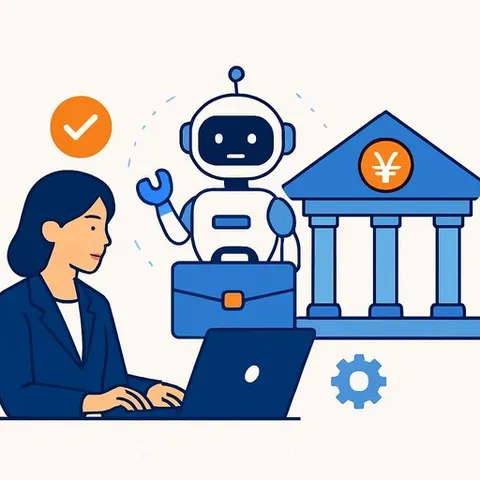
Sakana AI Builds Financial Agents With Real Bank Workflows
Sakana AI has moved from research into applied work, embedding AI agents directly into financial operations. The company's Applied Team is developing software to handle loan origination, client analysis, and proposal drafting at banks-work that traditionally requires significant manual effort from bank employees.
Two engineers driving this effort are Shota Sakai, a software engineer with experience at Accenture and freee building large-scale financial systems, and Katsuhiro Honda, an engineering manager who previously worked as CTO at legal tech startups. Both joined Sakana AI to work on AI agents before the technology became standard practice.
The Loan Origination Problem
Sakai is currently building an AI agent for a bank's loan origination process. The workflow requires gathering client information, analyzing financial data, running simulations, and drafting proposals-repetitive analytical work that consumes significant staff time.
The agent doesn't replace loan officers. Instead, it handles initial analysis and document drafting, freeing employees to focus on client relationships and final approval decisions. This mirrors how AI agents are automating business operations across sectors, though finance adds specific constraints.
Quality Control in Unpredictable Systems
Unlike traditional software with predictable inputs and outputs, AI agents produce variable results depending on context and prompts. Defining what "sufficient business quality" means for an AI system is the central technical challenge.
Financial institutions add another layer: strict security requirements, cloud restrictions, and integration constraints with legacy systems. The team must design for context management, tool execution, audit logs, human oversight points, and error recovery-all while maintaining stability.
Sakana AI's approach builds AI integration into workflows from the start. Sakai said: "Workflows are designed with AI integration from the outset. This allows us to leverage AI for efficiency while maintaining rigorous governance and quality assurance through clear instructions, validation environments, and sandbox execution."
This shifts what engineers do. Rather than writing repetitive code, they focus on architecture, specification decisions, code review, and risk assessment. AI handles the routine work; humans handle judgment calls.
Team Structure and Customer Feedback
The team includes Software Engineers handling platform and product development, and Solution Engineers managing customer integration and operational constraints. Members come from web development, data science, systems integration, cloud infrastructure, and site reliability backgrounds.
Honda expects the near-term focus on successful customer delivery-navigating real operational constraints and working across teams. Longer-term, insights from individual projects feed back into the platform and product cycle, creating continuous improvement.
Honda said: "I initially imagined a research-heavy firm, but I've found customer focus and teamwork to be paramount." The company emphasizes collaboration across business, product, and research roles rather than siloed technical work.
Competing on Implementation, Not Just Research
Sakana AI aims to establish its technology as the standard for AI use in Japan, then compete globally. The vision involves seamless human-AI collaboration within existing workflows-not replacing people, but changing how work gets done.
This requires delivering integrated solutions across user experience, application design, security, and operational evaluation. It's a shift from research papers to shipping products that actually work in banks with legacy systems, compliance requirements, and risk-averse cultures.
The company is hiring to expand the team. For product developers, the relevance is direct: AI for finance is moving from theoretical to operational, and the engineering decisions being made now will shape how these systems work at scale.