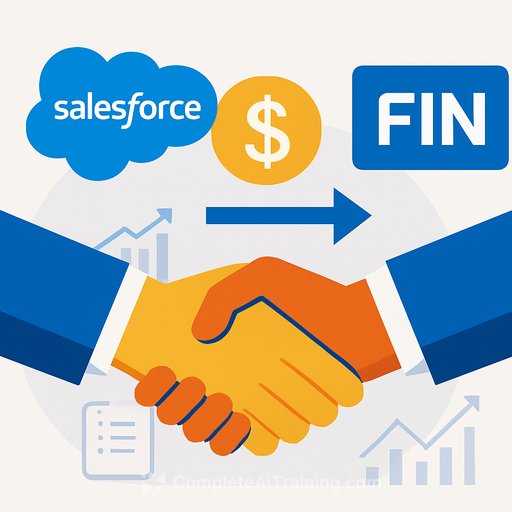
Salesforce is acquiring AI customer service company Fin, formerly Intercom, in a $3.6 billion deal that signals the CRM giant is betting heavily on autonomous service agents to drive growth in customer experience technology.
The acquisition brings one of the most recognized names in conversational customer engagement into Salesforce's portfolio. Intercom helped define modern messaging-based support for startups and digital-first businesses. Recently rebranded as Fin, the company has shifted to AI for Customer Support, building AI-native automation that Salesforce sees as critical as the industry moves toward agentic AI.
The scale gap is stark. Fin reportedly generated about $100 million of Intercom's $400 million annual recurring revenue last year, while Salesforce brings in more than $42 billion annually. Salesforce expects future growth from AI service automation to materially affect its revenue trajectory.
Midmarket AI customer service opportunity
The deal gives Salesforce access to a faster-moving midmarket customer base that often prefers lighter-weight platforms requiring less customization. Fin's AI agents are designed for rapid deployment, with pre-trained models that companies can launch without extensive workflow engineering. Fin serves more than 30,000 customers globally, a segment Salesforce has not always captured consistently.
That positioning could prove valuable as businesses shift from AI experimentation to production deployments and prioritize measurable outcomes over platform breadth.
A single AI agent across the customer lifecycle
Fin's approach aligns with Salesforce's push to connect customer data and workflows across the enterprise. Paul Adams, Fin's Chief Product Officer, said customers don't experience businesses through internal silos. "For a customer, it's a company, it's a brand, it's a product, and they don't care about your internal issues or whether one department talks to the other."
Adams argued that separate AI agents for sales, service, and success would recreate the broken handoffs that frustrate customers. "If you have multiple agents, one for sales, one for service, one for success, especially if these agents come from different companies… These agents have different context… They have different customer history, different memory, and it'll end up being a big mess."
Instead, Fin trains a single agent across roles, a model that could address fragmented customer context-a persistent problem in enterprise CRM.
Expanding contact center ambitions
The acquisition strengthens Salesforce's push into the contact center market. Fin's AI agents operate across chat, email, WhatsApp, SMS, phone, and Slack, giving Salesforce an established omnichannel autonomous support layer. Fin claims its agents resolve an average of 76 percent of customer support interactions end-to-end, a metric that is increasingly important as businesses look to reduce support costs.
Salesforce CEO Marc Benioff said in a statement: "We're thrilled to welcome Fin to Salesforce as we enable every company to become an agentic enterprise."
Agentforce adoption and the growth challenge
Since early 2025, Salesforce has made more than a dozen acquisitions aimed at strengthening Agentforce. Yet adoption remains limited-only about 12 percent of Salesforce customers use Agentforce, despite Benioff positioning it as central to the company's next phase of growth. The $3.6 billion price tag is roughly three times what Agentforce currently generates in annual revenue, highlighting the gap between AI ambitions and commercial scale.
Salesforce shares have lost more than a third of their value year-to-date, reflecting investor concern that generative AI and autonomous agents could disrupt traditional CRM models. Buying Fin is a test of whether Salesforce can own the AI agent layer before that layer weakens the perceived value of the CRM systems beneath it.
Intercom's pivot to autonomous support
The acquisition caps a dramatic shift for Intercom. Eoghan McCabe, CEO and co-founder, wrote on X: "Nearly four years ago, in need of a reboot, we jumped on weeks-old modern LLMs to create and define the category we know as Customer Agents today." Fin has built a proprietary model, Apex, which it says outperforms general-purpose frontier models from OpenAI and Anthropic on customer service resolution tasks.
McCabe emphasized that development will continue under Salesforce: "With the resources of Salesforce this will only accelerate. And yet little will practically change. I'll still be CEO, Des will still be running R&D, we'll both still be committed to continuing to lead this category."
Salesforce's acquisition strategy accelerates
The Fin deal continues a resurgence in Salesforce M&A after years of investor pressure to slow large-scale purchases. In May 2025, Salesforce announced an approximately $8 billion purchase of data management company Informatica, and later moved to acquire headless content management platform Contentful. The consolidation suggests Salesforce is assembling the layers needed for enterprise AI agents: trusted data, structured content, workflow orchestration, and autonomous customer interaction.
The Fin acquisition is expected to close in the fourth quarter of Salesforce's 2027 financial year. Its longer-term impact will depend on whether Salesforce can convert Fin's capabilities into broader Agentforce adoption.
Why this matters for Executives and Strategy
For executives evaluating AI investments, this deal illustrates the shift toward autonomous service agents as a potential growth lever. It also raises questions about how quickly AI platforms can move from strategic narrative to material revenue. The gap between Salesforce's AI ambitions and Agentforce's current adoption underscores the execution risk in large-scale AI for Executives & Strategy initiatives. The move signals that even dominant incumbents are willing to spend billions to secure a foothold in agentic AI before customer expectations and competitive pressures reshape the CRM market.
Your membership also unlocks: