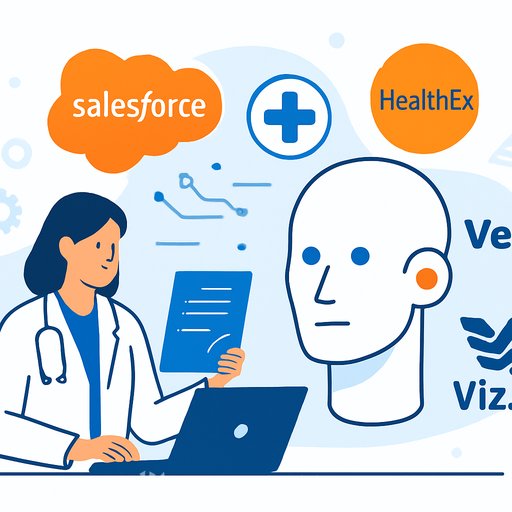
Salesforce Partners With HealthEx, Verily, and Viz.ai to Expand Healthcare AI Agents
Salesforce is expanding its Agentforce for Health platform with new AI agents and fresh integrations from HealthEx, Verily, and Viz.ai. The goal is simple: automate the administrative grind and streamline core workflows across payers, providers, and public health agencies.
These agents operate as a 24/7 administrative layer. They handle referrals, EHR updates, hospital logistics, and infectious disease monitoring so clinicians and staff can focus on care, not data wrangling.
"We cannot ask our healthcare heroes to operate in a system that is constantly failing them with fragmented data and soul-crushing administrative work," said Amit Khanna, senior vice president and general manager of health at Salesforce.
What's new
Salesforce introduced Agentforce for Health in 2025. The latest release adds six AI agents aimed at patient access, clinical research support, and public health management.
- Accelerate closed-loop referrals and coordinate next steps
- Explain insurance deductibles and out-of-pocket costs in plain language
- Manage hospital facility logistics and resource allocation
- Analyze disease trends to support public health authorities
- Update EHRs with bidirectional data exchange for contact centers and care teams
- Support claims, coverage, and member services at scale
Deeper data integrations to unify patient context
The new partnerships aim to bring clinical, wearable, and operational data into one workflow so decisions happen faster and with better context.
- HealthEx: Aggregates diagnoses, meds, labs, procedures, and clinical notes across care settings using national standards like TEFCA and FHIR. The result: a more complete record, fewer gaps, and smoother handoffs.
- Verily: Contributes data from wearables, nutrition trackers, and lab tests. This supports multimodal risk signals, earlier interventions, and more personalized care plans.
- Viz.ai: Integrates imaging and EHR data to flag suspected diseases and trigger downstream workflows, connecting detection to action.
How it plays out in daily operations
- Referrals and assessments: Triage inbound referrals, route to the right specialists, recommend needed assessments, and schedule follow-ups without the back-and-forth.
- EHR updates: Bidirectional data exchange with systems like athenahealth lets contact center teams submit med refill requests and update demographics from one screen.
- Coverage clarity: Respond to claims and benefit questions with precise, member-specific answers that deflect calls and reduce rework.
- Hospital logistics: Coordinate beds, transport, and facilities with real-time signals to cut delays and shorten length of stay.
- Public health analysis: Monitor disease trends, spot anomalies, and route alerts to the right agencies with traceable actions.
Why it matters
Healthcare doesn't suffer from a lack of data. It suffers from scattered data and slow handoffs. A persistent, AI-driven administrative layer helps close loops-referrals completed, authorizations resolved, records updated-without pulling clinicians into manual tasks.
Expect fewer delays, clearer cost explanations, and faster throughput in high-friction processes. That translates into better patient experiences, less staff burnout, and more predictable operations.
Availability and timelines
- Some agents are live today within Agentforce for Health.
- Referral triage and root cause analysis are slated for June 2026.
- Data integrations with HealthEx, Verily, and Viz.ai are expected to reach general availability later this year.
What healthcare leaders should do now
- Map your highest-friction workflows: Start with referrals, coverage questions, and discharge logistics. Define success metrics before deploying agents.
- Tighten data foundations: Validate FHIR endpoints, TEFCA participation, consent models, and identity matching so agents can act on reliable data.
- Prep your EHR interfaces: Confirm bidirectional APIs for demographics, meds, orders, and notes. Involve your CMIO and HIM leads early.
- Pilot, then scale: Run 60-90 day pilots with clear SLAs and KPIs-closed-loop referral time, first-contact resolution, turnaround time, and staff hours saved.
- Hardwire governance and safety: Establish human-in-the-loop rules for clinical-impact actions, audit trails, and incident response.
- Equip your data ops teams: If your HIM or records teams need upskilling on AI-supported EHR workflows, see this AI Learning Path for Medical Records Clerks.
Bottom line
Agentforce for Health is moving from promise to practical use. With HealthEx, Verily, and Viz.ai in the mix, more of the administrative burden can be automated end-to-end-while keeping clinicians in control. The organizations that prepare their data, APIs, and governance now will capture the most value, fastest.
Your membership also unlocks: