
AI news ·
Samsara launches AI tools for road maintenance, waste management, and student transportation in U.S. public sector
Samsara launched three AI tools for U.S. government agencies: Ground Intelligence for road monitoring, Waste Intelligence for service verification, and Ridership Management for student transport. All run on its Connected Operations Platform.
Samsara Targets Public Sector with Domain-Specific AI Tools for Infrastructure
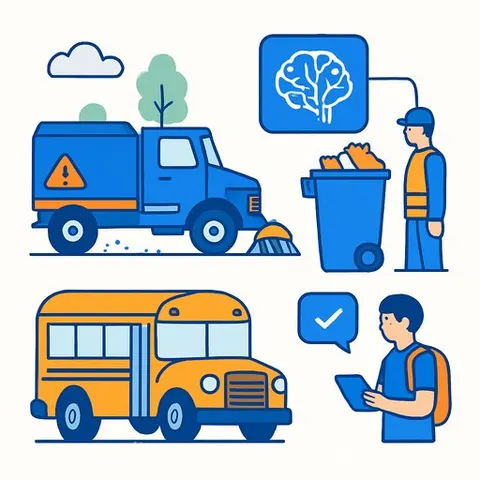
Samsara has launched three AI-powered solutions for U.S. public sector agencies: Ground Intelligence for road condition monitoring, Waste Intelligence for automating waste management verification, and Ridership Management for student transportation. The company built these tools specifically for government infrastructure challenges rather than offering generic analytics platforms.
Ground Intelligence enables proactive road repair prioritization. Waste Intelligence automates service verification. Ridership Management digitizes transportation processes for improved safety and compliance. All three run on Samsara's Connected Operations Platform and aggregate real-time data from vehicles and assets.
Public sector agencies face mounting pressure: aging infrastructure, constrained budgets, and demands for transparency. Samsara positions these solutions as ways to deliver measurable return on investment while improving decision-making.
The Shift From Reactive to Data-Driven Operations
Government agencies have historically lagged in adopting advanced analytics, often blocked by siloed data and legacy systems. Samsara's approach embeds AI directly into operational workflows rather than creating separate dashboards.
This reflects what enterprise buyers now prioritize. According to a survey of 820 organizations in March 2026, 55% measure AI success primarily through productivity improvements, ahead of cost reduction (51%) and revenue increase (39%). Agencies want outcomes, not insights.
The focus on use cases like proactive road repair and automated service verification aligns with what government decision-makers say they need: measurable cost reduction, risk mitigation, and constituent satisfaction.
Execution Risk Remains the Central Question
AI's track record in government is mixed. Legacy systems, fragmented procurement processes, and staff skepticism often derail deployments. Samsara emphasizes rapid deployment and defensible ROI, but scaling from pilot to production across diverse jurisdictions is a different challenge.
Public sector environments demand reliability, transparency, and ongoing value in settings where budget scrutiny and public accountability never pause. Sustained impact depends on whether Samsara can deliver on those fronts consistently.
Competition and Platform Lock-In Shape the Market
Samsara's Connected Operations Platform positions itself as the backbone for AI-driven government modernization. But established vendors like Oracle and IBM, along with new AI-native competitors, are moving into the same space.
As agencies modernize, the risk of platform lock-in grows. Proprietary integrations can limit future flexibility and increase switching costs. The vendors that win will balance deep vertical integration with openness, allowing agencies to adapt as needs change.
What Matters Next
- Adoption pace: Will agencies move from pilots to full-scale deployments by 2027, or will legacy barriers slow progress?
- ROI proof: Can Samsara deliver credible case studies showing measurable cost and risk reduction within 12 months?
- Competitive response: How will legacy vendors and new entrants counter this domain-specific approach?
- Procurement standards: Will government buyers demand open, standards-based platforms, or will proprietary ecosystems become entrenched?
For managers evaluating AI investments in government operations, the lesson is clear: domain-specific tools that solve real workflow problems outperform generic platforms. But success requires sustained execution and transparent ROI, not just pilot results.
Learn more about AI for Management and AI for Operations to understand how these tools fit into broader organizational strategy.