Samsung's AI living push at CES 2026: What product teams should take from it
At its "The First Look" event ahead of CES 2026 in Las Vegas, Samsung framed AI as the backbone of its product strategy, not a bolt-on feature. The theme - "Your Companion to AI Living" - signals a unified approach across TVs, appliances, and digital health. For product development leaders, the message is clear: build for connected context, long-term software support, and privacy-first personalization.
AI as a platform play, not a feature
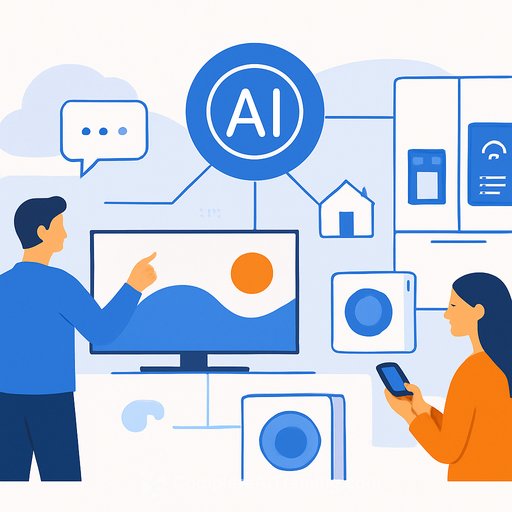
Samsung is embedding AI across categories, then stitching it together with SmartThings, which now counts 430 million users. The intent: a consistent, cross-device experience that learns, adapts, and persists over years. Tizen will see software support for up to seven years, which sets expectations for update cadence, dependency management, and component lifecycle planning. Security is anchored by Samsung Knox and Knox Matrix, both positioned to handle new AI-driven risks. Learn more about the platform at Samsung Knox.
Entertainment: AI in the display stack and the UX layer
On the hardware front, the 130-inch Micro RGB TV uses independently controlled microscopic red, green, and blue LEDs, with a Micro RGB AI Engine Pro optimizing scenes in real time. The lineup supports HDR10+ Advanced for dynamic metadata and better tone mapping - details here: HDR10+. Samsung also introduced Eclipsa Audio spatial sound and an ultra-thin OLED S95H, a new Freestyle+ portable projector, and Music Studio 5/7 speakers designed with Erwan Bouroullec.
On the software side, Vision AI Companion brings voice-first control and personalized picks for content, food, and music across Micro LED, OLED, Neo QLED, and UHD models. Two focused features stood out for UX control: AI Soccer Mode Pro for live sports tuning and AI Sound Controller Pro for independently adjusting commentary versus crowd noise - concrete examples of cross-device Design choices that prioritize user agency.
Home appliances: perception, automation, and habits
In the kitchen, Family Hub now integrates an upgraded AI Vision system built with Google Gemini. It improves food recognition and inventory tracking and adds automated recipes, video-to-recipe conversion, and FoodNote - a weekly summary of consumption habits. This is a practical loop: perception → insight → recommended action.
Samsung also refreshed its Bespoke AI Laundry Combo, AI AirDresser, and the AI Jet Bot Steam Ultra. The robot vacuum adds liquid detection and home monitoring, running on a Qualcomm processor. Expect more sensors, better edge inference, and event-driven automations that play nicely with the rest of the home graph.
Digital health: moving care upstream
Samsung outlined a shift from reactive care to prevention by combining smartphones, wearables, and home devices. The plan includes personalized coaching, early detection of abnormal patterns, and remote consultations via platforms such as Xealth. Research is expanding into early dementia signals using wearable data - a sensitive area where model validation, consent flows, and auditability matter; see Research.
Security and longevity are product features
Continuous upgrades to Knox and Knox Matrix aim to keep pace with new AI threat models. Seven years of Tizen updates set a new bar for patching, UI refreshes, and feature rollouts across a device's lifespan. For product teams, that implies tighter release engineering, backward compatibility plans, and a strategy for deprecations without breaking user trust.
Implications for product development
- Build AI as a shared capability layer across devices, not a single feature per SKU.
- Design for seven-year update horizons: component choices, firmware strategy, telemetry, and kill-switches for risky features.
- Prioritize on-device inference for latency, privacy, and cost; reserve cloud for heavier lifts and cross-device learning.
- Give users control over personalization: explicit settings, transparent explanations, and reversible choices.
- Instrument the full loop: sensing → inference → action → feedback. Use events to trigger lightweight automations.
- Make voice a first-class input but always offer silent, precise controls for shared environments.
- Treat security as part of the value prop: isolation, keys at the edge, and continuous verification.
- Develop partner pathways (content, health, home services) with clear data contracts and revocation rules.
Questions to pressure-test your roadmap
- Where does your AI run (device, hub, cloud), and why? What fails gracefully offline?
- What's your seven-year plan for updates, parts availability, and regulatory changes?
- How do users see, edit, or delete the data that trains their experience?
- What are the safety rails for misclassification in vision, voice, and health use cases?
- Which third-party services plug into your ecosystem, and how do you monitor drift or breakage?
- What metrics prove the AI is helpful (activation, correction rate, opt-out rate, time-to-value)?
Signals to watch in 2026
- Activation and retention for Vision AI Companion across TV tiers.
- SDKs or APIs that open Samsung's AI features to developers and partners.
- Edge vs. cloud processing ratios and their impact on latency and cost.
- Adoption of FoodNote and similar habit tools as everyday utilities, not novelties.
- Clinical validation paths for wearable-based early detection, plus regulatory feedback.
- Security posture updates and any changes to Knox/Knox Matrix threat models.
Why this matters
Samsung isn't pitching a single hero device. It's building a coordinated system where vision, voice, and context thread across screens, appliances, and health. If you're shipping connected products in 2026, your competitive edge will come from how well your AI coordinates across the home - with clear controls, strong defaults, and updates that earn trust.
If you're upskilling your team for AI-first roadmaps, see practical role-based programs at Complete AI Training - Courses by Job.
Your membership also unlocks: