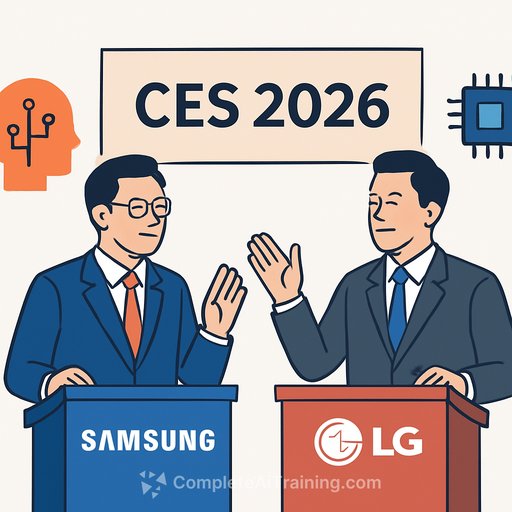
Samsung vs. LG at CES 2026: Two AI agendas, two leadership debuts
Samsung Electronics President and co-CEO Roh Tae-moon and LG Electronics CEO Lyu Jae-cheol step onto the global stage this week at CES 2026 in Las Vegas. Back-to-back keynotes set the tone for how South Korea's two hardware leaders plan to push AI - and how their rivalry could shift.
For both, CES is an early test: leadership style, product direction, and how far they'll take AI beyond features into real use. The contrast is clear already.
Samsung: AI as a lived-in ecosystem
Roh opened Sunday at Samsung's The First Look event with a theme: "Your companion to AI living." He kept it light on specs and heavy on experience. "Samsung is building a more unified, more personal experience across mobile, visual display, home appliances and services," he said. "With our global connected ecosystem and by embedding AI across categories, Samsung is leading the way to offer more meaningful everyday AI experiences."
Samsung's presence backs that narrative. It holds the largest single-brand footprint at the show at 4,628 square meters. Inside, SmartThings ties TVs, refrigerators, washers, and Family Hub displays into a "seamless AI life," including a Bespoke refrigerator that uses Google's Gemini to hold simple conversations.
On the display side, Samsung is showing what it calls a world-first 130-inch Micro RGB TV using sub-100 micrometer RGB LEDs. The message: scale the platform, then flex on premium hardware.
LG: AI that listens, adapts, and fits the space
Lyu appears Monday at LG World Premiere - his first CES as CEO - under the theme "Innovation in tune with you." It reflects LG's "affectionate intelligence" approach: systems that listen, adapt, and respond without forcing the user to manage them.
Core to that plan are "integrated spatial solutions," first introduced at IFA and now turning into concrete programs, especially in B2B across Europe and North America. Rather than pushing standalone products, LG is positioning AI as a layer that adjusts to how people move through and use physical spaces.
In the booth, LG's CLOiD humanoid household robot takes center stage, with two arms and five-fingered hands. Lyu has called AI platforms and robotics long-term growth engines. Also in focus: the Micro RGB Evo display, a CES Innovation Award winner signaling LG's intent to compete hard in the premium tier.
What this means for executives
- Two bets on AI value: Samsung is doubling down on an end-to-end consumer ecosystem; LG is leaning into context-aware solutions and B2B use cases. Leaders looking for strategic frameworks can explore AI for Executives & Strategy.
- Partnership signals matter: Samsung's use of Google's Gemini in appliances hints at a multi-assistant future inside the home. Expect more cross-brand integrations and questions around who owns the user relationship; this also ties into broader Generative AI and LLM trends.
- Hardware as a brand signal: Micro RGB/MicroLED demos reinforce premium positioning. Watch for production scalability, cost curves, and supply chain implications before assuming volume impact.
- Robotics as a long play: LG's humanoid push suggests a services angle (home and commercial). Pilot carefully, define safety and support models early, and set realistic ROI gates.
- Data and privacy: Cross-device identity, in-home sensors, and voice agents raise governance stakes. Build consent, data minimization, and audit into any partnership or platform rollout.
What to watch next
- Platform traction: SmartThings active users, device attach rates, and cross-category bundles.
- Developer momentum: SDKs, APIs, and third-party services that plug into each ecosystem.
- B2B proof points: LG contracts in Europe and North America; verticalized solutions in retail, hospitality, and healthcare.
- Unit economics: Robotics deployment costs, service models, and support tooling.
- Premium displays: Production timelines and channel strategies for Micro RGB/MicroLED.
If you're building org-wide AI capability in 2026, here's a curated path by role: AI courses by job.
Your membership also unlocks: