Samsung's unified AI vision: one system, many devices
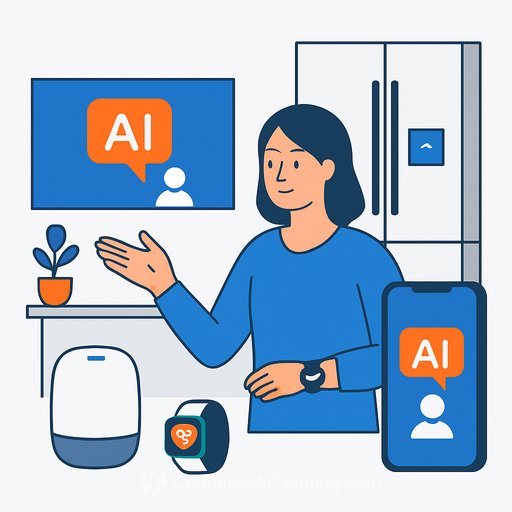
At CES, Samsung framed AI as a company-wide operating model, not a feature list. The pitch: TVs, audio, appliances, and health services act like companions that understand context, share data securely, and coordinate tasks across the home.
For product teams, the message is clear. Treat AI as a layer that spans hardware, software, and services-then design the experience as a continuous flow across screens and spaces; see AI Design Courses for patterns and approaches that support cross-device product experiences.
Why this matters for product development
- AI as a system layer: Voice, vision, and context operate across categories, not in silos.
- Cross-device continuity: Phones, TVs, appliances, and wearables hand off tasks without friction.
- Lifecycle commitment: Seven years of Tizen OS upgrades signal long-term support expectations.
- Security-first posture: Knox/Knox Matrix, model testing, and data controls are table stakes.
Entertainment: AI that understands context
Samsung's Vision AI Companion (VAC) runs on premium TVs and select screens. It interprets viewing context and voice requests, then adjusts visual and audio settings on the fly.
- Modes: AI Soccer Mode Pro rebalances picture and sound to highlight on-field action and stadium energy.
- Controls: AI Sound Controller Pro lets viewers tune crowd noise, commentary, and background music.
- Availability: VAC spans Micro RGB, OLED, Neo QLED, UHD, and the Freestyle+ projector (works on walls, ceilings, corners, even curtains).
The flagship display is a 130-inch Micro RGB model with micro-sized red, green, and blue diodes and a "Timeless Frame" design. The Micro RGB AI Engine Pro fine-tunes output at a granular level to keep images consistent across content types.
The 2026 TV range supports HDR10+ Advanced, improving brightness handling, motion, and local tone mapping for video and gaming. Samsung also added new Odyssey monitors, including its first 6K 3D Odyssey G9, plus the G6 and multiple G8 variants for both creators and gamers.
All new screens run an updated Tizen OS, with a promise of seven years of upgrades. That's a strong signal for how long premium devices should receive meaningful software support.
- Audio ecosystem: Two WiFi speakers-Music Studio 5 and 7-slot into TV and mobile setups and support multi-speaker configs. The dot-based industrial design comes from Erwan Bouroullec.
Home: appliances that coordinate routines
The Family Hub fridge takes center stage. It now uses AI Vision with Google's Gemini model to identify items as they move in and out, then tracks inventory to inform meal planning.
- "What's for Today?": Gamified prompts and recipe suggestions based on what's inside (or at random).
- SmartThings Food: Step-by-step cooking flows that can send programs to connected ovens.
- Video to Recipe: Converts cooking videos into written steps without pausing playback.
- FoodNote: Weekly usage summary-top ingredients, recent recipes, restock cues.
- Now Brief + Voice ID: More widgets and personalized views per household member.
Laundry and cleaning push for end-to-end automation. The Bespoke AI Laundry Combo merges wash and dry with a faster super speed cycle. The Bespoke AI AirDresser adds Auto Wrinkle Care with air and steam. The Bespoke AI Jet Bot Steam Ultra uses a Qualcomm Dragonwing processor and an Active Stereo 3D Sensor to detect liquid spills (even clear water), navigate with a camera that can double as a home monitor, and accepts more natural voice via Bixby. The lineup received a CES Innovation Award.
Health: ambient coaching across devices
Samsung plans to blend wellness features across wearables, phones, TVs, and appliances. Expect continuous monitoring and coaching around exercise, sleep, and nutrition-tied to what's actually in the fridge.
Security and governance: baked in, not bolted on
Data protection sits at the base of the stack with Samsung Knox and Knox Matrix. The platform monitors for AI-specific risks, protects data used in model training, and runs red team testing before deployment.
- Learn more about Knox Matrix: samsungknox.com
- HDR reference: hdr10plus.org
Product playbook: patterns worth borrowing
- Make AI a platform capability: central services for voice, vision, personalization, and policy-consumed by every product team.
- Design for handoffs: start on the watch, continue on TV, finish on the oven-with shared state and permissions.
- Expose controllable layers: let users mix audio elements, pick modes, and set persistent preferences.
- Commit to long support windows: plan hardware headroom and a modular OS to deliver multi-year updates.
- Turn routines into loops: small prompts (e.g., "What's for Today?") build stickiness and reduce decision fatigue.
- Mix on-device and cloud: privacy-sensitive tasks local; heavy compute and shared intelligence in the cloud, with clear consent.
- Use multimodal inputs: camera-to-steps (Video to Recipe) and context-aware voice reduce friction.
- Ship with privacy defaults: visible indicators, role-based profiles (Voice ID), and easy data deletion.
- Test models like software: red teaming, dataset provenance checks, and rollback paths.
Questions to pressure-test with your team
- Where does the AI layer live in our stack, and how do other teams consume it?
- What state needs to follow the user across devices, and how is it secured?
- What's our OS upgrade policy, and is the hardware roadmap aligned with it?
- How do we expose fine-grained controls without overwhelming the user?
- What's the audit trail for model updates, prompts, and user data flows?
- Which features truly benefit from multimodal input-and how do we fail gracefully when sensors are wrong?
If your roadmap involves building cross-device AI experiences, it's worth skimming role-based learning paths that map skills to deliverables. A practical starting point: AI Learning Path for Training & Development Managers.
Your membership also unlocks: