Samsung's 2026 AI reset: what product teams should do next
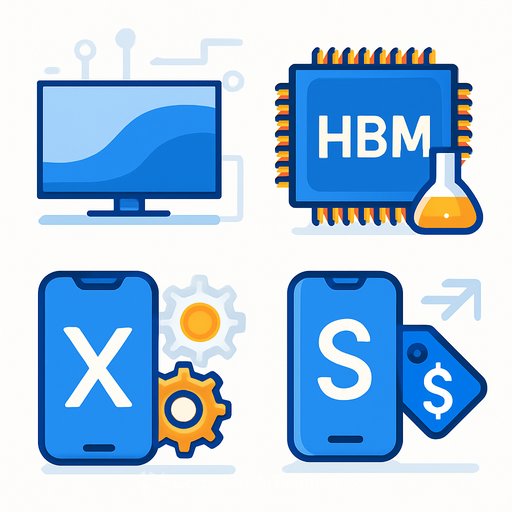
Samsung opened 2026 with a clear signal: rebuild semiconductor leadership while turning the device business into an AI-first machine. Two CEOs addressed two very different battles-DX is reorganizing around "AX" (AI Transformation), and DS is pushing hard with HBM4 and foundry differentiation.
On top of that, Samsung is holding the line on Galaxy S26 pricing despite rising component costs, acquiring industrial HVAC expertise to tackle data center cooling, and shipping consumer hardware that removes setup friction with on-device intelligence. If you build products, this is a useful playbook.
DX: "AX" makes AI the operating system for product development
TM Roh introduced AX as a process, not a feature. The goal: use AI to change how teams think, plan, and ship, with faster cycles and a bias for action.
Translation for product leaders: treat AI as a workflow layer across research, design, engineering, testing, and support. A practical starting point is AI Learning Path for Research & Development Engineers. Instrument everything, shorten feedback loops, and set explicit speed/Productivity targets tied to AI Assist, GenAI prototyping, and automated QA.
DS: HBM4 traction and a bid to close the foundry gap
Jun Young-hyun acknowledged recent setbacks in memory, then pointed to HBM4 momentum and customer feedback that "Samsung is back." HBM is the memory tier behind AI training and inference, and the next cycle will be won or lost on bandwidth, thermals, and yield.
Samsung's pitch is a one-stop stack across Logic, Memory, Foundry, and Advanced Packaging-plus AI tools inside chip development itself. For teams planning AI hardware or heavy on-device AI, track HBM4 roadmaps closely and model supply risk through 2027. For context on the standard, see JEDEC's HBM spec overview here.
Cooling is strategy now: Samsung + FläktGroup
Samsung completed its acquisition of FläktGroup, bringing a century of air and cooling expertise into its orbit. Think industrial data center cooling paired with a connected ecosystem-timely as AI racks push energy use and thermal limits.
The target is leadership in HVAC by 2026 with high environmental certification coverage, plus new facilities in Korea, India, and the US. Product takeaway: treat thermal design as a product pillar, not a constraint. Integrate hardware, controls, and software so efficiency is measurable and marketable. Samsung's newsroom has more context here.
Consumer devices: price discipline under cost pressure
Samsung is reportedly freezing Galaxy S26 series pricing: $799 (S26), $999 (S26+), $1,299 (S26 Ultra) in the US, with 12GB/256GB as the baseline. A 16GB/1TB Ultra is expected in select markets, plus a 3x Zoom HDR feature for better mid-zoom shots.
Why this matters: component costs are up across the board-foundry AP, DRAM, NAND, sensors. Exynos 2600 may help offset some of the bill, but memory prices limit upgrades elsewhere. Expect Unpacked in late February in San Francisco, a few weeks later than usual.
Freestyle+ 2026: ship AI that removes setup friction
Samsung's Freestyle+ 2026 projector centers on AI OptiScreen-automatic 3D Auto Keystone, real-time focus, Screen Fit, and wall color/pattern calibration. Less fiddling, more watching.
It adds a Vision AI Companion with enhanced voice support, Samsung TV Plus, and Gaming Hub, with launch rolling out in the first half of the year. The lesson: use on-device AI to erase setup steps and stabilize quality in messy real-world environments.
Market signals you can act on
- Make AI a workflow, not a widget: define your AX-where AI assists discovery, spec writing, prototyping, testing, localization, and support. Track time saved and defect rates monthly.
- Build for memory constraints: plan SKUs and features with HBM supply volatility in mind. Create fallbacks for inference tiers, model BOM sensitivity to DRAM/NAND swings, and pre-negotiate alternates.
- Treat cooling as part of the product: if you touch AI hardware or dense compute, thermal performance and energy efficiency should be on the roadmap as customer-facing value.
- Price strategy beats feature bloat: hold pricing where you can, trim low-ROI upgrades, and invest in the few AI features that remove friction or create daily utility.
- Shorten validation loops: copy the Freestyle+ principle-ship features that self-correct in the field (autofocus, auto-calibration, auto-layout). Reduce support load and returns.
- Plan for tight supply through 2027: expect chip stockpiling and long lead times. Run scenario plans by quarter and secure second sources early.
- Upskill the team: standardize on AI product tools and training for PMs, designers, and engineers. A curated place to start is here: AI courses by job.
Why this reset matters for product development
Samsung is moving on three fronts at once: reorganize how products get built (AX), secure the compute and memory that fuel AI, and ship consumer features that feel effortless. That mix-process, supply, and experience-wins cycles.
Your move is similar: tighten the system that makes products, secure the inputs that constrain them, and ship the few AI features customers will use every day without thinking.
Your membership also unlocks: