
AI news ·
San Jose trains 1,000th city employee on AI tools
San Jose has trained its 1,000th employee on AI, with 30% of staff to be equipped by 2027 amid a $50M budget cut. Each assistant saves 100+ hours yearly, keeping jobs.
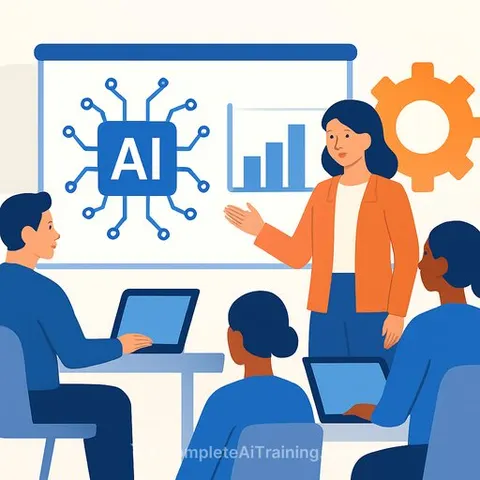
This month, San Jose trained its 1,000th city employee on artificial intelligence tools, part of a plan to arm 30% of its workforce with AI skills by June 2027. The push comes as California becomes the first state to track AI-related job losses, and as San Jose faces a $50 million budget cut that forced the elimination of vacant positions and a scaling back of certain community services.
The city operates one of the leanest major-city workforces in the state, with just one employee for every 111 residents. Officials see the AI training not as a prelude to layoffs but as a way to shift staff time toward the most pressing problems, preserving jobs and service levels in a tight fiscal environment. "We've documented tens of thousands of hours of time saved," Mayor Matt Mahan said. "What's exciting is that rather than replacing labor, we're able to shift people's time to addressing the most critical problems."
How the training works and early wins
The program uses a train-the-trainer model: employees learn to build their own AI assistants, then return to their departments to teach colleagues directly. Each assistant developed through the AI Upskilling Program saves staff 100 hours or more per year, according to the city. Concrete results are already visible. Mahan said AI tools have helped ensure fire trucks are stocked and ready, while also speeding up response times on the 311 non-emergency line, which handles issues like graffiti and illegal dumping.
City Manager Jennifer Maguire framed the effort as a responsibility. "As the Capital of Silicon Valley, San Jose has a responsibility to lead on artificial intelligence in a way that benefits residents and prepares our workforce for the future," she said. "Our vision is to build a city where technology supports safer neighborhoods, faster services, and a stronger quality of life while ensuring AI is implemented responsibly, transparently, and with public trust."
State and national momentum
San Jose is not alone. San Francisco's city attorney began using AI last year to analyze municipal codes, Oakland is piloting autonomous drones to combat illegal dumping, and California state employees are testing a generative AI tool called Poppy for summaries, data retrieval, and process automation. At the same time, Gov. Gavin Newsom announced a monthly dashboard to track AI-related job losses - the first of its kind in the nation - to guide interventions such as job-search support or retraining.
San Jose's role as a founder of the GovAI Coalition in 2023 places it at the center of this shift. The city's approach to AI for Government includes data privacy, protocols, and ethical use training alongside technical skills. The coalition hosts an annual summit, with this year's event set for Dec. 9-11 at the McEnery Convention Center.
Why this matters for government professionals
For employees in public agencies, San Jose's model offers a concrete example of how AI training can become a form of job security. Instead of replacing workers, the tools are designed to reduce tedious tasks so staff can focus on higher-value work - a shift that can protect positions when budgets tighten. Understanding how to build and use AI assistants, and being able to train others, is quickly becoming a practical skill for career resilience in the public sector.