Sanders and AOC Push Data Center Moratorium, Drawing Bipartisan Pushback
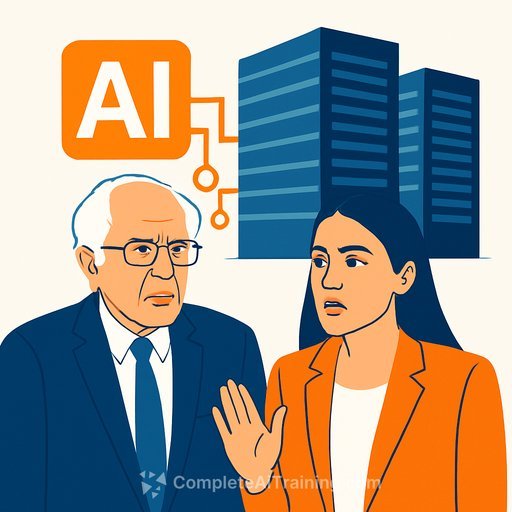
Sen. Bernie Sanders and Rep. Alexandria Ocasio-Cortez introduced legislation Wednesday that would freeze all new artificial intelligence data center construction until Congress passes comprehensive AI safety rules. The Artificial Intelligence Data Center Moratorium Act would block projects until lawmakers address worker displacement, environmental concerns, and wealth distribution from AI companies.
Sanders said the moratorium would "give us the time to figure out how to ensure that AI is safe and effective." The bill's conditions for lifting the freeze include federal review of AI products before release, union labor requirements for data center construction, and local community approval rights over projects.
The Economics Argument
Critics argue the bill misunderstands how AI companies generate profit. Unlike subsidized industries, AI developers make money by offering services worth more than their cost to consumers. Most Americans already benefit: anyone with a retirement account holds equity in companies central to AI infrastructure-Alphabet, Amazon, Meta, Microsoft, Nvidia, and Oracle.
Adam Thierer, senior fellow at the R Street Institute, called the bill "an outright declaration of war on computation in America" that would hand technological leadership to China. Sen. John Fetterman and Sen. Mark Warner, both Democrats, criticized the proposal as counterproductive to American competitiveness.
Local Control Already Exists
Communities already have tools to reject data centers. Maryland's Prince George's County stopped issuing permits after a petition gathered 20,000 signatures. Atlanta requires special permits, and adjacent counties imposed restrictions in 2024 and 2025.
Ocasio-Cortez acknowledged this reality during the announcement: "More than 100 local communities across 12 states have already enacted local moratoriums on data centers."
Economic Benefits Data Centers Bring
Data centers generate tax revenue that helps localities reduce costs. Loudon County used data center tax revenue to decrease resident car taxes. Where permitted, data center operators fund electrical generation expansion, often lowering consumer prices.
Kevin Frazier, senior fellow at the Abundance Institute, said the federal moratorium would strip states and localities of their traditional authority over land use, zoning, and energy infrastructure-powers that have historically driven American growth.
Unlikely to Advance
The bill faces steep odds. Only two Republicans-Sens. Josh Hawley and Marsha Blackburn-show interest in heavy-handed AI regulation. President Trump would likely veto the measure, which contradicts the White House's National AI Policy Framework released last week.
For construction and real estate professionals, the proposal highlights the tension between federal regulation and local control over infrastructure projects. Learn more about AI for Real Estate & Construction and how technology affects development decisions.
Your membership also unlocks: