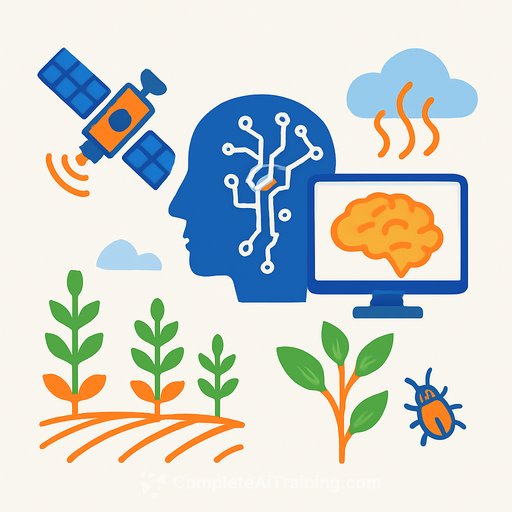
How researchers are using AI and satellite data to address global challenges
AI, machine learning and deep learning are changing how scientists read Earth systems at scale. Pair those models with satellite and drone sensors, and you get faster, more consistent insights for agriculture, ecology and climate.
Across the University of Minnesota's College of Food, Agricultural and Natural Resource Sciences (CFANS), teams are applying these tools to map invasive plants, monitor croplands and track atmospheric gases. They're also asking a hard question: when should we use AI, and at what environmental cost?
Mapping invasive species with remote sensing and deep learning
Ce Yang, faculty member in the Department of Bioproducts and Biosystems Engineering, leads work supported by the Minnesota Invasive Terrestrial Plants and Pests Center to detect invasive plants earlier and more accurately. The team pairs deep learning with satellite and drone imagery to automate detection across fields and rangelands.
The focus includes Palmer amaranth, spotted knapweed and Canada thistle. The aim is to replace slow, labor-heavy scouting with a dual-level sensing pipeline that delivers timely maps to farmers, land managers and policymakers-so interventions happen before infestations spread.
Zooming in on precision agriculture: Yang's work with the Precision Agriculture Center applies sensing and analytics to improve crop growth decisions, from variable-rate inputs to targeted weed control.
Monitoring croplands at scale with machine learning
David Mulla (Department of Soil, Water and Climate) and Philip Pardey (Department of Applied Economics), with collaborators in Computer Science, are building automated methods to map where crops are grown over large regions and long timeframes. Their models process satellite imagery to produce consistent, comparable crop maps faster than traditional surveys.
These outputs support decisions tied to food security, land use and environmental sustainability. The research also surfaces practical hurdles-data quality, label scarcity, generalization across regions-that must be addressed for dependable deployment.
Tracking atmospheric gases from space using advanced algorithms
In a global study led by Kelley Wells (Department of Soil, Water and Climate), researchers developed AI-enabled retrievals for more than a decade of satellite observations. By refining algorithms that interpret infrared measurements, they tracked volatile organic compounds that affect air quality and climate across regions and seasons.
The results highlight where current climate and atmospheric models miss key signals, guiding better predictions and targeted field campaigns. For context on satellite remote sensing, see NASA Earthdata learning resources.
Advancing AI with environmental responsibility in mind
As these methods scale, CFANS researchers are weighing AI's environmental footprint. Nick Phelps, head of the Department of Fisheries, Wildlife, and Conservation Biology, underscores the tradeoffs linked to the data centers that run large models.
The goal is twofold: develop high-value AI applications and study how to cut the energy and water costs behind them. That includes smarter model selection, efficient training and serving, and clear criteria for when AI is warranted versus when simpler analytics will do.
Practical takeaways for science and research teams
- Start with the decision, then the data. Define the management or policy decision first; back into the sensing cadence, spatial resolution and labels required.
- Invest in ground truth. A small, well-curated, representative label set often outperforms a large, noisy one-especially for transfer across regions and seasons.
- Plan for drift. Cropping patterns, management and climate vary year to year. Build monitoring to detect and retrain against distribution shifts.
- Measure compute and water use. Track energy per experiment, choose efficient architectures, and schedule workloads where low-carbon electricity is available.
- Publish methods and metadata. Reproducible pipelines, model cards and uncertainty estimates build trust and speed adoption by other teams.
- Combine platforms. Use satellites for coverage, drones for detail and field checks for validation-then fuse the signals in your models.
- Close the loop. Deliver maps and metrics in formats that farmers, land managers and agencies can act on within existing tools and timelines.
Further resources
- Copernicus Sentinel-5P (TROPOMI) data access - useful for atmospheric trace gas studies and algorithm benchmarking.
- AI for Science & Research - methods, tools and case studies for researchers applying AI to sensing and environmental data.
- AI Learning Path for Sustainability Analysts - practical workflows for environmental analytics, carbon tracking and ESG reporting.
Your membership also unlocks: