AI Strategy at WEF 2026: Satya Nadella on Diffusion, Outcomes, and the Infrastructure That Makes It Work
At Davos, Microsoft CEO Satya Nadella sat down with BlackRock's Larry Fink to cut through the hype and get to the point: AI creates value when it is widely used, not just built. As he put it, the companies and countries that diffuse AI fastest win - regardless of who invented it.
That framing shifts the question for executives from "What can we build?" to "How quickly can we deploy useful AI into real workflows?" The signal is clear: execution beats invention.
From hype to outcomes: AI in healthcare and other regulated sectors
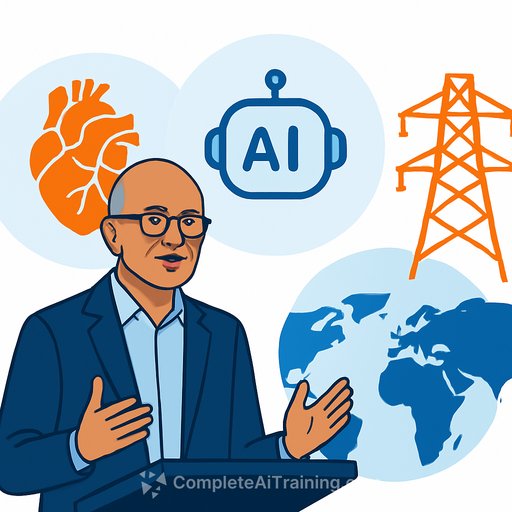
Nadella called for results over theory. Healthcare is a prime example. He cited OpenAI's ChatGPT Health as a move into high-impact, regulated work: cutting clinical admin time, preparing for appointments, summarizing patient records, and supporting drug discovery - all with attention to privacy and security requirements.
The takeaway: AI belongs in operational systems that actually move the needle. If it doesn't touch outcomes, it's a distraction.
Access isn't the blocker - relevance is
Fink pressed on a core issue: most AI benefits still skew to educated economies. Nadella's view: access isn't the constraint. Use cases people recognize are.
He pointed to a rural Indian farmer using an early GPT-based bot to reason through farm subsidies. The pattern is familiar - much like smartphones, adoption accelerates when everyday problems meet practical tools.
The unglamorous moat: power, networks, and public-private investment
AI doesn't scale on code alone. Nadella emphasized the "necessary conditions" for durable adoption: stable power, resilient telecom networks, and aligned investment. Even with private capital ready, the grid remains a government function - and everything depends on it.
He also referenced building "token factories" - AI-driven infrastructure tightly linked to local energy and communications, delivering "token plus bits." Translation for operators: pair digital intelligence with physical capacity, especially in emerging markets.
Strategy notes for executives
For executive-level diffusion and governance guidance, see AI for Executives & Strategy.
- Shift focus from pilots to production. Prioritize 3-5 use cases that hit cost, speed, or risk. Hold them to outcome metrics, not demos.
- Treat regulated sectors as a proving ground. Bake in privacy, security, and auditability from day one. Earn trust early.
- Make relevance your distribution engine. Build use cases that match local workflows and languages. Don't overfit to headquarters.
- Anchor AI plans to infrastructure reality. Inventory power availability, network reliability, and data locality. Sequence rollouts accordingly.
- Blend capital stacks. Pair private deployment with public partnerships for energy, spectrum, and permitting. Speed is a policy issue as much as a tech issue.
- Operationalize diffusion. Standardize onboarding, prompts, and guardrails. Train "AI operators" in every function, not just IT.
- Measure the spread. Track percentage of tasks touched by AI, model-assisted decisions, and time-to-value by use case.
Why this matters now
AI advantage is shifting from model superiority to organizational diffusion. The leaders who win won't be the ones with the flashiest demos - they'll be the ones who move fast, embed AI where it counts, and build the power and pipes to keep it running.
For broader context on Davos priorities, see the World Economic Forum's agenda for this year's meeting: World Economic Forum events.
Build team capability without stalling execution
If you need structured upskilling by role while you deploy, explore practical programs built for operators: AI Learning Path for VPs of Strategy and AI Learning Path for Business Unit Managers.
Your membership also unlocks: