Copilot's promise vs. reality: Nadella steps in, hard
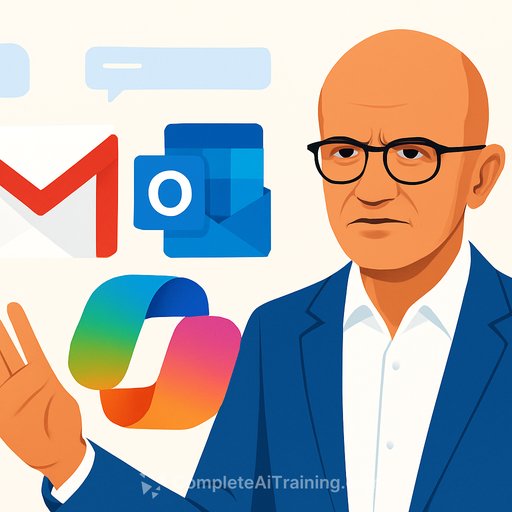
Microsoft's CEO is calling his own product out. In internal messages, Satya Nadella said the consumer Copilot integrations with Gmail and Outlook "don't really work" and are "not smart." That's not optics. That's product truth.
He's now acting like the company's chief product manager: bug reports sent directly to teams, weekly grill sessions with top engineers, and orders to consolidate post-training processes across groups. The goal is simple: make Copilot behave like a real "digital worker," not a demo.
Why product leaders should care
This is what happens when adoption lags, outcomes are fuzzy, and integrations fail at the edges. Microsoft's worry mirrors what many teams feel: the assistant doesn't consistently complete meaningful work inside core tools, and the metrics don't prove impact yet.
Feature velocity isn't the problem; reliability and outcome quality are. If the assistant can't confidently handle real workflows-calendar triage, inbox actions, spreadsheet modeling-usage stalls and trust erodes.
Signals for building AI products that actually ship value
- Integrations before "intelligence": Email and calendar connectors must be boringly reliable. OAuth scopes, message threading, and rate limits break more user sessions than model answers do.
- Leadership dogfooding isn't optional: High-frequency, hands-on QA by decision-makers shortens feedback loops and forces ruthless prioritization.
- Shared post-training stack: Unify tool schemas, evaluation harnesses, and safety layers across teams to avoid drift and duplicated fixes.
- Define "done" as task completion: Optimize for first-try success on real jobs (e.g., "schedule with three constraints," "summarize and draft reply with attachments"). Demos don't count.
- Hire for gaps, fast: Senior ICs who can own one E2E workflow beat another platform rewrite. Pay to accelerate where it matters.
- Partner where it moves the needle: External model vendors can increase reliability or latency headroom. Swap in what proves better, not what sounds better.
- Metrics over vibes: Talk less about MAUs, more about tasks completed, rework rate, and time saved.
Practical playbook for your assistant roadmap
- Write the "digital worker" contract: List 5 repeatable tasks your assistant will own in the next 60 days. Add acceptance criteria, guardrails, and rollback behavior.
- Build an E2E test harness for connectors: Gmail/Outlook scenarios with threading, calendar conflicts, time zones, and attachment types. Red-team failure modes weekly.
- Instrument real outcomes: Task completion rate, time saved, correction rate, escalation rate. Tie to cohorts and surfaces.
- Adopt a first-try success KPI: Track weekly. If it's below 70%, you're shipping experiments, not value.
- Create a fix-forward budget: Reserve capacity for reliability work every sprint. No more "we'll fix it later."
- UX for trust (see Design): Show work (sources, steps taken), expose permissions, and offer one-click revert. Quiet failure is the fastest way to churn.
- Model and tooling hygiene: Prune prompt chains, standardize tool schemas, add regression evals for each workflow before release.
- Security and privacy guardrails: Scoped OAuth, least privilege by default, clear data retention windows, and audit trails per action.
Metrics that actually prove it works
- Task completion rate (per workflow) and first-try success
- Time saved per user per week (instrumented, not just survey)
- Cohort retention tied to assistant usage, not just login
- Attach rate vs. eligible seats and expansion by function
- Support tickets per 1,000 seats and mean time to diagnose
- Net dollar retention for assistant-enabled customers
What to do next week
- Run 10 exec-level dogfooding sessions. Log every break. Ship two fixes in 7 days.
- Pick one high-leverage workflow (e.g., "inbox triage + draft replies with attachments"). Give it an owner. Freeze scope until it hits 75% first-try success.
- Cut two vanity features that don't move task completion. Reallocate that capacity to connector reliability.
- Add a visible "Why this failed" panel with retry options and safe fallbacks.
Risks to watch
- Leadership bottlenecks: Hands-on reviews help, but don't replace a durable eval and release process.
- Hiring arms race: Overpaying without focus creates cultural debt. Anchor hires on a few flagship workflows.
- Model dependency: Don't let vendor swaps stall roadmaps. Abstract the interface, measure, then decide.
Context and further reading
According to reporting by The Information, Nadella has been directly critiquing Copilot's shortcomings and pushing for faster fixes. For product documentation and capabilities, see the official Microsoft 365 Copilot page.
Level up your team's AI delivery
If your roadmap includes assistants inside email, docs, and spreadsheets, upskilling on workflow design, evaluations, and automation pays off quickly. See our practical programs: AI Automation Certification. Or explore the AI Learning Path for Administrative Assistants for hands-on modules on email, scheduling, and drafting.
Your membership also unlocks: