
AI news ·
Saudi Arabia’s Data Embassy Strategy and US Chip Shift Ignite AI Investment Boom
Saudi Arabia plans to create “data embassies” allowing foreign firms’ data to remain under home country laws. US lifting AI chip export controls supports its AI infrastructure growth.
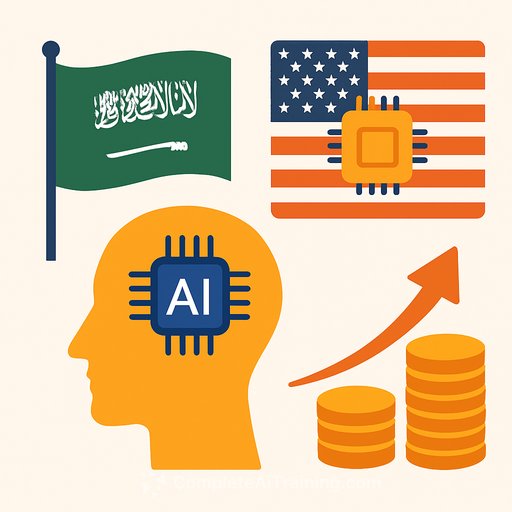
Saudi Arabia’s Bold Push into AI with Data Embassies and US Export Changes
Saudi Arabia is making significant moves to transform its data market from one of the smallest in the region to a major player in artificial intelligence. Key legal and political steps between Saudi Arabia and the US are encouraging investments in AI datacentres within the kingdom, aiming to create a secure and attractive environment for foreign technology firms.
One of the most notable developments is Saudi Arabia’s plan to designate foreign computer systems as “data embassies.” This means data stored by foreign firms would remain under the laws of their home countries, effectively shielding them from local interference. This move is intended to reassure companies concerned about data sovereignty and privacy in an authoritarian context.
US Export Controls Lifted, Opening Doors for AI Chip Supply
Previously, US export controls had blocked Saudi Arabia from accessing advanced AI chips critical for developing large-scale AI infrastructure. However, the US recently scrapped these restrictions, allowing the kingdom to import the technology needed to advance its AI ambitions.
In a striking sign of progress, Nvidia has agreed to supply 18,000 of its advanced AI chips to Saudi Arabia’s Public Investment Fund. This shipment is just the beginning of a larger plan to deploy hundreds of thousands of Nvidia Grace Blackwell chips over five years, which will require up to 500MW of power.
Legal Framework: The Global AI Hub Law
The proposed Global AI Hub Law is central to Saudi Arabia’s strategy. It offers foreign firms embassy-like status over their data centres, ensuring their operations remain under their home country’s jurisdiction. This legal shield is designed to attract multinational investments by minimizing risk and compliance costs linked to data sovereignty.
Saudi Arabia recently completed a public consultation on this law, coinciding with a high-profile Investment Summit attended by former US President Donald Trump and Crown Prince Mohammed bin Salman. At the summit, the two leaders oversaw $600 billion in trade deals, covering sectors such as defense, energy, technology, and healthcare.
Saudi Arabia’s Data Centre Market: Ambitions vs. Reality
Despite soaring ambitions, Saudi Arabia’s current data centre capacity is limited. Analysis shows Riyadh ranks near the bottom of major data markets in Europe, the Middle East, and Africa, with only 125MW planned, a fraction of London’s and the UAE’s capacities.
However, the kingdom hopes to change this drastically within a decade. Real estate experts predict Saudi Arabia could become a top-seven data centre market, supported by US cloud providers pledging nearly $9 billion in investments by 2027. One advantage for Saudi Arabia is its 20% lower electricity costs compared to the UK, combined with a large population and government agility that enables rapid digitization.
Data Sovereignty as a Strategic Advantage
Allowing foreign countries to retain sovereignty over their data centres is seen as a strategic move to reduce legal and compliance burdens for multinational companies. This approach contrasts with Europe’s strict data localisation rules, which can make cross-border data management complex and costly.
Experts note that Saudi Arabia’s law could give it an edge over countries hesitant to cede control over foreign facilities. However, some caution that investors will weigh political risks heavily, given the kingdom’s governance structure.
Challenges and Considerations
- Managing “grey” or “dark” fibre optic cables, which carry foreign data without local monitoring, remains a concern.
- Reducing the cost and complexity of compliance could boost capital inflows but requires ongoing regulatory clarity.
- Balancing rapid digitization with political risk will be key for attracting long-term investments.
Global Implications
Saudi Arabia’s data embassy concept is already influencing regional peers. Bahrain has had similar laws since 2018, and the UAE recently signed bilateral data embassy agreements with France and Italy. The idea originated in Europe, pioneered by Estonia, and is being adopted in other countries as a way to secure data centre investments amid stringent data protection regulations.
With the US opening its AI chip exports and Saudi Arabia pushing forward with data sovereignty protections, this partnership could reshape AI infrastructure development in the Middle East.
For professionals looking to deepen their understanding of AI developments and data infrastructure trends, exploring relevant courses can be helpful. Visit Complete AI Training's latest AI courses for practical insights and upskilling opportunities.