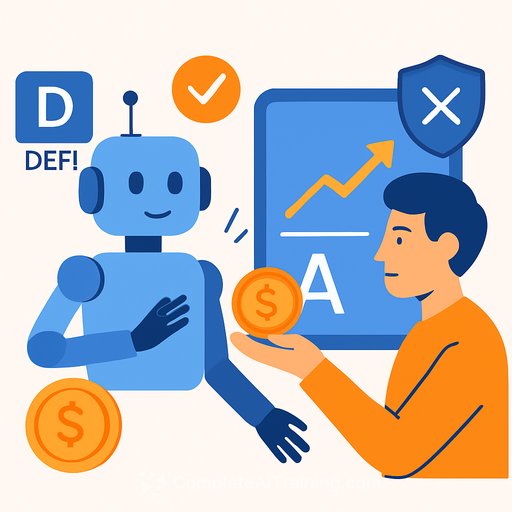
AI is strengthening the operational backbone of financial advice
The fundamentals of advice haven't changed. What's harder is delivering consistent, scalable advice without increasing operational risk. That's where AI is proving useful - not as a new advisory model, but as the scaffolding that strengthens the one you already run. It only works if your data is clean and your systems are connected; otherwise, automation just amplifies the cracks.
Connected workflows deliver immediate gains
Duplication chews through adviser time. Intelligent meeting capture that transcribes conversations and maps structured data into core systems can cut rekeying and reduce errors. When those transcripts drive your CRM, planning tools and compliance records, accuracy and consistency go up together.
Reporting benefits too. Structured transcripts and fact finds can feed prompt-driven templates to produce draft reviews, switch rationales and client recaps. The adviser still owns the judgment and edits, but the boilerplate is handled automatically - freeing more time for analysis and client engagement.
- Stop rekeying: sync fact finds, risk profiles and KYC once across CRM, planning and compliance.
- Standardize outputs: generate review packs and suitability letters from the same structured inputs.
- Reduce variance: templates aligned to policy remove ad hoc wording that invites scrutiny.
Research and compliance move faster on unified data
AI-driven search can connect fund filings, internal research notes and portfolio data so advisers can query holdings, fees or competitor positioning in plain language - inside a secure environment. Instead of juggling PDFs and portals, relevant insights surface from one connected dataset.
Pre-emptive validation tightens control. Document inspection against defined rule sets - including disclosure requirements and cost/charge frameworks - flags gaps before anything reaches a client. That supports stronger files and smoother audits under expectations like the FCA Consumer Duty.
Continuous oversight with smart alerts
Well-placed notifications keep teams proactive. Alerts that flag missing data, stale documents or material changes in underlying datasets turn oversight from episodic to continuous. When they're embedded in daily workflows, exceptions get caught early and resolved faster.
Accountability stays human
AI adds the most value inside secure, connected workflows powered by trusted data. It strengthens the evidence behind each recommendation and makes explanations clearer. But it can't judge a client's tolerance for volatility, weigh family dynamics or reconcile ethical preferences with trade-offs - that still takes conversation and experience.
It also can't apply professional scepticism. The adviser is responsible for the recommendation and for making sure the client genuinely understands it. That doesn't change because software drafted a paragraph.
What AI will not fix
Automation won't rescue weak governance or poor data capture. As you add more AI, expectations for auditability and explainability rise. Responsibility does not shrink just because a process runs faster.
A practical implementation playbook
- Data hygiene first: Standardize identifiers (ISIN, SEDOL), normalize fees and holdings, and maintain clear data lineage. Treat fund data, client data and model portfolios as shared services.
- Connect your stack: Use APIs to link CRM, financial planning, research, compliance and document management. Enforce role-based access and single sign-on.
- Meeting capture with controls: Use transcription with diarization, PII redaction and consent logging. Map key fields (goals, affordability, risk notes) directly into your systems with a mandatory human approval step.
- Template library: Maintain prompt-driven templates for reviews, recommendations and switch rationales. Version control them and align to policy and disclosure standards.
- Validation layer: Encode rule checks for costs/charges, risk warnings, sustainability claims, and performance disclosures. Block send if critical items are missing.
- Monitoring and alerts: Set thresholds for material changes (fees, risk ratings, asset allocation drift) and route exceptions to the right owners with timestamps and commentary.
- Governance and audit: Keep a model inventory, change logs, dataset catalogs, and reviewer sign-offs. Include periodic sampling, bias checks and vendor due diligence.
- Metrics that matter: Track document cycle time, rework rate, missing-data defects, suitability file pass rate, complaint rate and time-to-advice.
Measurable benefits you can defend
- 30-60% reduction in admin time per review through transcription-to-template workflows.
- Higher first-time file pass rates via automated disclosure and completeness checks.
- Faster research turnaround from unified search across filings, holdings and house views.
- Lower operational risk through continuous alerts and auditable approvals.
The bottom line
Efficiency without governance adds risk. Governance without efficiency caps growth. AI doesn't redefine advice - it reinforces the framework that delivers it. Invest in trusted data and connected systems, and you create the bandwidth to focus on better client outcomes.
Want more practical examples and workflows? Explore AI for Finance.
Your membership also unlocks: