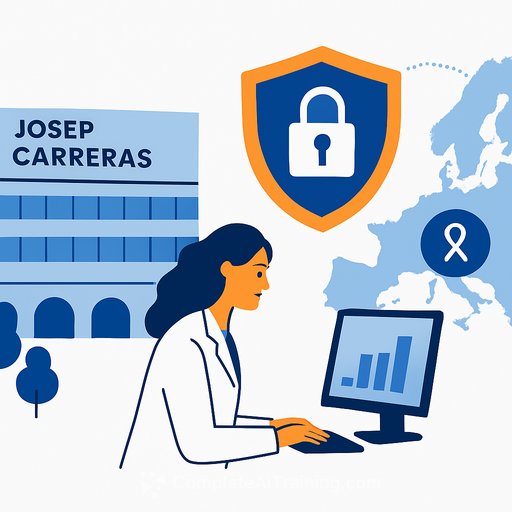
AI data processing meets privacy at the Josep Carreras Institute
Europe sits on vast clinical datasets from thousands of blood cancer patients each year. The opportunity is clear: better models, faster insights, stronger clinical decisions. The challenge is just as clear: protect patient privacy end to end while enabling meaningful analysis.
That's where SECURED Innohub comes in-a single collaboration hub hosted at the Josep Carreras Leukaemia Research Institute (IJC) for privacy-preserving, decentralized processing of health data. It brings cryptography, federated learning, secure multiparty computation, homomorphic encryption, and anonymisation assessment under one roof for providers and users across Europe.
From concept to coordination
On 3-4 December, partners across the SECURED initiative met at IJC to align roadmaps and sharpen collaboration. The goal is straightforward: enable researchers and clinicians to train and run AI models without exposing raw patient data at any point.
"We're working on a use case focused on predicting risk across cancer types," says Dr Eduard Porta, head of the Cancer Immunogenomics lab at IJC. "Together with our partners, we're training AI in a secure, privacy-preserving way and making predictions for specific patients while keeping their data protected end to end."
Why this matters for researchers
IJC is building AI models for real-world diagnosis and treatment of blood malignancies while enforcing strict privacy and legal safeguards. The workflow is engineered to comply with European data protection requirements, minimizing exposure risk and enabling clinical utility without centralizing sensitive data.
For teams planning similar work, the SECURED approach addresses core pain points: data locality, governance, reproducibility, and compliance. It prioritizes methods that prove privacy by design rather than relying on policy alone.
What SECURED will pilot
- Real-time tumour classification for faster decision support.
- Prediction of tumour evolution in children to extend telemedicine in paediatric care.
- Synthetic data generation to boost statistical power without exposing identities.
- Cross-border, remote access to patient genomic data with strict privacy controls.
Inside the technical stack
The Innohub integrates anonymisation, federated learning, secure multiparty computation, and homomorphic encryption to keep data protected at rest, in transit, and during computation. Models move, not raw data. Predictions are served with safeguards that prevent re-identification, and every step is auditable.
This setup is built for interoperability with clinical systems and for evaluation under European privacy rules. It's engineered for practical deployment, not just proofs of concept.
Funding and consortium
The SECURED project is funded by the European Union's Horizon Europe programme under grant agreement No. 101095717. The consortium is coordinated by the University of Amsterdam and includes partners from academia, healthcare, and industry across Europe.
About the Josep Carreras Leukaemia Research Institute
Patients with blood cancers are the core focus of IJC's mission. The institute advances haematological cancer research through specialised working groups, a translational program that moves discoveries to the clinic, and a Computational Diagnostics Centre combining AI and biological expertise to improve disease insight and therapy development.
IJC is accredited as a Severo Ochoa Centre of Excellence by the Spanish Ministry of Science, Innovation and Universities - State Research Agency, is a CERCA centre of the Generalitat de Catalunya, and is accredited by the Scientific Foundation of the Spanish Association Against Cancer.
Learn more
Project details, pilots, and partners: SECURED Project
European privacy requirements referenced: EU data protection rules (GDPR)
Your membership also unlocks: