AI in Ultrasound Imaging: Advances That Improve Care and Patient Safety
February 23, 2026
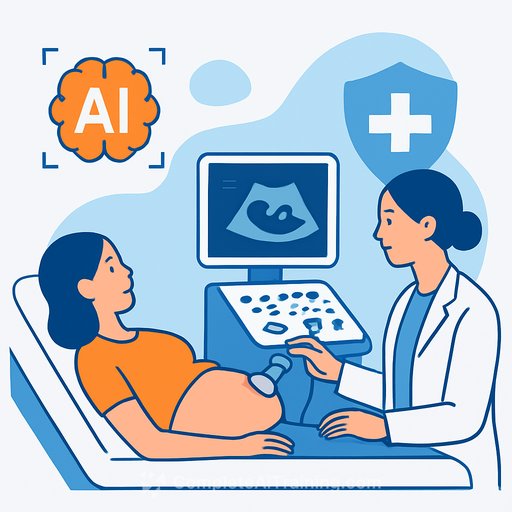
AI in ultrasound imaging has moved from "nice to have" to clinically useful. These systems guide probe placement, flag anatomy, automate measurements, and reduce variability, giving clinicians faster, clearer answers with fewer repeat scans.
From echocardiography to prenatal care and kidney assessment, AI-enhanced ultrasound supports earlier detection, more consistent reporting, and tighter coordination across the care team. The result: better decisions and fewer delays for patients.
Where AI in Ultrasound Delivers Value Today
Clinical accuracy is improving. AI can standardize views, assist with segmentation, and highlight structures that are easy to miss under pressure-especially in point-of-care settings.
Access is widening. Smaller hospitals and clinics can run advanced studies without relying on a limited pool of experts, bringing quality diagnostics closer to the bedside.
Demand is growing. With chronic disease on the rise, the need for precise, repeatable ultrasound reads is climbing. According to Towards Healthcare, the market for AI in ultrasound imaging is projected to reach USD 2.6 billion by 2035, up from USD 1.14 billion in 2025 (8.6% CAGR).
Challenges You Need to Manage
Privacy and security. PHI flowing through AI models must be protected end to end-storage, transmission, audit logging, and vendor access included.
Transparency and trust. Clinicians need to understand what the model is doing, where it performs well, and where it can fail. Clear model outputs and documentation reduce hesitation at the point of care.
Patient communication. Be explicit about how images are analyzed, what data is stored, and how results are reviewed by a human. Straight talk builds confidence.
Trends to Watch in 2025-2026
- More regulatory clearances: The US and Europe continue to clear AI-guided acquisition and quality tools. See the FDA's list of AI/ML-enabled medical devices and the EU's medical device regulation (MDR).
- Real-time 3D imaging: Algorithms now support dynamic 3D views (e.g., beating heart), improving interpretation at the bedside and in the lab.
- Smarter workflow: Automated measurements, view classification, and urgency triage reduce clicks, cut report time, and help standardize quality.
- Focus on chronic conditions: Strong uptake in cardiology, nephrology, and obstetrics for earlier detection and treatment planning.
- Stronger data protections: Vendors are implementing encryption, role-based access, and stricter data retention to protect patient information.
- More transparent systems: Clearer outputs, quality scores, and explainability features help clinicians trust and verify results.
What's Next
Expect faster, more precise tools that plug cleanly into PACS and EHRs. Hospitals will deliver consistent diagnostics even where specialists are limited, while integrated data flows cut friction across cardiology, radiology, and OB workflows.
As accuracy and usability improve, AI-enhanced ultrasound will keep pushing care earlier-catching problems when intervention is simpler and safer.
Implementation Playbook for Health Systems
1) Start with high-yield use cases
- Echocardiography: automated chamber measurements, strain, and view classification
- OB: standard plane detection and biometric consistency
- POCUS: quality guidance for FAST, lung, and vascular access
2) Build data governance early
- Define PHI handling, de-identification, retention, and vendor access
- Enforce encryption in transit/at rest and maintain audit logs
- Document data rights and permitted secondary uses in contracts
3) Validate clinically and monitor continuously
- Compare against expert reads and gold standards; set acceptance thresholds
- Monitor drift, false positives/negatives, and subgroup performance
- Establish a rapid rollback path if metrics degrade
4) Integrate without adding clicks
- Feed outputs into PACS/DICOM SR and push structured data to EHR via HL7/FHIR
- Surface quality scores and flags within existing reading and reporting tools
- Map AI outputs to downstream order sets and care pathways
5) Keep humans in the loop
- Require clinician review for all AI-assisted measurements and findings
- Provide failover to manual workflows and document exception handling
- Create a simple incident-reporting channel for suspected AI errors
6) Train teams and inform patients
- Short, role-based training for sonographers, cardiologists, radiologists, and ED teams
- Patient-friendly scripts explaining how AI assists and how clinicians verify results
- Refreshers aligned with software updates and new features
7) Get procurement and compliance right
- Security review: vulnerability management, pen test history, SBOM
- Regulatory documentation: indications, performance claims, post-market plan
- Contracts: uptime SLAs, update cadence, liability, and support model
- For deeper regulatory skills, see the AI Learning Path for Regulatory Affairs Specialists.
8) Track outcomes that matter
- Repeat-scan rate, time-to-diagnosis, and interobserver variability
- Measurement agreement with expert readers and downstream change-in-management
- Patient throughput, discharge time (ED/POCUS), and adverse event reports
Patient Safety, Up Close
- Fewer missed findings via consistent view acquisition and quality scoring
- Lower variability across operators and shifts
- Faster triage and treatment decisions in cardiac and obstetric scenarios
- Stronger data protections that reduce the risk of exposure and loss of trust
Bottom Line
AI in ultrasound is delivering practical wins: better images, cleaner measurements, and steadier workflows. With strong governance and clinician oversight, it improves care quality and protects patients.
For ongoing coverage of clinical AI use cases and workflows, explore AI for Healthcare.
Your membership also unlocks: