Israeli AI Researcher Selected for New UN Panel on Global AI Policy
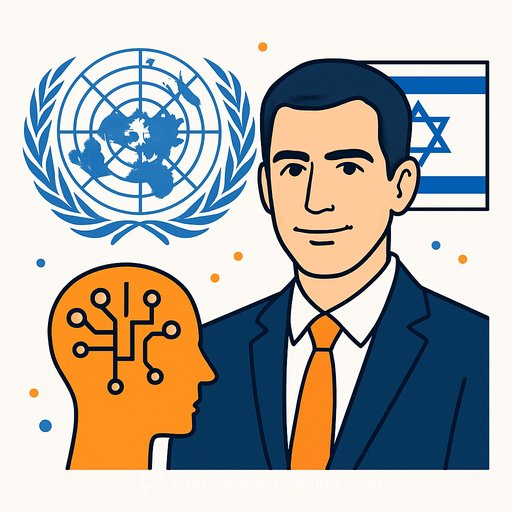
Prof. Lior Rokach of Ben-Gurion University has been recommended by UN Secretary-General António Guterres to serve as Israel's sole representative on a new United Nations scientific panel dedicated to artificial intelligence.
Chosen from more than 2,600 candidates across 140 countries, Rokach will join the 40-member Independent International Scientific Panel on AI. The group will study how AI affects societies and provide evidence-based guidance to decision-makers.
According to Ben-Gurion University, the panel will act as an early warning system for emerging AI developments and risks in non-military domains. It will also publish annual position papers to bridge research and policy and make AI insights accessible worldwide.
"Prof. Lior Rokach's appointment to the UN's Independent International AI Panel reflects his scientific leadership as one of the most cited researchers in his field, and the excellence of the University's Stein Faculty of Computer and Information Science," said Prof. Daniel Chamovitz, President of Ben-Gurion University of the Negev.
Rokach will serve alongside internationally recognized figures, including Prof. Yoshua Bengio, a Turing Award laureate, and Prof. Maria Ressa, a Nobel Peace Prize recipient noted for her work on disinformation and online manipulation connected to AI technologies. Learn more about their honors at the ACM A.M. Turing Award and the Nobel Prize.
Inside Ben-Gurion University's New Stein Faculty
The Stein Faculty, established this year, concentrates on cybersecurity, artificial intelligence, and computer science. It forgoes traditional departments and operates through five research institutes:
- Foundational AI
- Applied AI research
- Theoretical computer science
- Interdisciplinary computational science
- Software, systems, and security
Ben-Gurion University noted that Rokach will be available for interviews after the UN completes its formal vote to ratify panel membership. The university, based in Beersheba, emphasizes innovation across cybersecurity, climate, water, and health-echoing David Ben-Gurion's vision of the Negev as a source of practical solutions for Israel and beyond.
Why this matters for researchers
- Early alerts on non-military AI risks-e.g., disinformation, safety failures in consumer systems, and misuse affecting critical services.
- Common evaluation practices for safety, reliability, and socio-technical risk assessments.
- Guidance on data access, privacy, provenance tracking, and auditability standards.
- Templates for responsible deployment, red-teaming, reporting, and post-deployment monitoring.
- Global evidence-sharing to support countries with fewer resources.
- Clearer signals for public funding priorities linked to safety and societal benefit.
- Open calls for input where labs can submit results, datasets, and case studies.
How labs and institutes can prepare now
- Write 1-2 page, policy-ready summaries of recent findings with clear methods, limitations, and suggested metrics.
- Release reproducibility packages and safety test suites alongside publications.
- Adopt transparent model cards, data sheets, and incident reporting processes.
- Stand up internal risk reviews for fairness, security, privacy, and misuse before deployment.
- Partner with social scientists, legal scholars, and domain experts to validate real-world effects.
- Track upcoming UN consultations and prepare evidence submissions aligned to their formats.
If upskilling your team on evaluation, policy, and safety practices is on your roadmap, explore curated AI coursework here: AI Research Courses.
Your membership also unlocks: