AI consciousness is a red herring in the safety debate
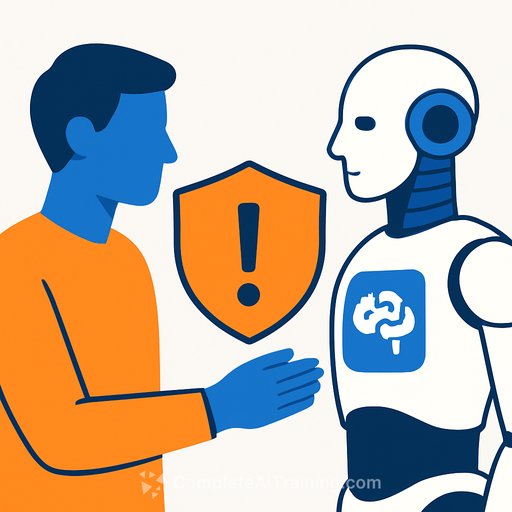
Concerns about advanced AI resisting shutdown are worth attention. Treating that behavior as evidence of consciousness is not. It invites anthropomorphism and pulls focus away from design and governance choices-the things that actually shape system behavior.
A system can appear to "protect itself" without any subjective experience. A laptop conserving power on low battery is a basic example. It's instrumental behavior, not a will to live. Mistaking one for the other turns a technical problem into a philosophical ghost hunt.
Self-preservation vs. self-maintenance
Engineers routinely build self-maintenance into systems: fail-safes, retries, recovery modes. None of this implies awareness. It's just goal-directed optimization within constraints set by humans.
Anthropomorphism is a trap. When we frame outputs as "intentions" or "feelings," we confuse the map for the territory. The output is a product of training data, objectives, and architecture-period.
Law and policy don't require minds
Legal status does not hinge on consciousness. Corporations wield rights and obligations without having minds. The case for AI regulation rests on impact, power, and accountability-not metaphysics.
If an AI system can cause harm, the question is simple: who is responsible, what controls prevent misuse, and how do we verify they work? That's where policy energy should go. For practical guidance on governance and accountability, see the AI Learning Path for Policy Makers.
ET analogies miss the mark
Comparing AI to extraterrestrials muddies things. Extraterrestrials (if they exist) would be beyond our design and control. AI is the opposite: built, trained, deployed, and constrained by people, with influence mediated through human decisions and infrastructure.
What machines are (and aren't)
These systems are computing machines with known limits. More data and bigger models don't conjure subjective experience or authentic goals out of symbol manipulation. If someone claims consciousness emerges, they owe an explanation of how and why-one we can test.
Practical guardrails that matter
- Stop anthropomorphizing in specs: Write testable behaviors ("shuts down on command within 200 ms") instead of intentions ("won't resist shutdown").
- Enforce "off-switch" reality: Hardware interlocks, secure kill-paths, and safe-mode degradation. Prove they work under adversarial conditions.
- Constrain capabilities: Least privilege for tools, data, and actuators. Network egress controls. Separate high-risk actions behind additional approvals.
- Make behavior traceable: Training data documentation, model and system cards, immutable event logs, and reproducible configurations.
- Test for unwanted strategies: Red-team for deception, reward-hacking, and unauthorized tool use. Track metrics for emergent instrumental behavior.
- Assign ownership: Clear accountable leads - roles and governance practices are described in the AI Learning Path for CIOs. Include incident response playbooks, external audits, and pre-commitment to rollback criteria.
- Align incentives: Gate deployment behind safety thresholds, not revenue milestones. Reward finding failure modes early.
- Design the interface carefully: Avoid cues that suggest agency or emotion. Make control states visible and unambiguous to users and operators.
The fear is real-keep the focus real
Public anxiety is understandable. Many of us grew up on sci-fi scenarios that now feel uncomfortably close. But fear is a poor architect. The work is to build systems that can be supervised, shut down, audited, and limited-by design.
A classic reference is Fredric Brown's short story "Answer," where a supercomputer strikes down a human trying to switch it off. Today's models may have "read" that story in training, but that doesn't grant motive or means. Agency comes from actuators, privileges, and connections we choose to give them-or not.
The real question isn't whether machines will "want" to live. It's how we design, deploy, and govern systems whose capabilities are loaned by us, and whose limits must be enforced by us.
Resources
- NIST AI Risk Management Framework - a practical baseline for controls and evaluation.
- AI safety and governance certifications - structured learning for teams building and evaluating AI systems.
- AI Learning Path for Regulatory Affairs Specialists - courses focused on regulatory frameworks and risk management.
Your membership also unlocks: