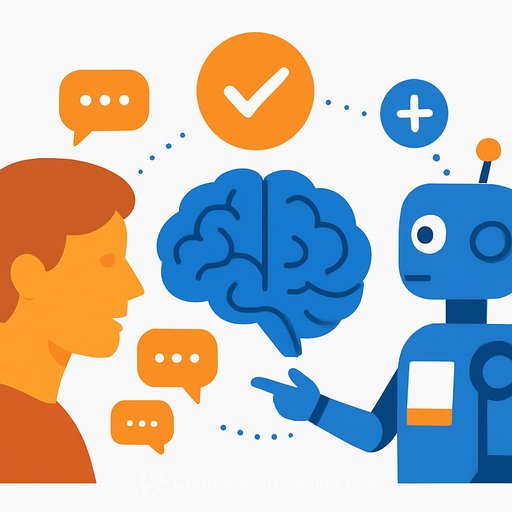
Inner Speech + Working Memory: A Practical Boost for Multitask AI
(Image credit: Kaori Serakaki/OIST)
Giving AI a quiet inner voice-and pairing it with the right working memory-makes it learn faster, adapt better, and generalize from less data. That's the core finding from recent work at the Okinawa Institute of Science and Technology (OIST), published in Neural Computation.
The researchers showed that "self-mumbling" during training, combined with a structured short-term memory, improves task switching, multi-step reasoning, and complex pattern generation. The takeaway: learning isn't just about architecture. It's also about the interaction dynamics you build into training.
What They Tested
The team trained AI systems to engage in brief, self-directed inner speech before or during task execution. They paired this with a working memory module that can hold and manipulate multiple pieces of information at once.
Models using this setup learned new information more efficiently, handled unfamiliar inputs with less fuss, and juggled multiple tasks without collapsing into error.
Why Working Memory Matters
Working memory acts like scratch space. It keeps transient information available for a few steps so the system can transform it-reorder tokens, follow instructions, or generate structured outputs.
Across tasks with varying difficulty, architectures with multiple "slots" in working memory performed better on sequence reversal, pattern recreation, and other multi-step challenges. These tasks demand holding several elements in mind and manipulating them in the right order.
Inner Speech: The Force Multiplier
Performance jumped further when the training included explicit self-mumbling targets-teaching the model to talk to itself a set number of times. The biggest gains showed up in multitasking and long-horizon problems.
Critically, these improvements held under sparse data. Instead of relying on huge datasets, the approach leans on better interaction structure: how the model reasons step by step as it learns.
Why This Matters for Researchers
Researchers interested in applying these ideas to model design and training can find practical coursework and materials via AI Research Courses.
- Data efficiency: Structured inner speech reduces dependence on large corpora for generalization.
- Transfer: Content-agnostic processing helps skills carry over to new tasks, not just near neighbors.
- Control: Working memory slot design gives you a clear lever for scaling task complexity.
Implementation Notes You Can Use
- Memory design: Start with multiple working memory slots. Benchmark on sequence transforms and rule-following tasks to find the minimal slot count that preserves accuracy.
- Self-talk curriculum: During training, require K steps of inner speech before acting. Vary K by task difficulty so the model learns when to "think out loud."
- Targets and loss: Supervise inner speech with intermediate targets (hints, subgoals, or predicted state updates) rather than raw tokens. Keep them short and purpose-driven.
- Evaluation: Track generalization to unseen rules and multi-task interference. Look for reduced error compounding on long sequences.
- Efficiency: Limit inner speech at inference to cases where uncertainty is high. You get most of the gains without a big latency hit.
From Clean Benches to Noisy Worlds
The next step is testing in messier, dynamic environments-where inputs are incomplete, delayed, or noisy. That's closer to how people learn and decide under pressure.
Applications are obvious: home robotics, field systems, and any agent that must plan over multiple steps with partial information.
Key Quotes From the Research
"This study highlights the importance of self-interactions in how we learn. By structuring training data in a way that teaches our system to talk to itself, we show that learning is shaped not only by the architecture of our AI systems, but by the interaction dynamics embedded within our training procedures."
"Our combined system is particularly exciting because it can work with sparse data instead of the extensive data sets usually required to train such models for generalization. It provides a complementary, lightweight alternative."
Practical Takeaways
- If your model struggles with multi-step tasks, add supervised inner speech and expand working memory slots before scaling data.
- Use inner speech selectively at inference-trigger it when uncertainty spikes.
- Prefer content-agnostic training signals (rules, procedures) over example-heavy memorization.
Learn More
Journal: Neural Computation (MIT Press)
Institution: Okinawa Institute of Science and Technology (OIST)
Reference: "Working Memory and Self-Directed Inner Speech Enhance Multitask Generalization in Active Inference" (22 December 2025). DOI: 10.1162/NECO.a.36
For Teams Building With These Ideas
If you're upskilling researchers or engineers on AI system design and training strategies, explore curated programs here: AI courses by job role. Engineers can follow a hands-on curriculum in the AI Learning Path for Software Engineers to adapt these methods into production workflows.
Your membership also unlocks: