New York's AI Act: What IT and Dev Teams Should Prepare For
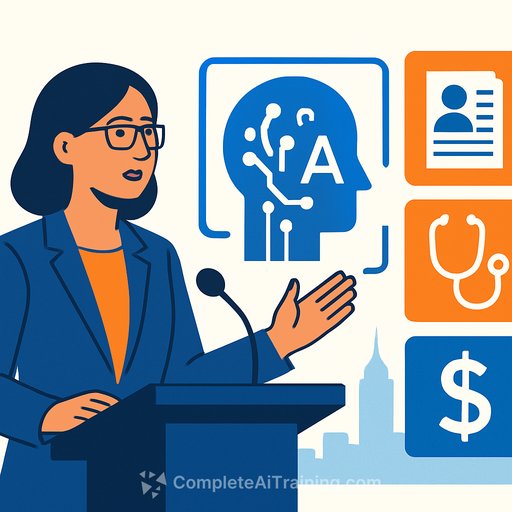
New York's state Senate Internet and Technology Committee held a hearing on the risks and solutions of AI in hiring, health care, and financial services. State Sen. Kristen Gonzalez, chair of the committee and lead sponsor of the New York AI Act, discussed why the state is moving on this. Her district spans Brooklyn, Queens, and Manhattan, covering parts of Astoria, Long Island City, Greenpoint, Williamsburg, Stuyvesant Town, Kips Bay, and Murray Hill.
If you build or deploy AI in New York, this is your heads-up. Compliance work is going to shift from nice-to-have to required.
Why this matters for engineering, data, and product
- Hiring: Expect scrutiny of automated screening, scoring, interview analysis, and ranking systems.
- Health care: Models that touch clinical guidance, triage, or PHI will face strict safety, privacy, and oversight requirements.
- Financial services: Credit, fraud, AML, underwriting, and claims decisions will need auditable fairness, security, and model risk controls.
What the New York AI Act is likely to require (based on current policy trends)
- Risk tiers and impact assessments: Classify systems by use and harm potential; run pre-deployment impact reviews for higher-risk uses.
- Bias and performance testing: Document evaluation data, methods, metrics, and limits. Test across relevant subgroups.
- Transparency: Disclose automated decision use to affected people; provide plain-language summaries and known limitations.
- Human-in-the-loop: Keep human review for significant decisions and offer a contest or appeal path.
- Audit logs and incident reporting: Track dataset versions, prompts, configs, model builds, and decision traces; report material failures.
- Data governance: Source provenance, consent, retention schedules, and deletion. Avoid hidden sensitive inferences.
- Security and red-teaming: Adversarial testing, input/output filtering, jailbreak defenses, and monitoring.
- Vendor accountability: Contracts that mandate evaluation access, change notices, and compliance attestations.
These align with existing frameworks many teams already use, such as the NIST AI Risk Management Framework. If you're not aligned yet, start now.
NIST AI Risk Management Framework
Practical checklist to start this quarter
- Inventory: Create a registry of all AI systems, versions, owners, data sources, and use cases.
- Classify risk: Tag uses as low/medium/high based on impact (employment, health, finance, rights).
- Document: Ship a one-pager per model: purpose, inputs, outputs, safeguards, known failure modes, support contacts.
- Evaluate: Establish repeatable tests (accuracy, calibration, disparity, toxicity, jailbreak). Automate where possible.
- Guardrails: Add policy filters, content classifiers, rate limits, and safe defaults. Log all decisions.
- Human review: Define escalation rules and override authority. Log overrides and outcomes.
- Data controls: Keep PHI/PII out of training unless explicitly allowed. Track consent and retention.
- Vendor due diligence: Require model cards, evaluation reports, SOC2/ISO27001, and change-notice SLAs.
- Red-teams: Schedule adversarial tests pre-release and on every major update.
- User disclosures: Add clear notices and appeal options anywhere automated decisions affect people.
- Incident playbook: Define thresholds, comms, rollback steps, and reporting timelines.
- Training: Brief engineers, data scientists, product, and compliance on policy updates and your internal process.
Notes for high-impact domains
Hiring: New York City already enforces audit and notice rules for automated employment decision tools. If you screen candidates with AI, you should be doing independent bias audits, publishing summaries, and notifying applicants.
NYC Automated Employment Decision Tools (AEDT) guidance
Health care: Keep AI in a support role, not final authority. Separate clinical from non-clinical tooling, restrict PHI exposure, and maintain clear disclaimers and review checkpoints. Track false positives/negatives by cohort, not averages.
Financial services: Treat AI as models under existing model risk policies (e.g., documentation, independent validation, monitoring). Check for ECOA/Fair Lending exposure and keep transparent feature use, especially for proxies.
What to watch next
- Definitions of "high-risk" use and whether they mirror hiring/health/finance or expand to education, housing, and public services.
- Depth of required public disclosures and audit summaries.
- Third-party liability: who is on the hook-developer, deployer, or both.
- Update cadence: how often you must re-test and re-certify after model changes.
Bottom line
The hearing signals where policy is heading. If your team builds with AI, a lightweight governance stack-registry, evaluations, guardrails, human review, and logging-will save time later and reduce risk now.
Upskill your team (optional resources)
- AI Governance for CIOs - governance, policy, and security-focused training for IT leadership.
- AI Learning Path for Regulatory Affairs Specialists - courses on compliance, risk monitoring, and documentation.
- AI Learning Path for Project Managers - practical training for cross-functional governance and project-level risk management.
Your membership also unlocks: