
AI news ·
Sen. Mark Warner seeks public comment on draft legislation to regulate AI agents
Sen. Mark Warner released draft legislation to regulate AI agents and block platform gatekeeping. Virginia Tech also secured a $2.8 million federal energy grant.
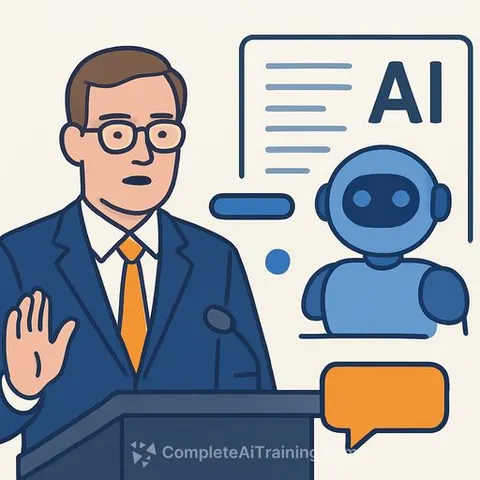
Sen. Mark Warner, D-Va., released draft legislation Monday that would set federal rules for AI agents - autonomous systems that act on behalf of consumers and businesses - and is seeking public comment before formally introducing the bill in Congress. The proposal arrives as these digital go-betweens take on more consumer-facing tasks, and Warner warns that dominant technology platforms could block competing AI agents in ways that limit choice.
The draft bill, called the AI AGENT Act - short for Artificial Intelligence Access, Gatekeeper Exchange and Nondiscriminatory Transfer - would require AI agents to safeguard user privacy and data. It would also enshrine fair competition principles, preventing large gatekeepers from shutting out rival agents and restricting what consumers can choose.
For IT and development teams managing autonomous systems, understanding agent governance is quickly becoming a core skill. AI Agents & Automation training resources cover the fundamentals of building and deploying intelligent agents securely.
"This discussion draft is a major step toward building a clear federal framework that promotes innovation, protects consumers, and ensures the United States continues to lead the world in emerging technology," Warner said in a news release. "I am releasing this draft to hear from stakeholders, experts, and the public so we can strengthen the legislation before it is formally introduced."
Security and data privacy requirements
The draft underscores that verifying trustworthy AI agents is essential for security, both for individual users and the platforms they interact with. While specific technical standards are still under discussion, the legislation would make privacy and data protection mandatory for any AI agent operating in the market.
Regional technology projects receive federal and state funding
Virginia Tech received a $2.8 million award from the U.S. Department of Energy's Advanced Research Projects Agency-Energy (ARPA-E) to develop a power electronics converter that outperforms traditional designs. The project is part of a $35 million ARPA-E campaign aiming to triple U.S. transmission capacity and deliver more resilient, cost-effective energy.
"Virginia Tech leads projects that can transform our electric grid and deliver more reliable energy to American communities," said U.S. Rep. Morgan Griffith, R-Salem. "Such projects are necessary when challenges to our electric grid persist. We must build a resilient energy system to better serve Virginia communities."
Separately, the GO Virginia economic initiative awarded a $61,409 grant to Smyth and Washington counties for the Glade Highlands Regional Industrial Park off Interstate 81. The funds will prepare the last two lots at the site for advanced manufacturing agriculture and logistics businesses. "By advancing a 24-acre parcel into a pad-ready, investment-ready site, the project strengthens regional competitiveness, expands industrial capacity, and aligns with the region's targeted industry sectors," the governor's office said in a June 26 news release.
Why this matters for general, IT and development, government professionals
For IT and development professionals, the AI AGENT Act signals that agent design will soon need to embed privacy and non-discrimination requirements by default. Early familiarity with agent governance can reduce compliance risk as the technology scales. Government professionals see in Warner's approach a model for seeking broad public input before codifying rules - and in the Virginia Tech and GO Virginia grants, examples of strategic federal-state investment in grid modernization and industrial infrastructure. For everyone watching the agent market, the draft legislation offers an early look at the guardrails that will shape how autonomous systems operate in everyday digital life.