AI Is Rewriting Risk Playbooks: What Insurance Leaders Need To Do Now
Risk used to be backward-looking. Now it runs live. Climate, customer, and market data feed into machine learning and generative systems to estimate hazard before it hits. Foresight beats cleanup.
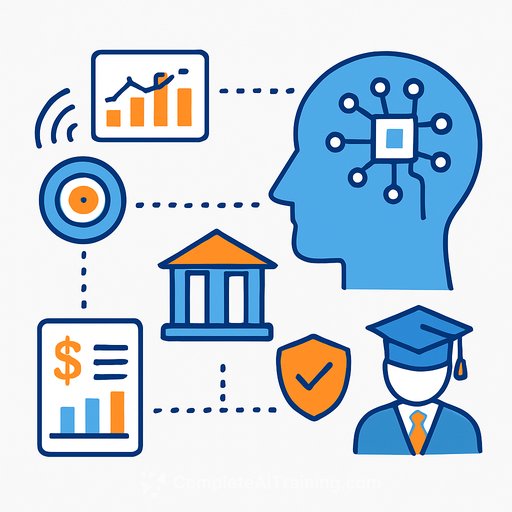
Three pillars anchor this shift: AI-based early warning systems, dynamic pricing and claims, and AI-driven regulatory technology. This isn't theory. It's changing underwriting, reinsurance, and the skill set insurers hire for-right down to what MBA programs should teach.
1) Early warning runs on live, messy data
AI ingests structured and unstructured sources-weather forecasts, sensor feeds, satellite imagery, transactions, and news-and updates risk registers continuously. High-hazard zones and exposed portfolios get flagged early, guiding underwriting, reinsurance, resourcing, and customer communication ahead of a catastrophe.
On the financial side, behavioral credit signals, macro indicators, and sentiment analysis spot emerging borrower or sector stress. That enables intervention now instead of loss recognition later.
- Data stack to prioritize: weather APIs, ESG scores, geospatial layers, credit stress indicators, and sector news streams.
- Use cases to implement: early alerts for perils by region, reinsurance cession triggers, portfolio heatmaps, and pre-event policyholder outreach.
- Governance to add: bias checks on model inputs, transparent feature importance, and clear challenge rights for model owners.
Useful context: climate reference data from sources like NOAA's National Centers for Environmental Information can anchor your hazard baselines.
2) Pricing and claims move with the environment
With real-time exposure, pricing and cover can't sit still. AI combines past loss experience with current conditions, property attributes, and IoT telemetry from smart homes, farms, and industrial sites to estimate event probability and severity at the local level.
Claims now live on the same rail. Models confirm events against meteorological feeds and geospatial footprints, anticipate likely damage, spot anomalies within minutes, and feed triage for decisioning. Faster, more consistent settlements reduce friction and protect trust-especially when premiums rise due to risk repricing.
- Pricing actions: micro-rating by peril and address, dynamic deductibles or limits, and parametric add-ons for clear triggers.
- Claims actions: straight-through processing for low-risk cases, satellite/imagery validation after events, and anomaly screening before payout.
- Controls: fairness tests across ZIPs and demographics, stability monitoring, and human review thresholds for edge cases.
3) RegTech moves from operations to strategy
AI now shortens KYC and AML checks and improves suspicious-activity detection. The bigger leap: mapping new rules to internal controls, issuing early alerts on likely breaches, and scanning transactions and public data for risk concentrations, governance issues, or misconduct.
This is where supervisors are headed too. Global bodies continue to study how AI, climate risk, and financial stability connect. See the BIS work on RegTech/SupTech for direction: BIS RegTech & SupTech.
For teams building or governing these capabilities, consider role-based curricula such as the AI Learning Path for Regulatory Affairs Specialists to align technical implementation with compliance responsibilities.
- Controls to build: automated obligation mapping, evidence capture, and audit trails that explain model decisions in plain language.
- Risk practices: red-team exercises against models, scenario tests with synthetic data, and clear escalation paths for model drift or bias.
- Reporting: unified dashboards that tie model outputs to policy, capital, and conduct outcomes.
Why this belongs in MBA programs (and your in-house academy)
Static caselets don't prepare teams for live risk. Students and analysts need hands-on work with weather feeds, ESG metrics, credit stress signals, and claims data-built into courses that blend climatology, analytics, and regulation. The goal: critique models, surface blind spots, and improve transparency and fairness.
Training managers designing in-house academies can structure curricula around practical, role-based paths-see the AI Learning Path for Training & Development Managers for ideas on upskilling, governance, and ethics training.
- Classroom methods that work: simulations, gamified stress drills, and live datasets for underwriting and claims decisioning.
- Skills to demand: data literacy, ethical reasoning, model risk management, and the confidence to question black-box outputs.
What insurers can implement before 2026
- Stand up an early warning program: ingest hazard, credit, and sentiment feeds; push alerts to underwriting, claims, and comms.
- Enable dynamic operations: location-level pricing refresh cycles, parametric triggers, and claims triage with geospatial checks.
- Upgrade compliance: obligation mapping, AI explainability, and continuous monitoring for bias, drift, and conduct risk.
- Upskill teams: run internal sprints with synthetic data; co-build capstones with B-schools; certify frontline staff on AI ethics and controls.
Want structured learning paths?
For tool stacks used in finance functions, see this resource: AI Tools for Finance.
The takeaway: early warning, dynamic customer-facing operations, and AI-enabled regulatory foresight are converging. Pair technical build-outs with tight governance, keep ethics front and center, and keep a direct line open with customers and regulators. Insurers that do this won't chase risk-they'll anticipate it.
Your membership also unlocks: