
AI news ·
Seoul residents push back against data centers as approvals across Korea decline
Small data centers near Seoul homes have become a political issue, with candidates winning local elections on pledges to block projects. Approved data center permits in South Korea fell from 25 in 2023 to 14 in 2025.
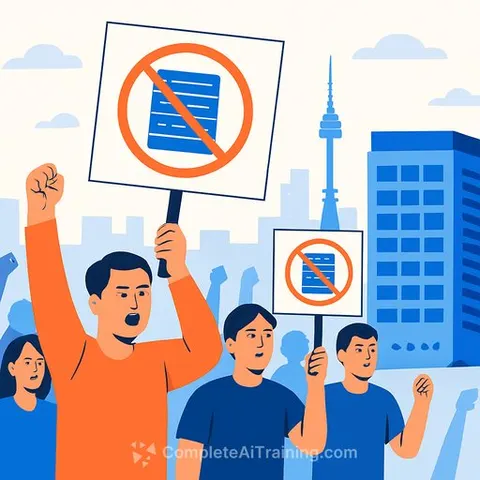
Seoul's Data Centers Become Election Issue as Residents Fight Back
South Korea's urban planners are facing a new political problem: small data centers in residential areas. During last week's local elections, several candidates in the Greater Seoul region pledged to block or intervene in ongoing projects, and some won their races.
The conflict centers on facilities far smaller than hyperscale operations. A planned 4.98-megawatt data center in Geumcheon-gu, southwestern Seoul, has become the most visible flashpoint. Construction began in October despite resident opposition to the facility, which sits less than 100 meters from an apartment complex.
The Geumcheon-gu Case
In March, the developer filed police complaints against three residents, accusing them of spreading false information and obstructing business operations. Two cases were resolved through mediation. One remains under investigation.
Residents cite electromagnetic fields, fire risks from electrical infrastructure, and noise as primary concerns. They also argue local authorities failed to gather adequate public input before approving the project.
The developer says safety assessments are complete. The district office has largely stayed neutral, saying no clear legal grounds exist to block a data center of this size.
Geumcheon-gu Mayor-elect Choi Ki-chan promised action. "On the first day of my term, I will process measures to improve the institutional framework surrounding data center construction and establish a permanent resident participation body," he said in May.
A Wider Pattern
Similar disputes have erupted in Yeongdeungpo-gu in Seoul and Michuhol-gu in Incheon. In Goyang, Gyeonggi Province, a National Assembly representative shaved his head in protest in 2024.
Approved data center projects in South Korea dropped sharply-from 25 in 2023 to 14 in 2025, according to real estate consultancy Rsquare.
The Safety Question
Experts say resident fears are often overstated. Park Jong-bae, a professor of electrical engineering at Konkuk University, told local media that electromagnetic wave impacts from data centers are "extremely limited" and that government reviews prevent excessive emissions or power consumption problems.
Other experts point to a communication gap. Yoo Seung-hoon, a professor at Seoul National University of Science and Technology, said residents need clearer information on safety assessments, noise levels, and fire prevention.
He suggested a different approach: "Data centers should move toward a benefit-sharing model that coexists with local communities, such as supplying district heating using waste heat from facilities and opening cultural or educational spaces within the centers."
The Business Case
Data centers closer to users are becoming critical infrastructure for Korea's digital economy. Faster data transmission matters increasingly for AI services, cloud computing, and online platforms.
But winning local approval has become harder. Developers now face organized resident campaigns, legal complaints, and elected officials campaigning on blocking projects.