
AI news ·
Serbia uses artificial intelligence as political theatre without legal scrutiny
Serbia deployed two AI robots at a rally despite lacking domestic laws, contradicting its pledges to 44 states. This exposes a legal vacuum regarding government AI use.
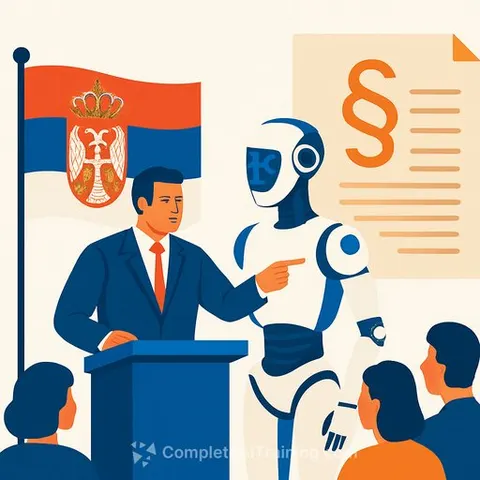
On June 27, 2026, two robots dressed in traditional Serbian folk costumes danced the Moravac at a rally of the ruling Serbian Progressive Party in front of the national parliament. The spectacle, organized to project political strength amid year-long student protests, inadvertently exposed a deeper reality: Serbia's government deploys artificial intelligence as political theatre, with no legal framework governing its use in public.
Thousands were bussed to Belgrade to demonstrate President Aleksandar Vucic's ability to summon a crowd. Robots Milutin and Dragutin performed the choreographed folk dance before the audience, but the questions that should follow such a public AI deployment remained unasked. As BIRN observed: "Nobody asked who built the robots, who owns the data they generate, or what legal framework governs their use in public. Indeed, there is no easy answer to the question 'Who governs AI in Serbia, and in whose interest?'"
Serbia's international AI ambitions
The country has simultaneously positioned itself as a regional AI leader. Its diplomatic record includes:
- Holding the presidency of the Global Partnership on Artificial Intelligence from late 2024 through 2025.
- Hosting a Ministerial Declaration on AI in December 2024, backed by 44 states, committing to safe, secure, and trustworthy AI development.
- Adopting an AI strategy earlier than any neighbour, drafting ethical guidelines for responsible use, and tasking a working group to produce the country's first AI law.
Practice diverges from promises
Beneath that regulatory surface, the practice tells a different story. The dancing robots were deployed without asking basic legal questions about data ownership, public safety, or liability. While a working group drafts an AI law, the current approach treats AI for Government as a stage prop, free from the scrutiny and rules that legal frameworks demand.
The gap between Serbia's international pledges and its domestic reality is not just a curiosity. It shows that diplomatic declarations and ethical guidelines mean little if they are not backed by enforceable statutes. For businesses and citizens, the absence of clear rules on AI data, accountability, and government use creates legal uncertainty.
Why this matters for legal professionals
For lawyers and compliance officers tracking AI for Legal developments, the Serbian case is a concrete warning. International AI agreements and regional leadership claims do not automatically translate into binding domestic law. When a government uses AI in public without defining data ownership, consent, or liability, the resulting legal vacuum exposes both public agencies and private entities to risk. The robots' dance was entertaining, but for legal practice, the real lesson is that regulatory substance cannot be replaced by spectacle.