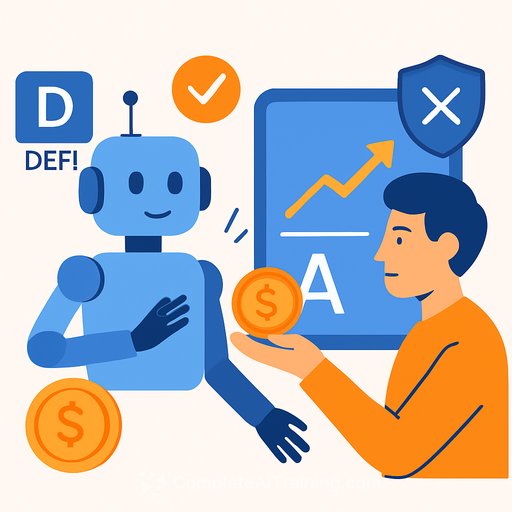
Million-Dollar Mistakes Loom as AI Agents Enter Digital Finance
The idea of texting a command and having a bot execute a complex trade is here. In decentralized finance, autonomous AI agents are shifting from prompt-followers to independent actors that place, monitor, and settle trades end to end.
This is a big unlock for speed and coverage. It also multiplies risk if you don't set hard boundaries.
From prompts to autonomous execution
Developers are shipping infrastructure that lets a user say, "swap my ETH to USDC if ETH drops below 2000," and let the machine handle the rest. As one interviewer put it: "You just say that to your agent and your agent just does it. No more worry."
The catch: removing friction removes guardrails. If the agent executes exactly what it's told-without constraints-you can scale a small mistake into a catastrophic one.
Blockchain is the money of machines
These agents won't wire funds through banks. They settle on-chain because wallets, liquidity, and finality are programmable. Toolkits like OKX's OnchainOS now stitch wallets, DEX routing, and market data into one stack, and its x402 pay-per-use protocol aims to let agents initiate and settle with zero gas on X Layer.
That means no human is manually approving price feeds, gas estimates, or route selection. The rails do it. For background, see Ethereum's overview of DeFi and OKX X Layer.
The "fat finger" problem now scales
Aya Kantorovich put it plainly: when UX is simple and parameters are loose, risk is amplified. Lever-looping 100 times instead of 10. Typing 1,000 instead of 1. An agent could push out hundreds of millions in BTC before a human notices.
The fix: strict risk parameters. Whitelist only what the agent can do. Set hard limits on prices, notional, leverage, venues, and actions. Assume the worst input will eventually be typed.
Risk parameters every finance team should enforce
- Scope whitelist: Explicitly allow only certain functions (e.g., swap, hedge, rebalance) and approved protocol addresses. Deny everything else by default.
- Notional caps: Max per-order, per-asset, per-day, and per-agent exposure. Include portfolio concentration limits.
- Price and slippage limits: Hard bounds on limit prices, max slippage, and min liquidity thresholds. Enforce TWAP/median oracle checks.
- Leverage and "looping" controls: Cap leverage, nesting depth, and number of sequential refinancing or re-collateralization steps.
- Frequency and concurrency: Rate-limit orders and cap concurrent transactions to contain blast radius.
- Venue allowlist: Approved DEXs/bridges only. Block unvetted or thin-liquidity pools.
- Fee and gas budgets: Max gas/fee per transaction and per period, even on "zero gas" L2s where other costs still apply.
- Time bounds: Order expiry, trading session windows, and cooling-off periods after large PnL swings.
- Two-person rule for size: Dual approval above thresholds; require human sign-off for withdrawals and cross-chain moves.
- Kill switch and circuit breakers: Halt on slippage breaches, oracle divergence, or VaR drawdown limits.
- Custody controls: Multi-sig wallets, withdrawal address whitelists, and staged settlement queues.
- Data and oracle hygiene: Multiple price sources, anomaly detection, and fallback behavior on data gaps.
- Audit trail: Immutable logs of prompts, state, quotes, decisions, and fills. Make every action explainable and replayable.
- Testing gates: Unit tests, simulation, and paper-trade sandboxes before mainnet. Block mainnet until checks pass.
Compliance isn't optional
- KYC/AML and sanctions screening: Counterparty and address screening, including OFAC blocks on both sides of a swap or bridge.
- Segregation of duties: Separate code changes, parameter edits, and approvals. Map to SOX-style controls for public companies.
- Reporting and retention: Archive orders, fills, and decision logs; support audit and regulatory reporting.
- Incident playbooks: Defined response paths for oracle failure, stuck settlements, smart contract risk, and key compromise.
Performance upside is real-if you keep a human in the loop
Kantorovich noted a 30% lift in team efficiency from AI tooling. The tech acts as a force multiplier, not a wholesale replacement.
The edge comes from speed plus a human-controlled review console. Let agents scan, route, and draft. Let humans approve size, risk, and exceptions.
Practical rollout plan
- Start narrow: One asset pair, tight notional caps, strict slippage limits.
- Build the console: Real-time PnL, exposure, VaR, queue, and a one-click kill switch.
- Simulate first: Backtest with stress scenarios and chaos tests (oracle delays, wide spreads, L2 congestion).
- Stage releases: Paper trade → small mainnet size → gradual scale with post-trade reviews.
- Parameter governance: Change control with approvals, versioning, and automatic reverts on anomalies.
Bottom line
AI agents are ready to execute. Without hard limits, they'll execute your mistakes faster than you can type "undo." Put policy in code, keep oversight human, and scale only after the system proves it can protect itself-and you.
For deeper context on applying AI in trading and risk, explore AI for Finance. Finance leaders setting governance for autonomous systems may find the AI Learning Path for CFOs useful.
Your membership also unlocks: