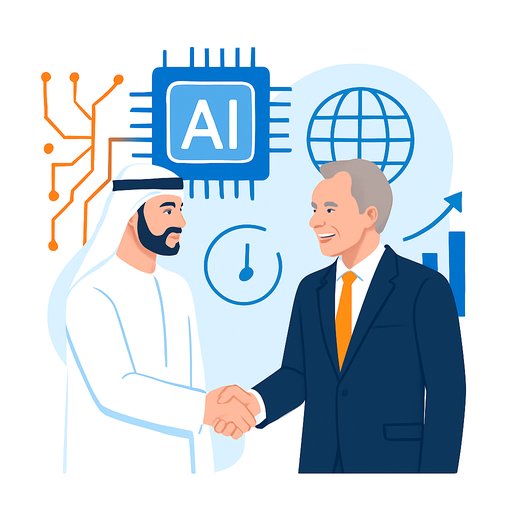
AI, energy, and government efficiency: takeaways from Sheikh Tahnoon's meeting with Tony Blair
Sheikh Tahnoon bin Zayed, Deputy Ruler of Abu Dhabi and National Security Adviser, met former UK prime minister Tony Blair to discuss advanced technologies with a clear emphasis on artificial intelligence. The conversation centered on how AI can improve government efficiency, strengthen decision-making, and support economic sustainability through the energy sector. They also compared approaches to building more resilient, future-ready public services.
Why this matters for public-sector leaders
Abu Dhabi is moving toward a service-based economy backed by AI and advanced tech, powered by the Government Digital Strategy 2025-2027. About Dh13 billion ($3.53 billion) is being deployed through 2027 to accelerate AI adoption across government. From January 2026, the National Artificial Intelligence System will serve as an advisory member of the Cabinet, supporting policy analysis and decisions. A new federal strategy cycle is placing AI at the core of planning and service delivery.
Key signals to track
- AI moves from pilots to core infrastructure: decision support, service delivery, and policy design.
- Budgets and mandates are in place, reducing friction for inter-agency data and AI projects.
- Energy remains a strategic anchor, with data and AI improving reliability, forecasting, and sustainability outcomes.
- Expect stronger governance, auditability, and shared standards across ministries.
What to do next in your department
- Prioritize 3-5 high-friction services (permits, benefits, casework) and define measurable outcomes: cycle time, accuracy, user satisfaction, cost per case.
- Stand up a decision-support workbench: policy simulations, impact analysis, and scenario testing with clear audit trails.
- Get data ready: inventories, quality checks, access controls, retention rules, and secure data-sharing agreements.
- Establish guardrails: acceptable-use policy, human-in-the-loop review, bias testing, and red-teaming before go-live.
- Adopt an "operate small, prove value" approach: 90-day pilots, weekly metrics, expand only after benefits are verified.
- Procurement fast-lane: pre-approved model providers, clear SLAs, security questionnaires, and sandbox environments.
- Model risk management: classify use cases by impact, require model cards, versioning, and performance monitoring.
- Interoperability first: APIs and shared schemas so solutions don't get stuck inside one agency.
- Cyber and privacy baked in: encryption, role-based access, PII minimization, and data-loss prevention on day one.
- Upskill teams: policy analysts, service owners, and IT should share a common AI vocabulary and playbook.
Practical use cases you can implement now
- Citizen service agents that summarize case history and auto-draft responses (with staff approval).
- Smart triage for benefits and permits to reduce backlog and flag edge cases for expert review.
- Policy co-pilots that surface prior rulings, evidence, and forecasted outcomes before decisions are made.
- Fraud and anomaly detection for grants, subsidies, and procurement.
- Inspection and maintenance scheduling optimized by risk and impact, especially across energy and utilities.
- Document summarization and translation for faster cross-agency collaboration.
- Demand and revenue forecasting to support energy planning and economic stability.
Governance and accountability checklist
- Documented purpose and limits for each AI use case; clear "off-ramps" to human review.
- Bias, accuracy, and privacy testing pre-launch and on a set cadence.
- Audit logs for prompts, outputs, and decisions; retention rules that match policy.
- Procurement clauses covering data ownership, IP, security, uptime, and model updates.
- Content provenance where possible (watermarking/signatures) for public-facing outputs.
- Regular red-teaming and stress tests against adversarial prompts and data leakage.
Context and further reading
For background on Tony Blair's policy and technology work, see the Tony Blair Institute for Global Change. For UAE policy context, review the official UAE AI Strategy.
Build capability inside your team
If you're standing up AI projects or need role-based upskilling for government functions, explore structured learning paths here: AI courses by job role. For strategic leaders focused on governance and decision-making, see AI for Executives & Strategy. For a quick scan of what's current, check the latest AI courses.
Your membership also unlocks: