
AI news ·
Sheriff considers contempt of court after AI hallucinations surface in Kirkcaldy case
A Scottish court case saw a litigant in person cite fictitious AI-generated legal citations. The sheriff warned that lodging false references obstructs justice and wastes court time.
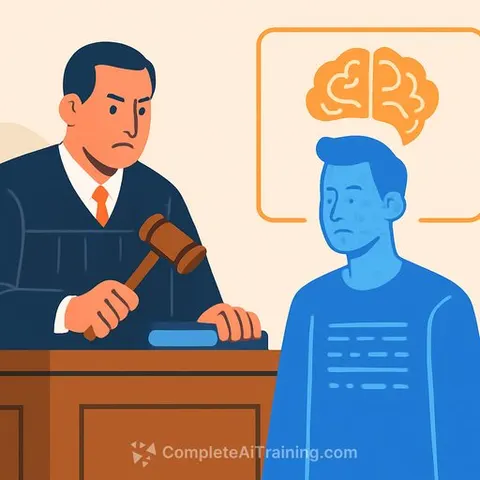
A Scottish court case where a litigant in person relied on fictitious AI-generated legal citations has thrown a spotlight on the growing risk of artificial intelligence hallucinations disrupting conventional court procedure. The case, Your Home Partners v Kellichan and Hood [2026] SC KDY 34, saw chaos unfold when the pursuer disputed the court's clarification of the statutory position and cited case law and legislation that did not exist.
The court could not locate the references for an excellent reason - they were invented. The pursuer claimed to have found the material "using online Artificial Intelligence in good faith." The sheriff noted that lodging false legal references "has the potential to obstruct justice," wastes court time, and misleads the court.
No routine screening for AI fabrications
AI hallucinations - where generative tools produce plausible but entirely false content - are a well-documented risk. Yet courts do not appear to have in place any detection or screening system to flag fictitious case law and legislation. The Courts and Tribunals Judiciary AI Guidance for Judicial Office Holders (October 2025) suggests judges apply their instincts and look for clues - submissions that use US spelling may hint that a litigant used AI.
Unqualified parties now have access to technology that researches the law and drafts writs, defences, and other litigation documents competently given the right prompts. The prevalence of AI use among lay court users is unclear but likely very common and increasing. Lawyers are officers of the court, heavily regulated and bound by professional duties. Laypersons face none of those constraints and are far harder to sanction.
Kirkcaldy chaos and a duty to verify
In the Kirkcaldy case, the sheriff considered contempt of court and referred to R (Ayinde) v Haringey LBC (DC) [2025] 1 WLR 5147. That ruling held that those who use AI for legal research "have a professional duty therefore to check the accuracy of such research by reference to authoritative sources, before using it in the course of their professional work."
Laypersons, however, bear no professional duty. Lord Justice Baker acknowledged the bind in D (A Child) Recusal [2025] EWCA Civ 1570: "Litigants in person are in a difficult position putting forward legal arguments. It is entirely understandable that they should resort to artificial intelligence for help." He added a clear warning: "All parties - represented and unrepresented - owe a duty to the court to ensure that cases cited in legal argument are genuine and provide authority for the proposition advanced."
The ease with which AI generates answers creates a seductive illusion of infallibility. When a litigant in person relies on that output, the absence of access to traditional law libraries or paid databases leaves them with no practical way to verify what the AI has produced. Legal professionals looking to avoid similar pitfalls can benefit from specialised AI for Paralegals training that covers verification of AI-generated legal research.
The leveller that leaves gaps
Andrew Stevenson, Secretary of the Scottish Law Agents Society, pointed to the unevenness of the situation: "One problem remains, however; it is a little harsh to forgive party litigants for using generative AI but complain when they then lack the access to traditional sources to verify it." His comment highlights a tension the courts are only beginning to confront.
Meanwhile, the rising use of AI for Legal tasks by laypersons creates new procedural challenges that existing safeguards were not designed to handle. Without routine AI detection alongside clear, enforceable obligations on unrepresented parties, the risk of fictitious material entering the record will grow.
Why this matters for legal professionals
Spurious citations waste time, threaten the fairness of proceedings, and can lead to serious consequences including contempt findings. Lawyers must proactively verify every AI-drafted document and submission, because opponents and litigants in person may not. Courts are already signalling that ignorance of an AI's fabrication will not excuse misleading the tribunal - whether you are a solicitor or a self-represented party.