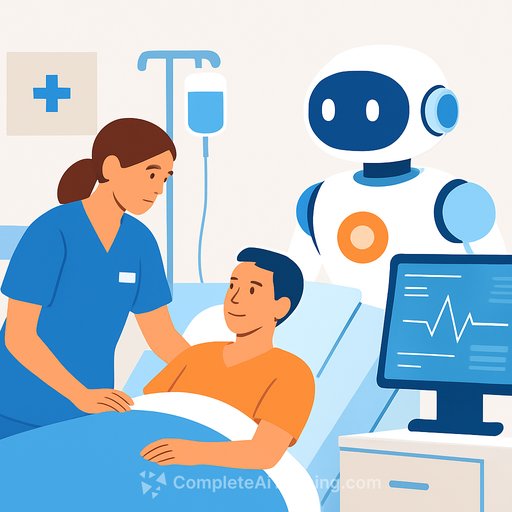
Tennessee hospitals turn to AI to tackle staffing woes and improve patient care efficiency
Hospitals across Tennessee are adopting AI to speed clinical decisions, reduce administrative drag, and help strained teams deliver safer care. The early focus: time-critical conditions, discharge planning, and bedside monitoring.
Faster stroke care at TriStar Skyline
TriStar Skyline Medical Center, the state's first Comprehensive Stroke Center, has implemented an FDA-cleared imaging platform that quickly analyzes brain scans and flags stroke-related abnormalities for the care team. The goal is clear: cut time to treatment and improve functional outcomes.
Neurologist Dennis Cole, MD, who leads the Neurosciences Program, said the system helps clinicians read imaging faster, "which can lead to improved outcomes when it matters most." With stroke occurring about every 40 seconds in the U.S., shaving minutes off decisions can be the difference between independence and disability.
Smoother discharge decisions in West Tennessee
West Tennessee Healthcare is piloting Dragonfly Navigate from Franklin-based Xsolis to support case managers. The tool synthesizes clinical and utilization data to guide discharge readiness, post-acute placement, and transitions to home health or skilled nursing.
Expectations are simple: fewer delays, clearer criteria, and better alignment between clinical status and next site of care-especially useful on units with high patient turnover.
Vanderbilt's push: clinical quality and workforce relief
Vanderbilt University Medical Center launched the ADVANCE Center to integrate AI across patient care, research, and training. Alongside that, an AI committee is targeting nursing shortages with tech that supports continuous monitoring and helps prevent avoidable harm.
"Adoption will be a little hard, but once people get it, they'll not work some place that doesn't have it," said Robin Steaban, chief officer of Vanderbilt's adult hospital. The intent is to give nurses more time at the bedside by offloading basic monitoring tasks and surfacing the right signal at the right moment.
What this means for clinical teams
- Acute pathways: Faster imaging reads can reduce door-to-needle and door-to-groin times. Establish baselines now to show impact later.
- Discharge planning: Decision support for case managers can lower avoidable days and improve post-acute fit. Standardize criteria and document rationale.
- Safety and monitoring: Continuous observation tools can help reduce falls and other preventable injuries. Define clear escalation protocols.
- Admin load: AI that summarizes data or flags utilization issues can free up hours each week. Track time saved and redeploy to direct care.
Implementation playbook (quick start)
- Choose measurable use cases: Stroke activation, discharge delays, falls-problems with clear metrics and high impact.
- Governance and guardrails: Validate outputs, monitor bias, and keep a human-in-the-loop for final decisions.
- Integrate with the EHR: Reduce swivel-chair workflows. Surface insights in the clinician's line of sight.
- Train the team: Short scenario-based training beats long manuals. Share quick wins early.
- Measure and iterate: Track clinical outcomes, length of stay, preventable harm, and staff satisfaction.
FDA: AI/ML-enabled medical devices
Upskilling for leaders and frontline staff
If your unit is piloting AI or you're planning a rollout, building team literacy shortens the learning curve and reduces resistance. For structured learning by role, see AI courses by job at Complete AI Training. For teams focused on evidence and methods, consider the AI Research Courses.
Bottom line for healthcare teams in Tennessee: focus AI where seconds matter, where handoffs break, and where staffing is tight. Measure relentlessly, keep clinicians in control, and scale what proves safe and useful.
Your membership also unlocks: