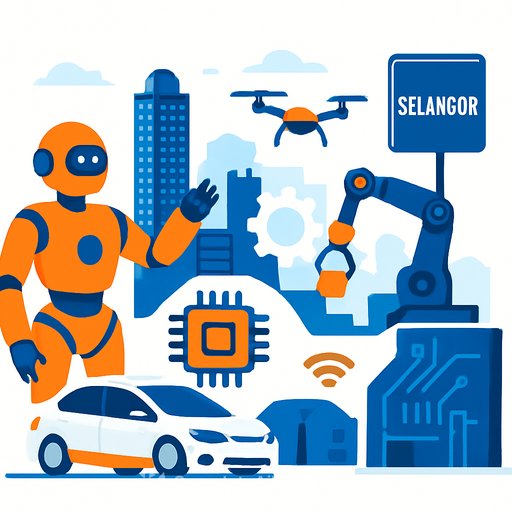
Sidec Steps Up Focus on Physical AI: What It Means for Developers and Engineers
Selangor's digital agency, Sidec, is doubling down on Physical AI across automotive, robotics, and next-gen mobility with a strong push into the low-altitude economy. The plan centers on an advanced AI System-on-Chip (AI-SoC) and a 3-in-1 platform spanning vehicles, robots, and drones. The message is clear: build, test, and deploy real systems that move, sense, and decide in the physical world.
The core: AI-SoC and a 3-in-1 platform
Sidec is backing an AI-SoC that supports cross-domain deployment-cars, robotics, and unmanned systems-under one platform. The focus includes autonomous driving stacks, EV platforms, drones, and eVTOL systems, with an emphasis on low emissions and practical rollouts. For dev teams, this suggests a unified toolchain and model portability across edge hardware.
Testbeds, sandboxes, and real-world validation
Selangor is preparing testbeds and sandboxes for autonomous vehicles, including robotaxis and commercial autonomous transport. Suitable locations have been identified for phased deployment, and relevant agencies will be engaged to support implementation. Translation for builders: expect pathways to pilot, gather telemetry, and iterate with regulators in the loop.
Talent pipeline: semiconductors and IC design
Sidec highlighted a collaboration between the Advanced Semiconductor Academy of Malaysia and the Indian Institute of Technology Madras to grow talent in semiconductors and IC design. The training focus aligns with automotive, robotics, and intelligent mobility needs. If you're a developer stepping into hardware-aware AI, this is timely reskilling territory. Learn more about IIT Madras at iitm.ac.in.
Low-altitude economy: drones and eVTOL
The initiative places special weight on low-altitude systems-think drones for logistics and inspection, plus eVTOL for future mobility. This opens up workstreams in perception, flight controls, mission planning, UTM/UTM-like services, and safety cases. For broader context on urban air mobility, see NASA's overview here.
Ecosystem progress and semiconductor footprint
Since inception, Sidec says it has supported 380+ companies with funding access, mentorship, and market entry. Accelerator programs-Triple X Accelerator, Retail-X, Deep-X, and Token-X-were strengthened to serve startups at different stages and across newer tech fronts. On top of that, Sidec expanded into semiconductors with two Malaysian Semiconductor IC Design Parks in Puchong and Cyberjaya.
Those parks currently host 15 companies and 261 engineers, reinforcing Selangor's position across the semiconductor value chain. The moves align with the National Semiconductor Strategy and signal a push for high-value engineering jobs and industry participation.
What this means for IT and development teams
- Edge AI on wheels/wings: Expect work on perception (multi-sensor fusion), planning/control, and real-time inference on constrained hardware.
- Unified deployment: Build once, adapt across automotive, robotics, and drones through a shared AI-SoC toolchain and runtime.
- Safety and compliance: Prepare for functional safety (ISO 26262), SOTIF (ISO/PAS 21448), and aviation/drone ops standards. Sandbox access should speed up validation.
- Data engines: You'll need repeatable pipelines for sim, replay, labeling, continuous training, and model QA-especially for edge-case handling.
Suggested stack and skills to prioritize
- Perception and inference: PyTorch → ONNX → TensorRT/TVM; quantization/compilers aligned with the AI-SoC; real-time I/O (GMSL, CAN, MAVLink).
- Middleware and controls: ROS 2, DDS, PX4/ArduPilot, AUTOSAR Adaptive, RTOS where required; trajectory planning, state estimation (EKF/UKF), MPC.
- Mapping and localization: SLAM (Lidar/Visual), HD maps, V2X readiness; robust logging and time sync for replay.
- Safety, security, and DevOps: ISO 26262 basics, cybersecurity (secure boot, TEEs), OTA, SBOM, and model governance.
- Semiconductor basics: NN accelerators, memory bandwidth trade-offs, quantization effects, profiling kernels, and power budgets.
How to get ready for the Selangor sandboxes
- Package a minimal, safe demo: clear ODD, fallback behaviors, geofencing, and a test checklist.
- Instrument everything: synchronized sensors, deterministic logging, and quick-turn replay for triage.
- Prove the basics first: perception KPIs, latency ceilings, and fail-safe triggers before complex scenarios.
- Bring a compliance narrative: hazard analysis, change logs, and traceability from requirements to tests.
Opportunities for startups and teams
- Domain-specific autonomy modules for logistics, agriculture, inspection, or campus transit.
- Tooling for data ops, simulation frameworks, and safety case automation.
- Custom accelerators or optimized operators for the AI-SoC toolchain.
- Skilling platforms for semiconductor and edge AI engineering.
If you're building skills for edge AI, autonomy, or semiconductor-aware development, explore the AI Learning Path for Software Engineers. Organizations and training leads planning skilling programs can review the AI Learning Path for Training & Development Managers.
Bottom line: Selangor is setting up the infrastructure-chips, sandboxes, and talent-to ship real Physical AI systems. For developers, this is a window to move ideas out of slides and into the street, the warehouse, and the sky.
Your membership also unlocks: