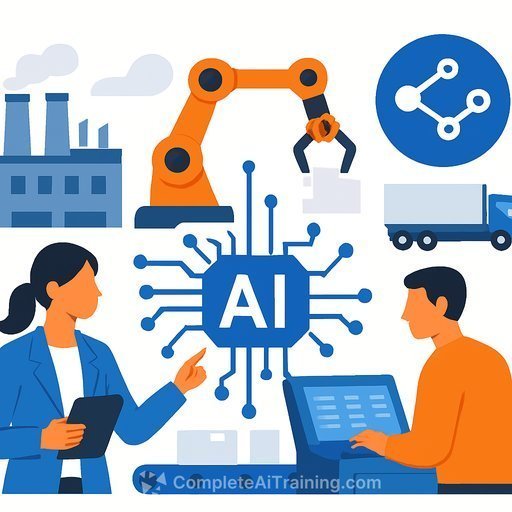
Siemens and Nvidia are building an Industrial AI operating system: What operations leaders need to know
Siemens and Nvidia are expanding their partnership to bring industrial and physical AI into day-to-day operations. The goal: an Industrial AI operating system that spans design, production and ongoing optimization. Nvidia brings AI infrastructure, simulation libraries, models, frameworks and blueprints. Siemens brings hundreds of industrial AI experts, plus its hardware, software and data footprint.
Roland Busch, Siemens president and CEO, says: "Together, we are building the Industrial AI operating system - redefining how the physical world is designed, built and run - to scale AI and create real-world impact."
Jensen Huang, Nvidia founder and CEO, adds: "Generative AI and accelerated computing have ignited a new industrial revolution, transforming digital twins from passive simulations into the active intelligence of the physical world."
What's actually new
- AI-accelerated factories: An "AI Brain" connects software-defined automation, Siemens industrial operations software and Nvidia Omniverse + AI infrastructure to analyze digital twins, test improvements and push validated changes to the shopfloor.
- First blueprint site: Siemens Electronics Factory in Erlangen, Germany, targeted for 2026 as the initial model for fully AI-driven, adaptive manufacturing.
- GPU acceleration at scale: Siemens plans full GPU acceleration across its simulation portfolio, with expanded support for Nvidia CUDA-X libraries and AI physics models to run larger, more accurate simulations faster.
- Generative simulation: Moving toward autonomous digital twins using Nvidia PhysicsNeMo and open models for real-time design and autonomous optimization.
- EDA acceleration: Integrated CUDA-X, PhysicsNeMo and GPU acceleration across Siemens' EDA tools targeting 2-10x speedups in verification, layout and process optimization, plus AI-assisted layout guidance, debug and circuit optimization.
- AI factory blueprint: Joint design for next-generation AI factories balancing computing density with power, cooling, automation and lifecycle efficiency.
- Early evaluators: Foxconn, HD Hyundai, Kion Group and PepsiCo are already assessing capabilities.
Why this matters for Operations
- Faster commissioning, lower risk: Test changes in the twin, deploy what works, shorten ramp times and reduce downtime during transitions.
- Continuous optimization: Close the loop from engineering to production with always-on monitoring and simulation-driven improvements.
- Resilience and sustainability: More flexible lines, better energy and throughput planning, and fewer surprises when shifting products or volumes.
- Decision speed: Real-time insights drive quicker, more confident calls at the line, cell and plant levels.
How the "AI Brain" plays on the floor
Think of it as a control loop tied to your digital twin. The system analyzes live data, runs virtual tests against physics-informed models, and recommends or executes changes after validation. You get shorter cycles from idea to implementation and fewer production hiccups.
Key tech signals you shouldn't ignore
- Omniverse for industrial simulation: Library-based simulation becomes the hub for cross-team collaboration and scenario testing. Learn more
- CUDA-X everywhere: GPU acceleration across Siemens simulation and EDA stacks points to larger models, better fidelity and faster results. See CUDA-X
- Physics-informed AI: PhysicsNeMo and AI physics models push toward autonomous digital twins that can propose and validate changes.
- EDA gains feed the factory: Faster chip design and verification can shorten upstream cycles and stabilize supply for your equipment and components.
Impact areas to scope now
- Commissioning and changeovers: Simulate and pre-validate PLC logic, robot paths and quality thresholds before touching the line.
- Throughput and yield: Use twin-driven tests to tune buffers, schedules and maintenance intervals without halting production.
- Energy and cooling: Treat compute density and facility infrastructure as one system; plan for load, heat and redundancy early.
- Workforce readiness: Upskill technicians and planners to read twin outputs, interpret model suggestions and approve changes. See the AI Learning Path for Process Engineers.
90-day action plan for Ops leaders
- Audit your digital twin maturity: What assets are modeled today? What data streams are connected? Where are the blind spots?
- Pick one high-impact pilot: Commissioning or changeover is usually the fastest win. Define a narrow scope, clear success criteria and a rollback plan.
- Stand up the data backbone: Ensure clean, timestamped telemetry from machines, MES, QMS and maintenance systems into your twin.
- Evaluate GPU capacity: Map current and near-term needs for sim workloads; plan for on-prem, edge or cloud acceleration.
- Create a "model approval" protocol: Decide who validates model outputs and how changes move from sim to production safely.
KPIs to watch
- Time-to-commission (new line, new product)
- Changeover duration and first-pass yield after change
- Unplanned downtime and mean time to recover
- Throughput per shift and OEE
- Energy per unit and cooling utilization
- Simulation-to-implementation cycle time
Risks and dependencies to manage
- Integration complexity: PLCs, MES and legacy systems need reliable bi-directional data flows.
- Data quality and governance: Garbage in, garbage out. Define owners, standards and audits.
- Model drift and validation: Periodically re-validate AI and physics models against real outcomes.
- Capacity constraints: GPU availability, cooling and power must be planned with Facilities.
- Change management: Operators need clear playbooks and confidence in model-backed changes.
Who's moving first
Foxconn, HD Hyundai, Kion Group and PepsiCo are already evaluating the stack. The Siemens Electronics Factory in Erlangen is set to be the first fully AI-driven, adaptive site blueprint in 2026.
Bottom line
This is a practical path to shorten cycles from idea to implementation, reduce commissioning risk and keep tuning processes without sacrificing uptime. If you lead operations, start with one pilot tied to a measurable KPI, build the data foundation, and develop a clear approval flow from sim to shopfloor. The teams that treat the digital twin as an active control partner will set the pace.
Upskill your team
If you're building capability around industrial AI, simulation and automation workflows, explore role-based options: AI Learning Path for Technology Managers.
Your membership also unlocks: