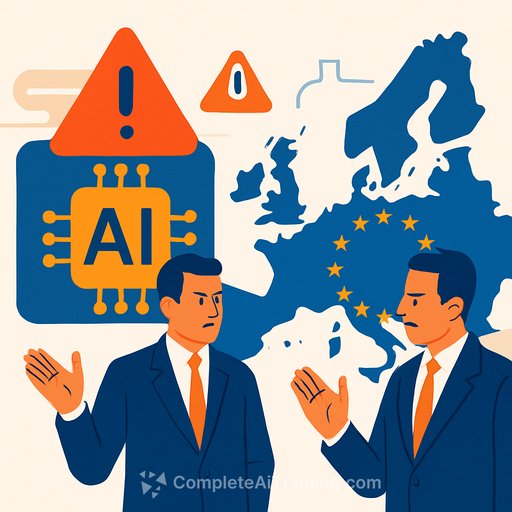
Siemens and SAP CEOs Criticize EU AI Legislation for Hindering Innovation
The CEOs of Siemens and SAP have voiced strong concerns over the European Union’s current artificial intelligence (AI) regulations, arguing that the laws are obstructing innovation and weakening Europe’s position in the digital economy. In an interview with Frankfurter Allgemeine Zeitung, Siemens CEO Roland Busch and SAP CEO Christian Klein called for a comprehensive revision of the EU AI Act and related regulatory measures.
Busch highlighted the complexity and contradictions within the EU’s data and AI rules as a major barrier to progress. He specifically labeled the EU’s Data Act, which regulates corporate and consumer data usage, as “toxic” for fostering viable digital business models.
Regulatory Frameworks Creating Barriers
The AI Act, enacted last year, categorizes AI systems by risk level and sets security and transparency standards accordingly. While the goal is to protect users and promote ethical AI development, Busch and Klein contend that the framework is instead slowing technological advancement across Europe.
Busch also distanced himself from a recent open letter signed by major tech companies like Alphabet and Meta that called for a delay in implementing the AI rules. He argued that the letter’s proposals do not sufficiently address the fundamental problems embedded in the legislation.
Data Access Over Infrastructure
SAP’s Klein emphasized that Europe’s challenges are not primarily linked to insufficient data infrastructure, as seen in the US. Instead, he pointed to restrictive data access rules as the main obstacle. “Infrastructure shortages are not the main barrier in Europe,” Klein said. “We need to reform data access rules first.”
Busch added that Europe sits on a vast amount of valuable data but lacks effective mechanisms to leverage it. “It’s not access to computing capacity that we’re currently lacking, but the release of resources,” he explained.
Implications for Legal Professionals
For legal practitioners working with AI and data compliance, these critiques signal a need to monitor evolving EU regulations closely. The tension between protecting rights and enabling innovation remains a central challenge. Understanding the nuances of the AI Act and the Data Act is vital for advising clients on compliance and strategic data use.
As debates continue over regulatory reform, staying informed about legislative changes will help legal professionals guide businesses navigating this uncertain environment.
Your membership also unlocks: