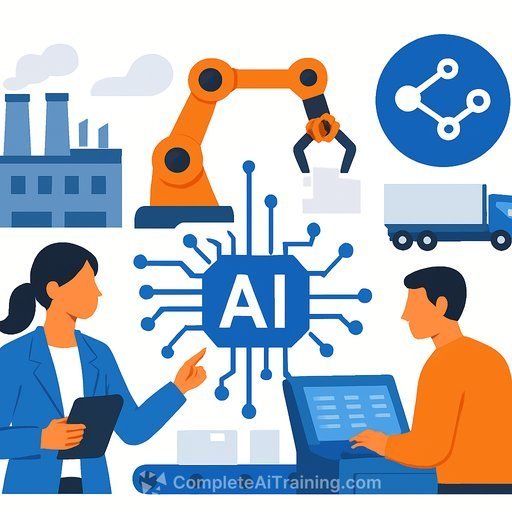
Siemens deepens Nvidia AI pact and unveils digital twin tools
Siemens expanded its work with Nvidia and laid out a bigger industrial AI push built around an "Industrial AI Operating System." The scope runs end to end: product development, engineering, manufacturing, operations, and supply chains. The companies framed it as software plus AI on top of the needed compute, with specifics tied to Siemens' product roadmap rather than fresh commercial terms.
Why this matters for product development
- Unified thread from concept to factory: Expect tighter handoffs between design, simulation, and shop-floor execution. That reduces iteration waste and shortens loops between engineering changes and actual throughput.
- AI in the workflow, not bolted on: Siemens is positioning AI inside existing processes-requirements, CAD/CAE, process planning, and operations-so value shows up as fewer reworks, faster decisions, and cleaner data trails.
- Compute as a constraint: The Nvidia angle signals heavier simulation and AI inference loads. Budget and architecture decisions (on-prem, edge, or cloud GPU) will shape what's feasible and how fast.
Digital Twin Composer: what could change
Siemens introduced Digital Twin Composer, planned for the Siemens Xcelerator Marketplace in mid-2026. It connects to their broader push for an "industrial metaverse at scale," using virtual models for design choices, scenario testing, and operations planning.
PepsiCo is an early user, applying simulations to facility upgrades in the U.S., with an intent to scale. For product teams, that points to practical use: validating layout changes, line reconfigurations, and energy trade-offs before touching hardware.
Siemens Xcelerator will be the entry point once the tool goes live.
Industrial copilots: nine announced
Siemens also unveiled nine "industrial copilots." No full list yet, and no confirmed split by tasks like engineering design, maintenance, or quality. The intent is clear: natural language interfaces wired to industrial data, documentation, and workflows to speed up day-to-day work.
- For product orgs, expect copilots to help with spec search, change-impact summaries, test plan generation, and shop-floor instructions.
- Value depends on data access, security, and how well the copilot grounds answers in approved sources.
Sector signals
Siemens highlighted activity in drug discovery, autonomous driving, and shop-floor efficiency-areas where simulation, automation, and data-driven tuning are core. No deeper technical details yet, but the direction matches where many product teams are investing: more virtual testing, more closed-loop optimization, fewer surprises in production.
Siemens reported €78.9B in revenue and €10.4B net income in fiscal 2025, with about 318,000 employees worldwide-scale that suggests long-term platform bets, not isolated pilots.
Wearable AI: Meta Ray-Ban AI Glasses
Siemens said it's bringing industrial AI to Meta Ray-Ban AI Glasses, with specifics still to come. If executed well, expect use cases like remote support, guided tasks, and hands-free access to procedures and part data-useful for commissioning and maintenance.
What product leaders should do next
- Map AI to your lifecycle: Identify 3-5 priority workflows (requirements traceability, concept validation, line balancing, quality triage, maintenance planning). Define measurable outcomes: cycle time reduced, yield improved, scrap avoided.
- Get your data house in order: Lock down sources of truth for designs, processes, and production data. Decide access patterns for copilots (read-only vs. write, RAG indexing, redaction for sensitive IP).
- Plan for compute: Forecast GPU needs for simulation and inference. Align with IT on where workloads run (plant edge, data center, or cloud) and how you'll scale.
- Pilot with a narrow scope: Pick one product line and one facility. Run twin-driven scenarios (layout change or energy optimization) and compare against baseline KPIs.
- Copilot guardrails: Define answer provenance, citation standards, and escalation paths when confidence is low. Train users on good prompts and verification steps.
- Change management: Update SOPs to reflect AI-assisted decisions. Keep humans in the loop for approvals and trace every recommendation back to data sources.
Open questions to track
- Integration specifics and timelines for Digital Twin Composer on Xcelerator.
- Which workflows the nine copilots target first and how they connect to existing tools.
- Security posture and identity management for wearables inside plants.
- Validation and traceability for AI-driven recommendations in regulated environments.
Practical evaluation plan (next 90 days)
- Week 1-2: Define 2 use cases and success metrics. Confirm data owners and access.
- Week 3-6: Build a thin pilot: one copilot-enabled workflow and one digital twin scenario.
- Week 7-10: Measure impact vs. baseline. Document gaps in data, compute, and governance.
- Week 11-12: Write the scale-up plan with budget and change controls.
If your team needs to ramp up skills for AI-assisted product work, see curated learning paths by role: AI Learning Path for Production Planners, AI Learning Path for Supply Chain Managers, and AI Learning Path for Training & Development Managers.
Related reference: Nvidia's simulation stack for industrial workflows, including Omniverse, is worth watching for compatibility and performance signals. Learn more.
Your membership also unlocks: