Siemens Introduces 26 Industrial AI Products, Expands Alibaba Partnership
Siemens announced 26 new automation and control technologies at its Beijing summit Monday, positioning itself to move industrial AI from pilot projects into large-scale manufacturing deployment. The company also deepened its partnership with Alibaba to bring advanced simulation software to the cloud.
Roland Busch, Siemens president and CEO, said the shift requires more than AI models. "It requires an industrial AI operating system: a technology stack that connects data, software and intelligent hardware," he said at the Siemens RXD Summit, where over 2,000 customers and partners gathered.
Simulation Software Moves to the Cloud
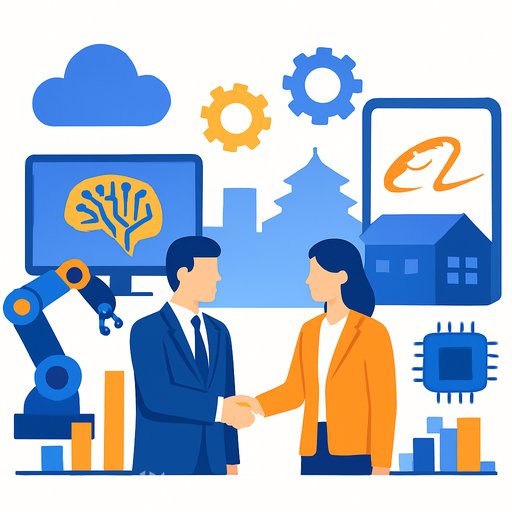
Siemens and Alibaba Cloud will combine Siemens' computer-aided engineering tools with Alibaba's cloud infrastructure, allowing engineering teams to run complex simulations without building expensive on-premise systems. Customers can now access scalable simulation environments through the cloud, with the elasticity to handle variable workloads.
The partnership also explores how Alibaba's Qwen large language models could add AI-assisted capabilities to Siemens' product lifecycle management software, opening possibilities for AI-driven design workflows.
Infrastructure for Data Centers and AI Workloads
Siemens introduced technologies designed for high-density data centers, including a new generation of direct-current circuit breakers that manage power distribution in AI infrastructure. The company also released an AI-powered cooling solution that continuously optimizes cooling operations to reduce energy consumption in data-intensive environments.
These products address a practical problem: AI infrastructure demands rapid increases in power density, and data centers need reliable systems to manage that load.
Shop Floor Execution Layer
Scaling AI in manufacturing requires systems that both generate intelligence and execute it on production lines. Siemens introduced new programmable logic controllers with improved performance and memory capacity to coordinate machines in real time.
The company also released compact servo systems that translate digital commands into precise robotic motion, and predictive maintenance software that detects equipment anomalies before they cause downtime.
For product development teams, these tools matter because they close the gap between what AI systems decide and what actually happens on the factory floor. A prediction is worthless if the machinery can't act on it reliably.
The Broader Strategy
Siemens frames these products as components of a single operating system delivered through Siemens Xcelerator, its open digital platform. That approach differs from point solutions-it assumes product developers need data connectivity, software intelligence, and hardware execution working together.
Xiao Song, president and CEO of Siemens Greater China, said the company is combining global technology with China's manufacturing scale and innovation pace. The Beijing summit signals that industrial AI deployment is moving beyond experimentation into actual production environments.
For teams building products or managing manufacturing operations, the shift means evaluating whether your current systems-simulation tools, automation controllers, predictive analytics-can communicate and share data effectively. Siemens is betting that integrated platforms will win.
Your membership also unlocks: