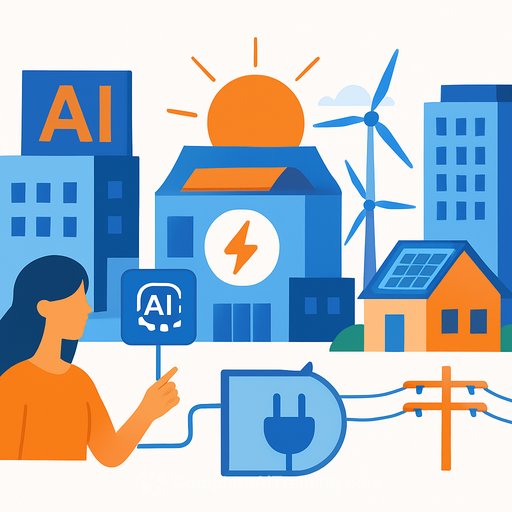
Sigenergy Opens Nantong Smart Energy Center and Puts "AI in All" to Work Across the Energy Stack
Sigenergy has inaugurated its Nantong Smart Energy Center in Jiangsu, China, and rolled out an "AI in All" strategy with new products for residential, C&I, and utility-scale projects. Nearly 2,000 guests from 50+ countries attended, signaling growing partner confidence and a bigger global footprint.
For executives, this is a play to shift from hardware-first competition to intelligent, integrated systems. The pitch: use AI to lift yield, cut O&M costs, and improve dispatch decisions across the full asset lifecycle.
Strategy: What "AI in All" Actually Means
AI is embedded across product, software, and system layers-moving from manual oversight to coordinated, data-driven operations. That matters because the bottleneck in distributed energy is no longer generation; it's orchestration.
- Product layer: Energy management, operational optimization, and dispatch control tuned by data, not static rules.
- Software layer: Faster setup, monitoring, and strategy execution-plus remote diagnostics that cut truck rolls.
- System layer: Linking devices across sites to coordinate charge/discharge, respond to tariffs, and stabilize fleets at scale.
If you're scoping your own AI roadmap, align vendor capabilities with governance, data rights, and measurable outcomes. See AI for Executives & Strategy for decision frameworks.
For a broader market view on digitalization and energy, the IEA's overview is useful context: Digitalisation and Energy - IEA.
Manufacturing as a Moat: Inside the Nantong Smart Energy Center
The facility spans 136,000 m² with RMB 500M (≈ USD 70M) invested, and annual capacity above 300,000 inverters and battery packs. It's positioned as an integrated hub across R&D, intelligent manufacturing, global delivery, and energy management.
- Integrated control: MES, WMS, and EMS connected end-to-end so material dispatch, equipment settings, and production plans sync in real time.
- Precision and speed: CCD-assisted welding at a 99.9% yield rate; SMT at 0.043s/component with 20-30 μm accuracy; DIP assembly time cut by 50% via automation and lean methods.
- Throughput: One battery pack every 15 seconds; one inverter every 21 seconds.
- Quality at scale: AI-driven inspections replace manual sampling; 3D intelligent logistics coordinates overhead and ground movement.
For operations leaders, the integrated MES/WMS/EMS stack is the real story. If you're modernizing plants or suppliers, compare this approach to your roadmap: AI for Operations.
Portfolio Update: Residential, C&I, and Utility
Sigenergy introduced three products to widen coverage across key segments and unify control under a single data and software layer.
- Residential - SigenStor Neo: A modular home energy system combining PV inverter, battery PCS, EMS, gateway, and battery pack. The goal is tighter integration, simpler setup, and better coordination across home energy use cases.
- C&I - 166 kW PV inverter: Higher power density and efficiency to improve project IRR and simplify solar-storage integration for enterprise sites.
- Utility - New high-density inverter: Up to 500 kW output; supports 1650 V DC input and 1000 V AC; up to 18 MPPTs with two strings each for better yield on complex terrain. Safety features include AFCI with detection up to 500 meters and multiple protection layers.
For O&M, the utility inverter adds MPPT-level fault detection, intelligent diagnostics, remote monitoring, and analytics. AI-assisted short-term and ultra-short-term forecasting blends equipment, site, and weather data to improve dispatch planning and revenue outcomes.
Why This Matters for Executives
- System economics: AI-led control can trim curtailment, reduce peak charges, and sharpen arbitrage-especially across multi-site fleets.
- Risk and assurance: Integrated manufacturing with high yields and automated QA reduces field failures and warranty exposure.
- Speed to value: Pre-integrated stacks cut commissioning time and simplify vendor management.
- Data advantage: Device- and fleet-level telemetry fuels better forecasts, pricing, and maintenance scheduling.
Due Diligence Questions to Ask Sigenergy (or Any Vendor)
- Data access: What APIs are available (read/write)? What is the data retention policy and who owns derived insights?
- Interoperability: How does the platform integrate with your SCADA, EMS, DERMS, and utility interfaces?
- Forecasting: What is the MAPE for short-term and ultra-short-term forecasts across different climates and asset types?
- Uptime and SLAs: What are the production QA metrics, field failure rates, and response times for critical incidents?
- Cybersecurity: What standards and third-party audits cover hardware, firmware, cloud, and update pipelines?
- Safety and compliance: How are AFCI, grid codes, and certifications handled across regions?
- Total cost of ownership: How do software licenses, upgrades, and warranties flow through the P&L over 10-15 years?
KPIs to Track in Year One
- Commissioning cycle time per site and cost per installed kW.
- Capacity factor delta from baseline and MPPT-level yield improvements.
- Forecast accuracy (intra-day and day-ahead) and dispatch uplift versus PPA or market benchmarks.
- Truck rolls avoided, mean time to repair, and parts consumption rates.
- Safety incident rate and nuisance trip rate tied to protection features (e.g., AFCI).
The Bottom Line
Sigenergy is making a bid to lead with integrated AI, backed by a factory that can scale quickly without sacrificing quality. If you run energy assets-or buy from those who do-the upside is in coordinated control, simpler operations, and fewer surprises in the field.
The next step is practical: quantify the value of better forecasts, faster commissioning, and lower O&M, then pressure-test vendor claims against your data, sites, and tariffs. That's where strategy turns into returns.
Your membership also unlocks: